
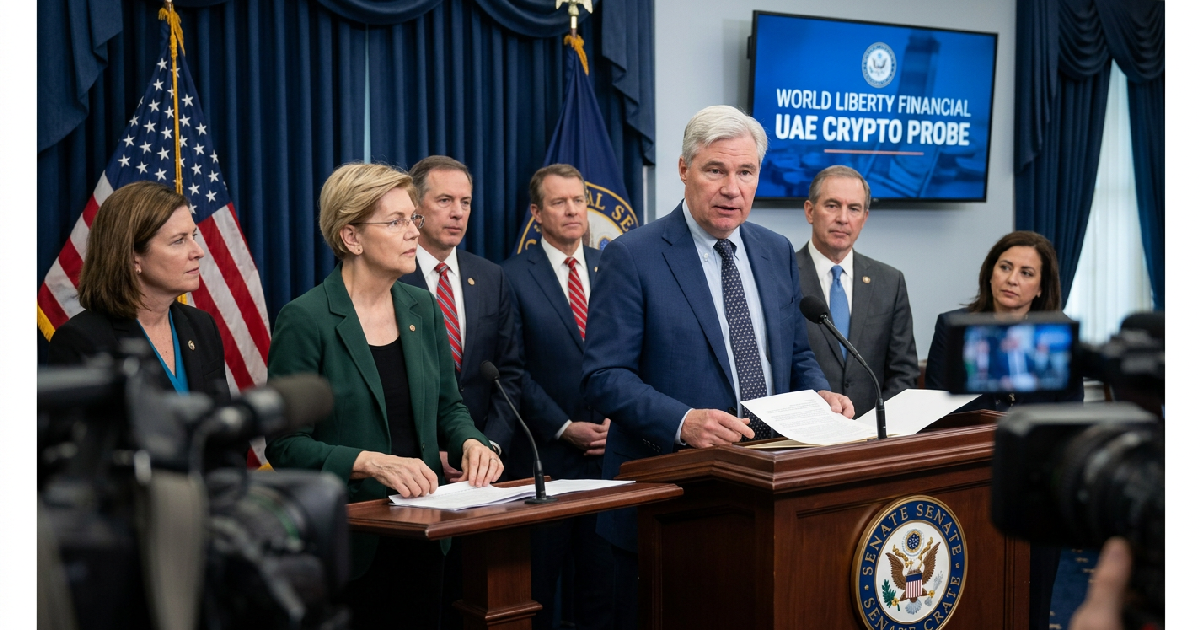

A group of Senate Democrats is calling for an immediate investigation into a $500 million cryptocurrency deal between the Trump family and United Arab Emirates royalty. In a letter released on Tuesday, lawmakers urged the Republican-led Senate to hold hearings and require Trump administration officials to testify under oath about the multi-million dollar transaction.
The controversy centers on World Liberty Financial, a digital asset platform tied to President Donald Trump. According to reports from the Wall Street Journal, an investment firm backed by Sheikh Tahnoon bin Zayed Al Nahyan, the UAE’s national security adviser, purchased a 49% stake in the firm in January 2025. Democrats are now questioning if this investment influenced subsequent foreign policy decisions.
Lawmakers probe timing of UAE arms and AI deals
The core of the Democrats’ concern lies in the timeline of official government actions following the private business deal. Just months after the UAE-backed firm invested in World Liberty Financial, the Trump administration finalized a major arms and artificial intelligence chip agreement with the Gulf nation in May 2025.
This deal proceeded despite explicit warnings from national security officials that China might gain access to the sensitive technology.
The letter, signed by Senators Elizabeth Warren, Richard Blumenthal, Gary Peters, Dick Durbin, and Ron Wyden, expresses deep concern over potential national security risks. They are investigating whether the UAE received favorable treatment in exchange for its investment. This scrutiny comes as market sentiment shifts as CLARITY Act advances through committees, highlighting the growing tension between crypto business and federal oversight.
President Trump has previously denied having knowledge of the specific $500 million stake. But the senators argue that Congress has a clear responsibility to determine if the investment impacted subsequent actions by the administration. They are particularly focused on whether private profit motives are dictating the terms of sensitive international military and technology exports.
Conflicts of interest and regulatory rollbacks
The senators are also questioning the administration’s recent moves to scale back oversight of the digital asset industry. The letter points to “steps to weaken enforcement,” including the decision to disband the Justice Department’s dedicated crypto enforcement team. They also criticized new rules that exempt certain crypto service providers from standard financial regulations, a move that directly benefits firms like World Liberty Financial.
Further pressure has been applied to Securities and Exchange Commission Chair Paul Atkins over the agency’s handling of specific cases. Lawmakers pressed the chair regarding the decision to drop a fraud case against Justin Sun, who is a known supporter of the Trump family’s crypto venture.
These regulatory shifts coincide with a period where crypto liquidations rise alongside Treasury yields, creating a volatile environment for investors and regulators alike.
Senator Elizabeth Warren has been vocal about these issues for months. In February, she urged Treasury Secretary Scott Bessent to conduct a formal review via the Committee on Foreign Investment in the United States (CFIUS). The goal of such a probe would be to determine the exact nature of the foreign stake in the President’s personal business interests and its legal implications.
Key details
The inquiry also touches on the pardon of Binance co-founder Changpeng Zhao. Senator Peter Welch and Representative Dave Min launched a probe in May into the circumstances surrounding this executive action. Reports suggest that Binance accepted a $2 billion investment from an Abu Dhabi fund earlier in 2025, which adds another layer to the investigation of UAE influence.
According to the research, that specific Binance deal required that funds be settled using USD1, the stablecoin utilized by the World Liberty Financial platform. This interlocking web of investments and policy decisions has led Democrats to argue that the administration has created a significant conflict of interest.
They maintain that the public must know if the pardoning of a major industry figure was tied to these larger financial maneuvers.
Republicans currently control the Senate and its committees, giving them the power to decide whether these hearings will actually take place. While the administration maintains that all transactions were handled properly and legally, the $500 million deal continues to face intense political and ethical scrutiny.
As the 2026 legislative session continues, the push for transparency regarding the President’s foreign business ties remains a priority for the minority caucus.