
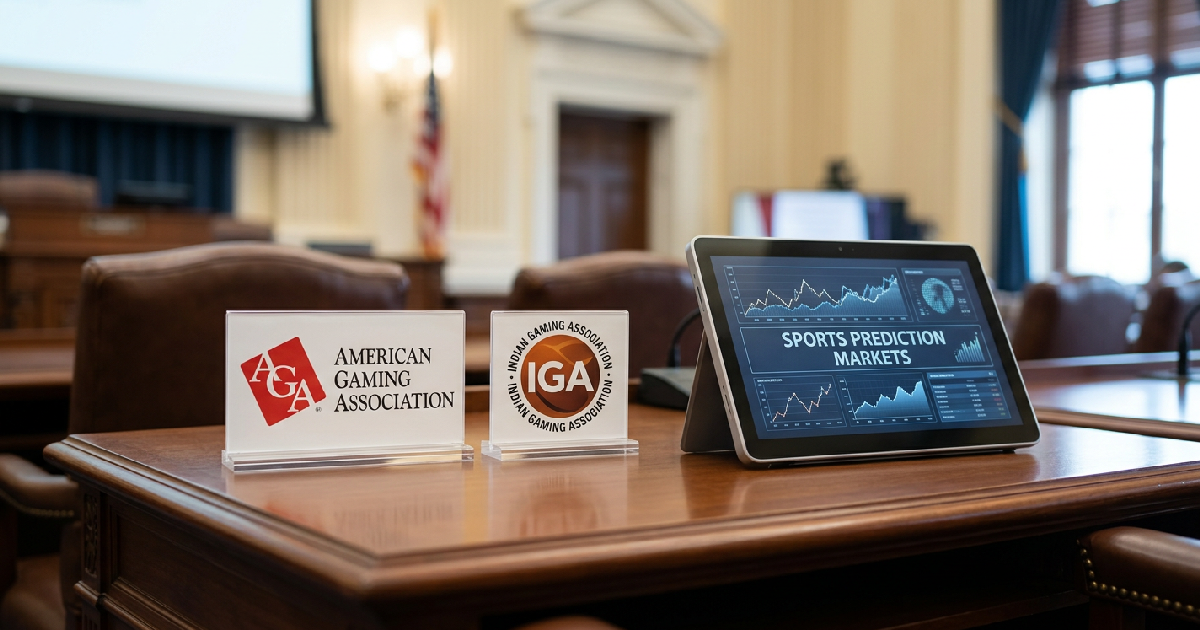

On June 16, 2026, a coalition consisting of the American Gaming Association (AGA), the Indian Gaming Association (IGA), and two major labor unions submitted a joint letter to the U.S. Senate demanding a ban on sports prediction markets within pending cryptocurrency legislation.
The group is pressing lawmakers to insert specific carve-out language into the CLARITY Act to ensure sports-betting event contracts are not classified as digital asset products. This targeted lobbying effort aims to curb the operations of platforms like Kalshi and Polymarket, which the coalition argues are bypassing established gambling regulations.
The coalition represents a rare alignment of interests between commercial casino operators, sovereign tribal nations, and organized labor. Joining the AGA and IGA are the AFL-CIO’s Hotel and Gaming Trades Council and UNITE HERE, a union representing 300,000 hospitality and gaming workers.
These groups contend that prediction markets have enabled the largest unauthorized expansion of gambling in U.S. history over the last 18 months, operating without voter approval or legislative oversight. The stakes are high for tribal nations, who saw revenues reach a record $43.9 billion in 2024.
The timing of the letter follows recent movements within federal agencies and congressional committees. On June 10, 2026, the Commodity Futures Trading Commission (CFTC) published a proposed rule that would permit most sports event contracts while banning those deemed vulnerable to manipulation. The gaming coalition believes this does not go far enough.
They are urging the Senate to reaffirm that sports betting falls entirely outside the CFTC’s remit, effectively leaving oversight to state regulators and existing licensing frameworks.
Tribal sovereignty and the threat of unlicensed platforms
For tribal governments, the rise of digital prediction markets is viewed as a direct challenge to the Indian Gaming Regulatory Act (IGRA). Legal experts and tribal leaders, including IGA Executive Director Jason Giles and Conference Chair Victor Rocha, argue these platforms interfere with the exclusivity provided by tribal-state compacts.
This legal tension has already spilled into the courts; three California tribes sued Kalshi in 2025, alleging the platform’s sports-linked contracts violate IGRA.
The opposition is not limited to the federal level. Sixteen tribes alongside the Indian Gaming Association recently filed an amicus brief in Connecticut supporting state regulators. Those regulators ordered Kalshi, Robinhood, and Crypto.com exchange services to halt what they termed unlicensed online gambling within the state.
The coalition argues that “event contracts” are often just a semantic shield used by firms to avoid the rigorous tax and consumer protection requirements faced by licensed sportsbooks.
More than 50 organizations have backed the push to the Senate, including:
- American Gaming Association (AGA)
- Indian Gaming Association (IGA)
- AFL-CIO’s Hotel and Gaming Trades Council
- UNITE HERE
- Association of Gaming Equipment Manufacturers (AGEM)
- Arkansas State Chamber of Commerce
Legislative hurdles and the CLARITY Act
The push to modify the CLARITY Act, which advanced through the Senate Banking Committee in May 2026, highlights the shifting market structure of the broader digital asset industry. While crypto proponents view prediction markets as a breakthrough for price discovery and data aggregation, the gaming industry sees them as a predatory loophole.
The coalition wants the act to explicitly prevent casino-style event contracts from being rebranded as digital assets to escape state gambling laws.
And there is already legislative momentum favoring these restrictions. Senators Adam Schiff (D-CA) and John Curtis (R-UT) introduced the “Prediction Markets Are Gambling Act” (S.4160) in March 2026. This bill aims to bring these platforms under stricter scrutiny, echoing the coalition’s sentiment that these activities are gambling by another name.
The involvement of UNITE HERE adds significant political weight, as the union represents food-service and hotel workers whose livelihoods are tied to the stability of the traditional gaming sector.
International precedents also loom over the debate. Just as U.S. tribes are fighting for local control, other jurisdictions have taken hardline stances against decentralized betting venues. Singapore’s Gambling Regulatory Authority, for instance, blocked access to Polymarket as early as January 2025, citing similar concerns about unlicensed gambling operations.
This global pushback suggests that as prediction markets grow, they will continue to face resistance from established regulatory bodies and industries alike.
Second-order consequences for the crypto industry
If the Senate adopts the coalition’s requested language, the impact on the decentralized finance (DeFi) sector could be severe. Sports betting remains one of the primary drivers of volume for prediction markets. Removing this category could stifle the growth of platforms that have otherwise begun to find mainstream traction.
However, for lawmakers, the choice is between protecting a nascent tech application and safeguarding billions in state and tribal tax revenue.
The outcome of this lobbying effort will likely dictate how digital “event contracts” are treated for years to come. If the gaming industry succeeds, platforms like Kalshi may find themselves forced to obtain the same state-by-state licenses as traditional sportsbooks, a process that is both costly and time-consuming.
For now, the traditional gaming giants and labor unions have proven they are ready to use every legislative tool available to protect their turf.