
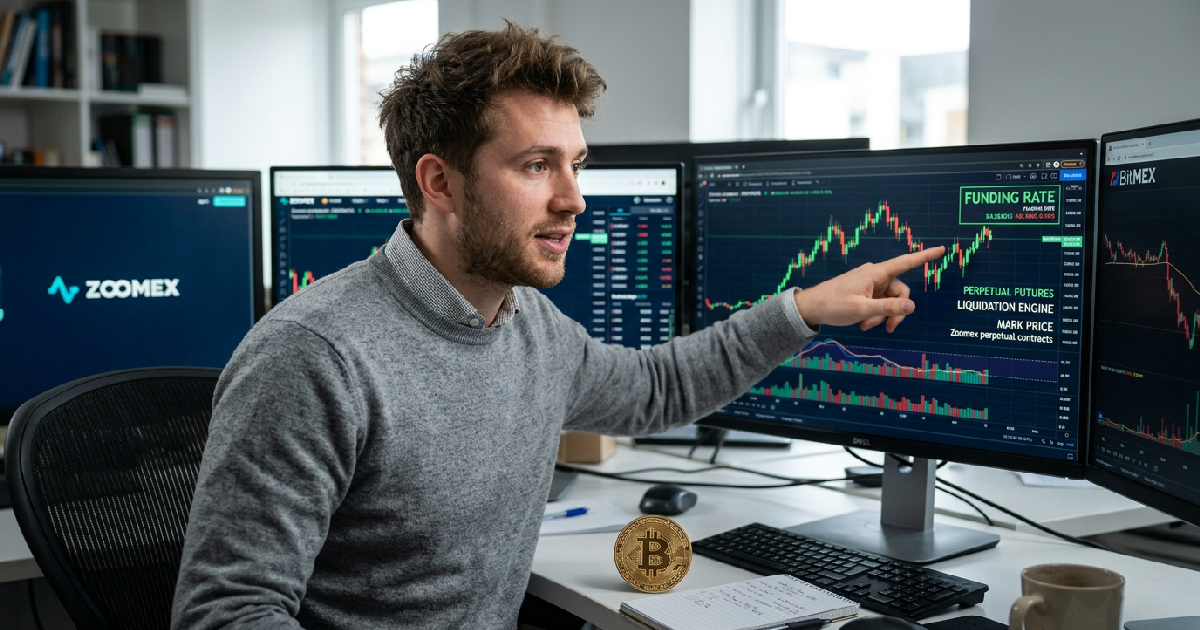

Traders on platforms like Zoomex are increasingly using perpetual futures to speculate on cryptocurrency prices without the constraints of traditional expiry dates. These specific derivative instruments, which reached a staggering $61.
8 trillion in trading volume during 2025, rely on three fundamental mechanics to maintain market stability: the funding rate, the mark price, and the liquidation engine. By decoupling the contract from a fixed settlement day, these tools allow users to maintain exposure to assets like Bitcoin indefinitely, provided they satisfy margin requirements.
The rise of perpetual futures has fundamentally reshaped the trading environment since platforms like BitMEX first popularised them in 2016. Unlike traditional futures that naturally converge with the spot price as they approach maturity, perpetuals require a synthetic “gravitational force” to prevent their price from drifting away from the actual market value.
Without these background systems, the price of a Bitcoin perpetual on a single exchange could trade significantly higher or lower than the global spot price with no mechanism to pull it back.
For many active market participants, understanding these underlying systems is a necessity for capital preservation. As Bitcoin signals indicate shifting market structure in mid-2026, volatility often tests the limits of exchange risk systems. Traders who fail to account for the impact of funding fees or the specific triggers used by liquidation engines frequently find their positions closed unexpectedly during sharp market “wicks.”
Maintaining price alignment through the funding rate mechanism
The funding rate is the primary tool used by exchanges like Zoomex to keep the price of a perpetual contract in line with the index price. It is a periodic fee exchanged between long and short positions, typically occurring every eight hours at 8:00 AM, 4:00 PM, and 12:00 AM UTC.
When the perpetual price is higher than the spot price, the rate is positive and longs pay shorts. Conversely, when the perpetual trades at a discount, the rate is negative and shorts pay longs.
On Zoomex, this rate is calculated using an Interest Rate and a Premium Index. The Interest Rate is a baseline component, often resulting in a 0.01% fee per funding period. The Premium Index is more dynamic, measuring the deviation between the perpetual’s price and the Mark Price.
These payments incentivise traders to take the opposite side of a popular trend, which naturally pushes the contract price back toward the spot value.
While an individual payment may seem small, the cumulative cost is substantial for long-term positions. An average 0.01% funding fee paid three times daily can lead to an annual cost of approximately 11% of the position size. This cost is a major reason why com/why-bitcoin-traders-care-200-day-moving-average-analysis/”>Bitcoin traders prioritise the 200-day moving average to determine optimal entry and exit points, ensuring they do not lose their margin to long-term funding drain.
Using the mark price to prevent market manipulation
To protect traders from “scam wicks”—sudden, artificial price spikes on a single exchange—Zoomex utilises a dual-price mechanism. This system distinguishes between the Last Traded Price, which is the internal price on the Zoomex order book, and the Mark Price. The Mark Price is a fair value measure derived from a global spot price index across major exchanges, including an added decaying funding basis.
The Mark Price serves as the reference for two critical functions: triggering liquidations and calculating unrealised Profit and Loss (PnL). Because it is anchored to a global average rather than an internal order book, it remains stable even if a local exchange experiences thin liquidity.
Traders can view the Mark Price line directly on their charts, often marked with a green flag, to monitor how close they are to their liquidation thresholds.
This protection is vital given that crypto derivatives, predominantly perpetuals, posted trading volumes 10-15 times larger than spot markets in early 2025. By anchoring liquidation triggers to a global index, exchanges prevent a single bad actor from manipulating the internal price of one platform to wipe out legitimate positions. This creates a more robust environment where legitimate traders are buffered from localised volatility.
Liquidation engines and the role of insurance funds
Liquidation is the forced closure of a leveraged position by the exchange’s engine. It occurs when a trader’s account equity falls below the required maintenance margin level due to price moves or funding payments.
Once the Mark Price hits a user’s Liquidation Price, the engine takes control, attempting to close the position before the balance goes negative. Many platforms, including Zoomex, first attempt partial liquidations to restore margin levels.
Exchanges manage this risk through several tiers of protection:
- Initial Margin: The capital posted to open the leveraged position.
- Maintenance Margin: The minimum equity level needed to keep the position active.
- Insurance Funds: Pools of capital used to cover losses if a position is closed at a price worse than the “bankruptcy price.”
Insurance funds are essential for maintaining platform solvency. If a position cannot be closed without slippage that exceeds the trader’s total margin, the insurance fund pays the debt to the winning party. This ensures that the winners receive their full profits even during extreme market events where whales accumulate during futures-led selloffs, keeping the overall system functioning and solvent.
The outlook for perpetual futures in 2026
As the crypto market continues to evolve in 2026, the structure of these contracts remains split between two main types. Zoomex offers Inverse Perpetual Contracts, collateralised in the base coin like BTC or ETH, and USDT Perpetual Contracts, which use stablecoins as collateral. The latter have become a standard for altcoin trading due to their broader range of available pairs and simpler collateral requirements.
Despite their popularity, perpetual futures face significant regulatory pressure, particularly within the United States. Due to a lack of regulatory clarity, many centralized exchanges restrict access for US customers, pushing much of the $60 trillion-plus volume to offshore venues.
For the individual trader, navigating this space in 2026 requires a deep understanding of the mechanics that determine whether a high-leverage position survives a volatile trading session.