
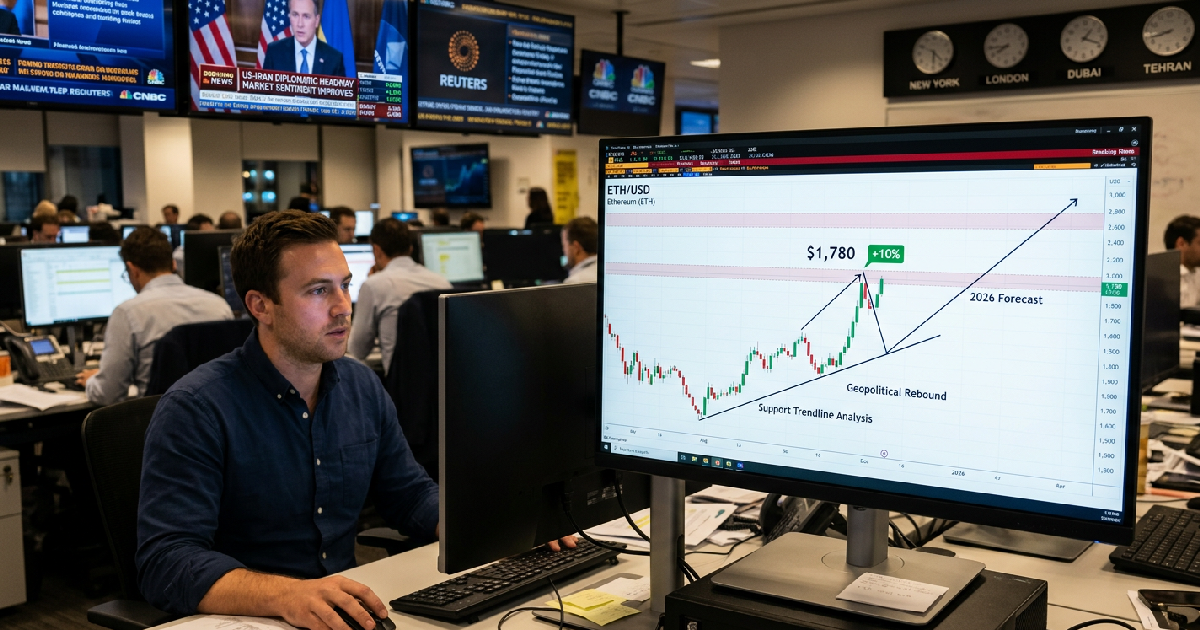

Ethereum (ETH) prices rebounded toward $1,800 on June 16, 2026, after testing a critical multi-year support trendline that has anchored the asset’s price action since 2019.
The recovery followed reports of a framework peace agreement between the United States and Iran, a geopolitical breakthrough that triggered a sharp rally across risk assets and eased global inflation concerns.
After dropping roughly 26% from June highs near $2,050 to a local low of $1,507, the second-largest cryptocurrency surged more than 10% on Monday, settling near $1,780 by Tuesday’s press time.
The sudden reversal in market sentiment provided relief to investors who had spent weeks reducing exposure to digital assets. Tensions in the Middle East had previously fueled fears of a closure of the Strait of Hormuz, driving oil prices higher and dampening appetite for volatile holdings.
Following reports of the peace deal, Brent crude fell 2.2% below $82 per barrel, while WTI dropped 2.5% to under $79. This shift in the macroeconomic backdrop allowed Ethereum to bounce off its deepest structural support level as traders look toward a reclaim of the $2,000 threshold.
Market analysts are focusing on the technical weight of this specific trendline. Visible on the OKX monthly chart, the ascending support line connects Ethereum’s bear market lows in 2019, the 2020 pre-rally base, and the 2022 cycle bottom. Historical data confirms that Ethereum previously achieved rebounds of 366% and 249% after defending this structural level.
The current support zone, which ranges from $1,600 to $2,000, is upheld by an ascending trendline that has remained intact since the lows of the 2022 bear market.
Geopolitical stability and whale activity lift Ethereum price
The primary driver for the 24-hour price surge was the easing of geopolitical friction between Washington and Tehran. As the framework agreement became public, the threat of energy-led inflation subsided, offering a clear runway for high-beta assets.
Additional support for the price came from whale activity, as large-scale holders stepped in to provide liquidity during the test of the multi-year support line. This accumulation helped stabilize the market after a month of intense sell pressure.
Before this rebound, Ethereum faced significant headwinds from shifting capital flows. Many investors moved funds toward artificial intelligence investments and new technology listings, which diverted liquidity away from the crypto sector. This rotation occurred while Ethereum faced various digital asset outflows that had pressured the price toward the June low of $1,507.
The Monday bounce effectively countered this trend, with short liquidation clusters now forming above current prices.
Reported data from CoinGlass indicates these liquidation clusters could trigger a potential “short squeeze” if the rally continues. Forced buy-backs from short sellers often act as fuel for further gains, potentially pushing ETH toward its next resistance targets. This shift in market structure aligns with recent com/bitcoin-signals-market-structure-analysis-2026/”>Bitcoin signals market structure analysis, where experts are watching for broader sector breakouts in late 2026 as macroeconomic conditions stabilize.
Technical resistance hurdles on the path to $2,000
Despite the optimistic recovery, Ethereum faces a gauntlet of resistance levels. The first major obstacle lies at $1,873, followed by the psychological $2,000 mark. At the time of writing, Kraken data placed ETH at $1,778.21, representing a 3.32% gain over the last 24 hours. The market capitalization stood at approximately $214.
6 billion, with a circulating supply of 120,715,577 ETH. While the bounce is significant, Ethereum remains down more than 27% over the last 30 days of trading.
Longer-term indicators provide a nuanced outlook for the summer. The monthly MACD histogram reads a positive 129.89, which suggests underlying momentum remains in place despite recent volatility. However, to confirm a structural bull trend, the price would need to target the 50-day Simple Moving Average (SMA) at $2,440.86.
If the current support levels fail to hold, the next structural reference point is the $1,500 zone, which aligns with the accumulation phase seen throughout 2023.
The correlation with the wider market remains a pivotal factor for ETH holders. Bitcoin recently recovered above $66,000, providing a more stable environment for altcoins to breathe. However, Ethereum still competes with other ecosystems for capital as traders look for diversity. For example, com/bnb-chain-open-interest-surge-binance-chain-token-open-interest-surges/”>surging open interest in Binance Chain tokens suggests that market participants are active across multiple networks. Ethereum’s ability to attract this liquidity back will be essential for reaching higher price targets.
Future outlook for Ethereum in June 2026
As the international community monitors the reopening of the Strait of Hormuz, Ethereum’s focus shifts to network fundamentals and trading volume. Volume reached $12.1 billion on Tuesday, suggesting that the recent price action is supported by active market participation. If the U.S.
-Iran agreement holds, the reduction in oil-linked inflation fears could sustain a “risk-on” environment for the remainder of the month. This would be particularly beneficial for platforms with high developer engagement.
The coming weeks will determine whether the test of the 2019 trendline marks a definitive bottom. Traders are looking for a sustained close above $1,873 to signal that the correction has ended. Failure to maintain these levels may lead to a retest of the $1,600 support zone.
For now, the successful defense of the multi-year trendline has prevented a deeper slide and allowed bulls to keep the $2,000 price target in their sights.