
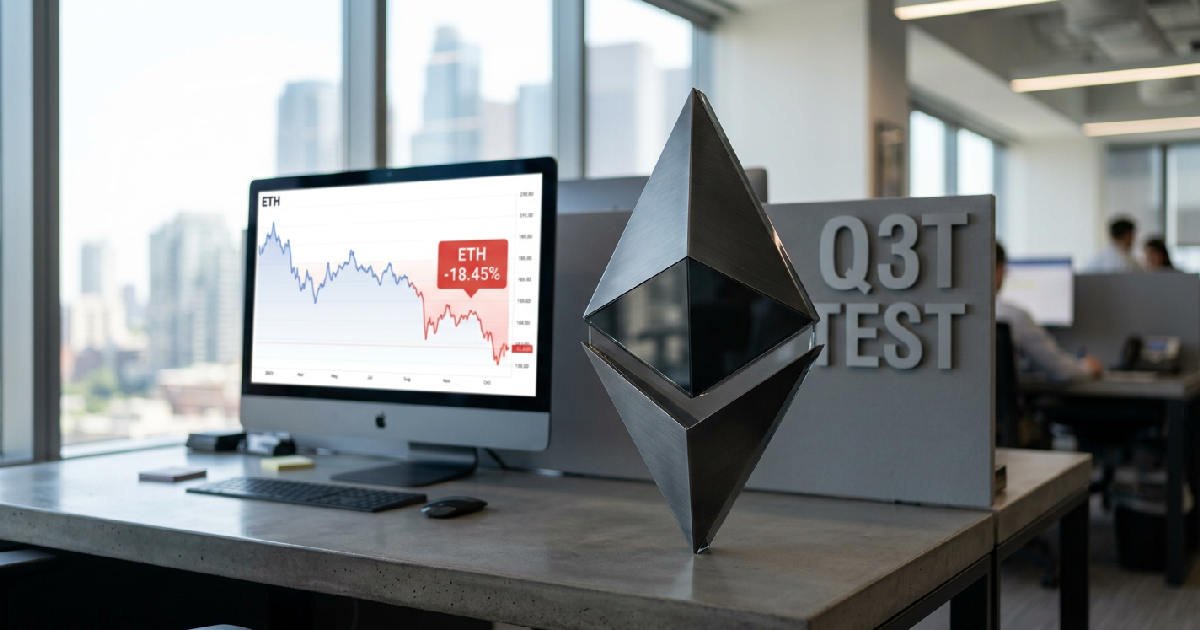

Ethereum (ETH) is entering a decisive third quarter in 2026 as the cryptocurrency faces a potential “red” streak that would mark a first in its trading history.
According to a research report from the KuCoin exchange and data from market analysts, the second-largest digital asset by market capitalization is at risk of recording three consecutive quarters of negative returns if it fails to reverse its current price slump by the end of June 2026.
The stakes for the upcoming quarter are historically high because Ethereum has never seen three straight quarters of losses since its inception. Currently, ETH is down 18.45% for Q2 2026, following a first-quarter return that analysts like Daan have pegged as low as -29.26%.
This sustained downward pressure has pushed the asset nearly 40% below its yearly opening price of $2,966, leaving investors on edge as the Q3 window approaches.
Market sentiment has shifted into what researchers describe as “deep fear” as ETH trades at levels last seen in the second quarter of 2025. While the current outlook appears grim, historical data suggests that consecutive negative quarters often precede a significant relief rally.
For instance, after drawing down 80% across the first half of 2022, Ethereum surged by 24% in the third quarter of that year, providing a potential roadmap for recovery.
Technical resistance and the quest for a price floor
Ethereum currently finds itself in a tight trading range between $1,550 and $1,800, where it has consolidated for much of the past two weeks. As of June 15, 2026, ETH is trading at $1,717.31, representing a modest 2.6% gain over the last 24 hours.
Despite the slight bounce, the asset remains far below its 200-day moving average, which currently sits at $2,414—nearly 45% above current market prices.
Immediate resistance is clustered at $1,720 and $1,800, with $2,000 acting as a primary psychological barrier for bulls. On the downside, analysts warn that a break below the $1,550 support level could expose the asset to a further tumble toward the $1,400 mark. This technical fragility makes the next few weeks critical for determining whether ETH can claw back into positive territory for the quarter.
Some analysts are preparing for even deeper corrections if the historic support levels fail to hold. Data scientist Ali Martinez has highlighted the Delta Price model, which suggests an “ultimate value zone” near $700.
For Ethereum to reach this floor, it would require a 58% decline from current levels, a scenario that would likely only unfold in the event of a broader systemic shock to the digital asset market.
Institutional shifts and the Glamsterdam upgrade
While the price action is cautious, on-chain metrics reveal a shift in how investors are holding their assets. Ethereum exchange reserves have hit a record low of 14.5 million ETH as holders move toward staking, long-term cold storage, and newly launched exchange-traded funds (ETFs).
This reduction in liquid supply typically suggests a decrease in immediate selling pressure, creating a healthier environment for a potential price rebound.
The network is also looking toward fundamental improvements to spark interest. The upcoming “Glamsterdam upgrade” is expected to launch later this month, aiming to slash gas fees by 78.6% and boost throughput to 10,000 transactions per second. Traders are watching this development closely, as com/bitcoin-price-77000-market-confidence-geopolitics-2026-analysis/”>market confidence during geopolitical shifts has already seen a boost from a reported U.S.-Iran peace agreement, lifting total crypto market cap by 2%.
External factors and shifting supply dynamics may provide the necessary tailwinds to help investors find the best altcoin to buy now as volatility continues. Low exchange balances suggest that while prices are struggling, long-term conviction remains. This divergence between price and on-chain health is what makes the Q3 2026 test so vital for the asset’s recovery trajectory.
Projected price scenarios and market recovery models
Analyst Sam Daodu has outlined two primary paths for Ethereum for the remainder of 2026. In the “Base Case Scenario,” the Glamsterdam upgrade ships with no immediate market reaction and ETF inflows remain slow but positive. In this outlook, if Bitcoin rises above $85,000 without a decisive breakout, ETH is projected to clear $3,000 in Q3 2026 and then test the $4,000 level.
A more optimistic “Bullish Scenario” relies on the Glamsterdam upgrade launching on schedule in June while ETF inflows accelerate. If Bitcoin breaks above $90,000 under these conditions, Ethereum could move above $4,000 as early as Q3 2026. This scenario sees ETH finishing the year between $5,000 and $7,500, marking a significant departure from its current bear market pattern.
However, the neutral RSI of 52.86 on the 4-hour chart indicates that the market is currently in a state of indecision. If the broader market fails to find a catalyst, ETH may continue to struggle within its current range.
Analyst Daan noted on X that while current prices are attractive for multi-year accumulation, bear markets frequently last longer than participants expect, demanding patience from those looking for a quick reversal.