
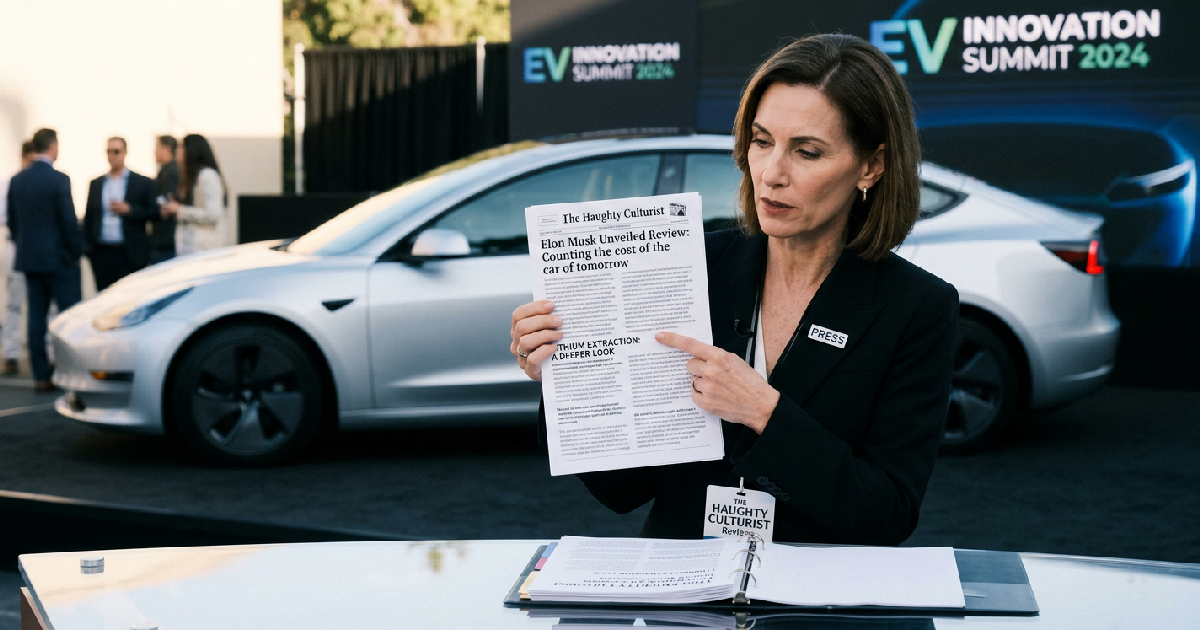

A new critique from The Haughty Culturist titled “Elon Musk Unveiled Review: Counting the cost of the car of tomorrow” has surfaced, questioning the hidden ecological and social price of the future envisioned by the Tesla CEO.
The review argues that the automotive vision presented by Elon Musk carries a financial and environmental burden that extends far beyond the initial sticker price of the electric vehicles. By focusing on supply chain ethics and the physical limitations of current infrastructure, the piece challenges the prevailing narrative of a seamless transition to next-generation transportation.
The critique highlights the massive resource requirements necessary to sustain a global shift toward the “car of tomorrow.” Central to this argument is the intensive extraction of lithium and cobalt, minerals that form the backbone of modern battery technology.
According to the review, the environmental degradation caused by mining operations can, in some cases, rival the carbon footprint that the vehicles aim to reduce during their operational life on the road.
And then there is the matter of social equity in the autonomous era. The Haughty Culturist notes that safety features and self-driving software are increasingly treated as luxury commodities rather than standard equipment. This shift toward subscription-based safety models could create a divided road system where advanced protection is only available to those willing to pay a recurring premium to the manufacturer.
Infrastructure challenges and the Elon Musk Unveiled roadmap
One of the most pressing concerns raised in the review involves the readiness of global power grids to support a massive influx of electric vehicles (EVs). The author contends that many urban centers lack the physical capacity to manage the charging load required for a fully electrified fleet today.
This suggests that the “Unveiled” roadmap may be getting ahead of the actual utility infrastructure available in most major cities.
This reliance on high-cost infrastructure to unlock technological potential isn’t unique to the automotive sector. For instance, Apple Inc satellite connectivity advances demonstrate a similar trend where consumer tech depends on massive, separate investments in peripheral systems to be viable. The review warns that without a parallel transformation of the energy grid, the cars of tomorrow will remain tethered to the constraints of yesterday.
The software transformation of vehicles also comes under fire. The review describes modern EVs as “computers on wheels,” a design choice that shifts power away from the owner and toward the manufacturer.
This permanent reliance on over-the-air updates means that the longevity of the vehicle is no longer just a matter of mechanical maintenance, but a question of how long the manufacturer chooses to support the software.
Economic reality and the car of tomorrow maintenance trap
While the marketing for these vehicles often emphasizes long-term savings on fuel, the review points to a “maintenance trap” for new buyers. Specialized repair requirements, high insurance premiums, and the rapid pace at which battery technology becomes obsolete contribute to a total cost of ownership that remains prohibitive for the average consumer.
These physical manufacturing “hard limits” differ sharply from the scalable nature of digital assets.
This reality check for tech-focused industries comes at a time of broader market volatility. While some investors are looking for a late-2026 breakout potential in various sectors, the Haughty Culturist argues that the physical world of raw materials does not follow the same growth curves as software.
You cannot simply “patch” a global shortage of rare-earth metals or an aging power transformer with a code update.
The review also suggests that brand loyalty to the Tesla CEO may be reaching a saturation point. As traditional automakers enter the EV space with established manufacturing pipelines, the “Elon Musk” brand must prove it can deliver more than just visionary promises.
The critique suggests that engineering transparency and ethical supply chains will soon become the primary metrics by which consumers judge the car of tomorrow.
Future implications for the green transition
The review concludes by looking at the psychological toll of a purely autonomous, subscription-driven future. It argues that as vehicles become more like service-based appliances, the fundamental sense of freedom traditionally associated with driving is being eroded. This shift represents a broader movement toward corporate control over personal mobility that the public has yet to fully debate.
Ultimately, the critique serves as a warning that the green transition must be more honest about its industrial origins. Whether the automotive industry can address these scarcity and grid issues will determine long-term consumer trust. Much like how market confidence during geopolitical shifts relies on tangible stability, the future of the car of tomorrow depends on solving real-world supply chain problems today.