
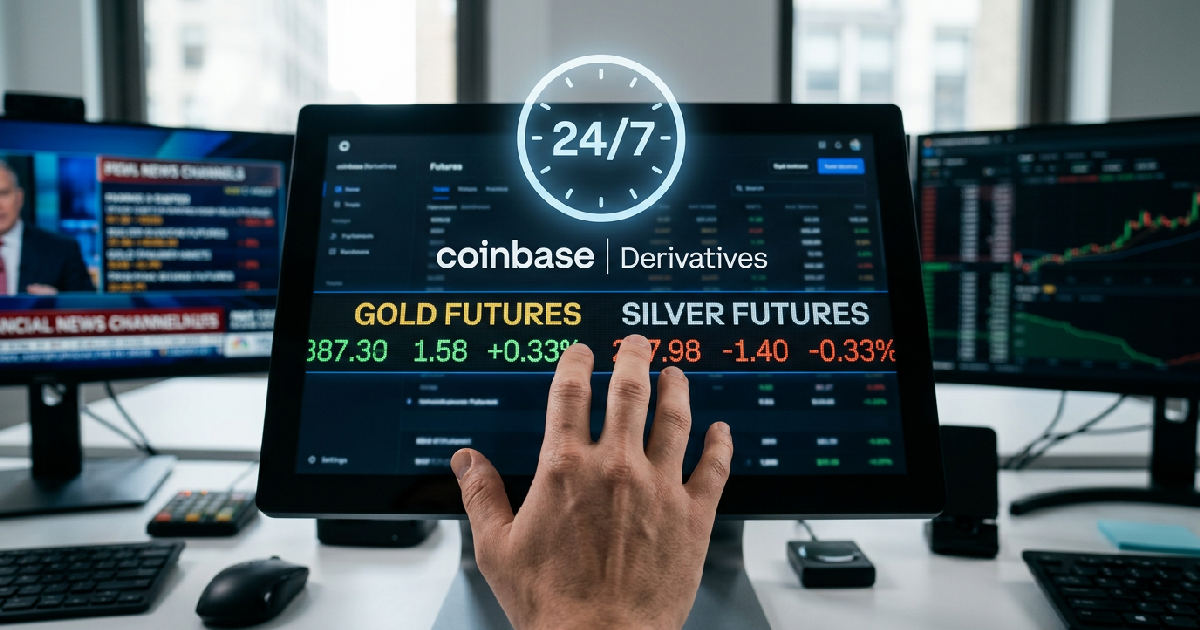

Coinbase is moving to fundamentally alter the structure of U.S. commodities markets by bringing 24/7 trading to its gold and silver futures contracts.
Coinbase Derivatives (CDE), a Commodity Futures Trading Commission (CFTC) registered exchange, announced on June 12, 2026, that it is actively working with regulators to transition these precious metal futures to an around-the-clock schedule. While the shift is currently labeled as “coming soon” for U.S.
traders, the move signals an aggressive push to apply the 24/7 liquidity of crypto markets to traditional financial assets.
The transition targets a long-standing friction point in legacy finance: the weekend gap. Traditionally, U.S. commodity markets close on Friday evenings and reopen on Sunday nights, leaving traders exposed to geopolitical shifts or economic data released during the “blackout” period.
By moving toward a continuous model, Coinbase aims to eliminate this risk, allowing domestic retail and institutional investors to manage positions in real-time through brokers like Interactive Brokers, Webull, and Wedbush.
This push for constant uptime is already a reality for some energy traders. Coinbase currently offers Nano Crude Oil Futures (NOL) on a 24/7 basis, with the only interruption being a brief one-hour maintenance break on Fridays from 5 PM to 6 PM ET.
This current oil offering, representing 10 barrels of WTI Crude Oil per contract, serves as a proof of concept for the broader “Everything Exchange” strategy. It demonstrates that regulated U.S. commodity instruments can indeed function outside the rigid constraints of traditional banking hours.
Regulatory hurdles and the race for 24/7 liquidity
While the international arm of the exchange has already successfully launched gold and silver perpetual futures, the domestic transition remains pending final coordination with the CFTC. Non-U.S. traders currently access GOLD-PERP and SILVER-PERP products with up to 25x leverage, settled directly in USDC.
In the United States, however, exposure remains limited to standard session hours until the regulatory green light confirms the shift to 24/7 operations.
The competitive pressure to modernize is mounting from legacy institutions. CME Group recently disclosed plans to move its 1-ounce gold futures on COMEX to a 24/7 schedule effective July 26, 2026. This institutional rivalry suggests that the 24-hour nature of Bitcoin signals market structure analysis 2026 is becoming the new standard for all asset classes, not just digital ones.
The demand for such flexibility is backed by strong initial data. When CME Group introduced 24/7 cycles for its crypto futures, the exchange recorded 7,200 contracts in the very first weekend of operation. This level of engagement confirms that market participants are eager to move away from arbitrary market closures, especially as com/why-bitcoin-traders-care-200-day-moving-average-analysis/”>Bitcoin traders care 200-day moving average data and other technical indicators require constant monitoring to manage risk effectively.
Market volume and the shift to USDC settlement
Coinbase Derivatives has already carved out a significant niche in the traditional commodities space. In the first quarter of 2026, the exchange processed more than $52 billion in notional volume across its commodity futures offerings. This represented approximately 7.6% of all contracts traded on the exchange during that period, highlighting that precious metals and energy are no longer secondary to the platform’s crypto core.
The contract sizes are designed for accessibility, with gold futures set at one troy ounce and silver at 50 troy ounces. Unlike physical commodities, these are dollar-settled, providing price exposure without the logistical burden of delivery. This structure is particularly appealing to retail investors who may be wary of the com/tether-treasury-holdings-us-debt-risk/”>risks associated with stablecoins or other digital counterparts but desire the efficiency of a blockchain-adjacent trading venue.
As Coinbase continues to integrate traditional assets like equity index futures and oil into its 24/7 ecosystem, the distinction between “legacy” and “crypto” exchanges is disappearing. The move to bring gold and silver into a non-stop trading cycle is a direct acknowledgement that global events do not stop for the weekend, and neither should the markets that price them.