
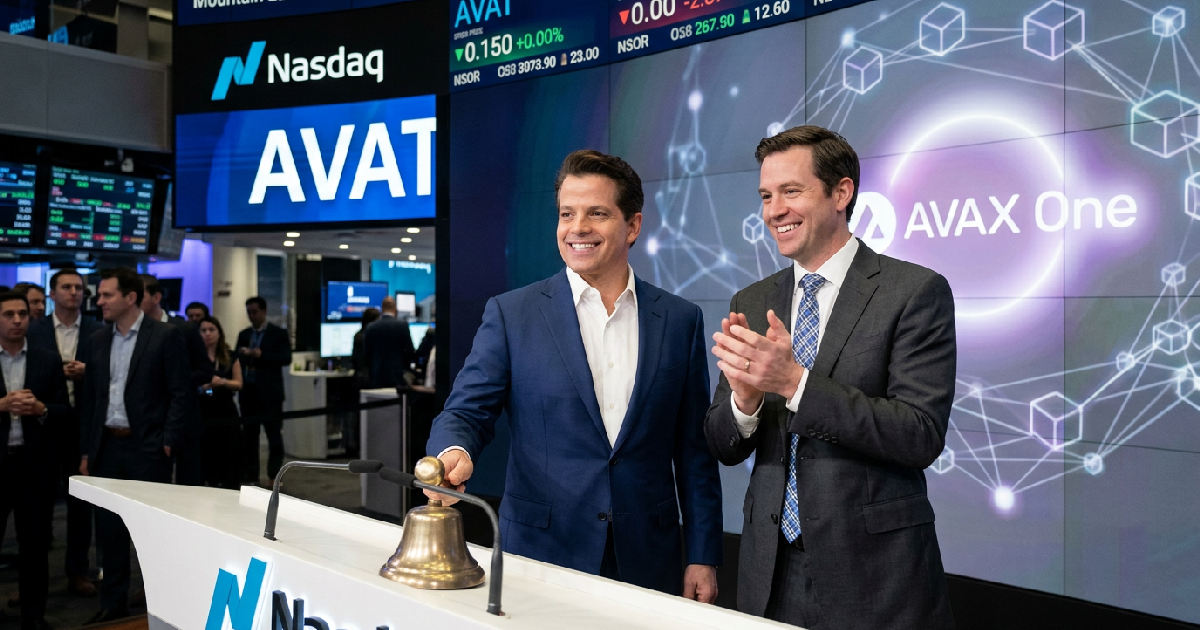

Avalanche Treasury Co. officially began trading on the Nasdaq Stock Market on Thursday, June 11, under the ticker symbol AVAT. The listing follows a merger with Mountain Lake Acquisition, a deal valued at $675 million when the initial agreement was signed in October.
The venture is driven by AVAX One, led by Chairman Anthony Scaramucci and CEO Bart Smith, formerly of Susquehanna and AllianceBernstein (NYSE: AB).
The transition to a public market marks a pivot from passive holding strategies common in the digital asset space. CEO Bart Smith has explicitly stated that AVAT is not a “buy token, sit back, pray” play. Instead, the entity focuses on active capital allocation to support the growth of the Avalanche ecosystem.
This approach mirrors a broader trend where altcoin investment strategies are becoming more structured for institutional participants.
The Treasury manages approximately 15 million AVAX tokens, which represents about 3.5% of the total circulating supply. This capital is intended to fund specific sectors of the Avalanche economy that can drive higher network utilization. By listing on a major exchange, the group is providing a regulated gateway for investors seeking exposure to blockchain development without the complexities of direct token ownership.
AVAX One targets institutional blockchain adoption barriers
The institutional case for Avalanche, presented by AVAX One in March, argues that the network’s architecture is uniquely suited to solve legacy barriers to blockchain adoption. Unlike earlier iterations of the technology, current tools allow for the level of privacy and control that financial firms require.
This has already attracted a high-profile list of partners, including BlackRock (NYSE: BLK), Franklin Templeton, and Apollo Global Management (NYSE: APO).
As analysts suggest a shifting market structure in the digital asset sector, Avalanche has focused on real-world utility. The network currently hosts over 550 projects and more than $1.65 billion in tokenized real-world assets. It ranks as the 33rd-largest cryptocurrency by market value on CoinGecko, supported by major entities like FIFA and the state of Wyoming.
The deployment of the “Evergreen” toolset in April 2023 was a foundational step for this institutional push. These tools allow financial companies to maintain private-style controls while operating on a public blockchain infrastructure. This addresses legal and functional requirements for total segregation, which was historically impossible under older subnetting architectures where validators could not escape the public network.
Technical foundations of the AVAT treasury listing
The infrastructure allowing for institutional isolation became fully functional with the launch of Avalanche9000 in December 2024. Through the ACP-77 update, Layer-1 validators gained the ability to operate without a dependency on the Primary Network. This allows sovereign institutions to create isolated networks with their own validator sets, ensuring they do not compete for blockspace during times of high mainnet congestion.
Institutions using Evergreen L1s can now program specific rules for their environments, including KYC/KYB guidelines for pre-approved counterparties. They can also implement geofencing to restrict access to certain jurisdictions. Importantly, these chains can maintain their own fee structures and governance mechanisms, protecting them from unexpected changes decided by the broader community voting system.
To prevent these private chains from becoming liquidity islands, the network utilizes interchain messaging technology. This allows the various components of the ecosystem to communicate while maintaining internal permissions. Such technical flexibility is likely why market confidence in digital assets is increasingly tied to the ability to bridge private institutional needs with public market liquidity.
Regulatory approvals and emerging stablecoin deployments
The listing of AVAT on the Nasdaq occurs alongside significant legal and regulatory milestones for the Avalanche network in early 2026. In January, legal experts for the state of Wyoming cleared the network for the deployment of FRNT. This asset is recognized as the first U.S.-backed stablecoin, highlighting the network’s growing acceptance by state-level government bodies.
Simultaneously, the legal team at VanEck approved VAVX in January 2026. This is the first U.S.-listed ETF designed to merge AVAX price action with staking yields on the Nasdaq. These developments suggest a coordinated effort to integrate Avalanche-based assets into traditional financial products through both corporate treasuries and regulated investment vehicles.
The active management of the Avalanche Treasury is essentially a bet on the continued professionalization of the digital asset industry. By moving away from “single-crypto” holding companies, AVAX One is attempting to prove that a blockchain-based treasury can function as a dynamic capital allocator.
The performance of AVAT will serve as a test case for whether traditional equity investors value this active participation in decentralized economies.