
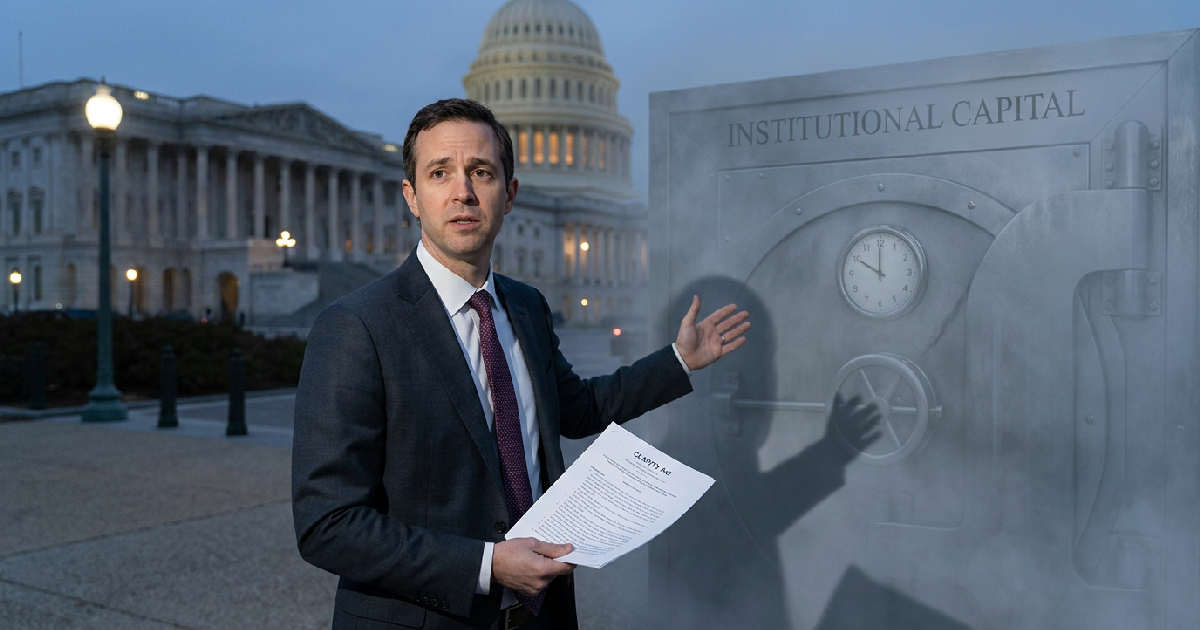

Matt Hougan, the Chief Investment Officer of Bitwise, argued in a weekly memo published on Tuesday, June 2, 2026, that the American cryptocurrency market is trapped in a regulatory “in-between” that prevents institutional capital from flowing into major assets.
Hougan stated that the final outcome of the CLARITY Act matters less than simply ending the current state of legislative limbo. He noted that while the industry could survive the bill’s failure, it cannot thrive as long as the timeline for a final Senate vote remains uncertain.
The CLARITY Act currently sits at a crossroads in Washington, with its fate dictating whether institutional investors remain on the sidelines. While Polymarket traders have recently priced the odds of year-end approval at 55%, Hougan’s internal sources are much more pessimistic. He revealed that Washington insiders and political analysts he consulted placed the actual probability of the bill passing between only 5% and 30%.
Without a statutory framework to replace the current enforcement-led oversight by the SEC and CFTC, institutional investors are choosing safer, high-performing bets. “Who needs crypto when the Nasdaq-100 is up 43% year-over-year?” Hougan asked, pointing to the record-breaking performance of AI and tech stocks. He believes Bitcoin signals market structure shifts that require clear rules before the next wave of capital can enter.
Institutional capital remains frozen by legislative delays
The “floor math” in the Senate suggests a difficult path forward for the legislation despite previous momentum. The House of Representatives passed the bill with a 294-134 bipartisan majority in July 2025, but the Senate requires 60 votes to overcome procedural hurdles.
With Republicans holding only 53 seats and only two committee Democrats backing the bill during a May 14 session, the path to a supermajority looks increasingly narrow.
This stagnation has real-world consequences for asset prices, leading to what Hougan describes as a “painful metamorphosis” for the sector. Large-cap assets have struggled throughout 2026 as investors rotate toward sectors with more predictable regulatory horizons. Bitcoin has dropped between 21% and 24% year-to-date, while Ethereum has seen corrections of 33% to 36% and Solana has fallen between 37% and 40%.
The stakes of a delay are high for the long-term roadmap of American finance. Senator Cynthia Lummis recently warned that if the CLARITY Act fails to pass in the current session, the industry might not see another chance for comprehensive legislation until 2030. A four-year legislative freeze would likely push innovation toward jurisdictions with faster-moving regulatory bodies, further dampening U.S. market dominance.
The shift from momentum trading to contrarian bets
As the “AI revolution” continues to dominate headlines, Hougan suggests that crypto has moved into a contrarian phase. This isn’t necessarily a negative for all investors, as it rewards those looking for value outside of the hype cycle.
“Contrarian bets are won by looking in the places no one is looking,” Hougan wrote in his memo, suggesting that the current malaise might be a precursor to a market bottom.
While large-cap assets struggle, certain protocols with “credible fundamentals” are finding success by focusing on real revenue generation. Hougan recently noted how Hyperliquid targets a $600 trillion market through its unique platform. Hyperliquid (HYPE) surged roughly 72% in a single month, demonstrating that capital is moving toward idiosyncratic growth stories rather than broad market momentum.
Other smaller assets have also defied the downward trend seen in the majors. Zcash rose 50% and Stellar climbed 44% in the last month, suggesting a market that is becoming increasingly discerning. This divergence indicates that even without the CLARITY Act, individual projects can find success if they provide clear utility and transparent economic models that appeal to fundamental investors.
What happens if the CLARITY Act fails in the Senate
If the bill fails to reach the President’s desk, the immediate impact would likely be a continuation of the status quo. However, Hougan argues that even a definitive “no” is better than a never-ending “maybe.” A clear failure allows the industry to adapt to existing conditions, seek out alternative pathways through the courts, or focus heavily on tokenization products that already have some traction.
There is precedent for growth despite legal headwinds in the United States. Following the passage of the GENIUS Act in July 2025, blockchain projects focused on stablecoins and tokenization raised over $1 billion. Institutional interest in stablecoin risks and Treasury holdings remains a central theme for firms like Circle and Stripe, providing a floor for the industry’s development.
Ultimately, the crypto market’s resilience will be tested by the Senate’s scheduling decisions in the coming weeks. Whether the CLARITY Act passes or fails, the market needs a resolution to move past the current volatility. Until Washington provides a final answer, the “great institutional rotation” into crypto is likely to remain on hold while AI stocks continue to draw the most aggressive investment capital.