
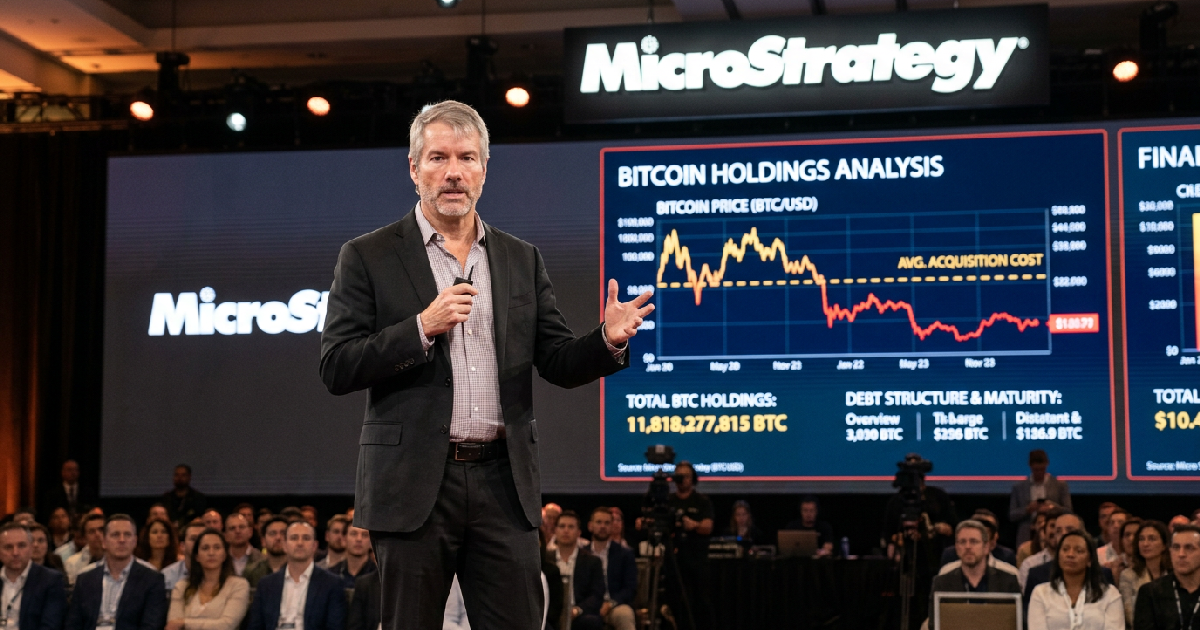

Michael Saylor, the Executive Chairman of MicroStrategy, has officially dismissed growing rumors of an imminent margin call on the company’s massive Bitcoin treasury. In a direct response on the social media platform X on June 5, 2026, Michael Saylor replied with a simple “No” to concerns raised by portfolio manager Michael A.
Gayed regarding the safety of the firm’s digital assets. The clarification comes as the Bitcoin market experiences a period of consolidation, with prices recently fluctuating between $61,000 and $67,000.
The speculation gained traction because Bitcoin has been trading significantly below the average acquisition cost for MicroStrategy’s current holdings. As of June 6, 2026, the firm holds approximately 713,000 BTC acquired at an average price of roughly $75,699 per coin.
This puts the company’s “paper” position in the red, sparking fears among some analysts that lenders could force a liquidation to cover outstanding debts. However, Michael Saylor has long maintained that his firm’s balance sheet is uniquely insulated against such market volatility.
MicroStrategy’s financial structure relies heavily on unsecured and long-dated debt rather than traditional margin loans. Because much of the $2.2 billion in total debt consists of convertible senior notes and at-the-market equity offerings, no specific lender has the authority to seize Bitcoin holdings based solely on short-term price drops.
Michael Saylor previously noted that the company is “10x over-collateralized” on its only major secured obligation, a $205 million loan originally sourced from Silvergate Bank.
Michael Saylor explains why margin call fears are overblown
The primary reason Michael Saylor can remain indifferent to price swings relates to the maturity dates of the company’s debt. Most of the firm’s obligations do not come due until 2027 and 2028, meaning there is no immediate “repayment cliff” that would necessitate selling assets in a down market.
This long-term horizon allows the company to absorb shifting market structures without the pressure of liquidating its 713,000 BTC stake at unfavorable prices.
Furthermore, the structure of the convertible debt often allows for a “smooth conversion” into equity if certain price targets are met. For instance, the $1.05 billion in debt due in February 2027 was structured with a conversion target of approximately $39,686 per coin.
Even in a catastrophic “doomsday” scenario, analysts estimate the floor price for Bitcoin would need to hit roughly $2,649 to force a mandatory liquidation of the entire $1.05 billion debt package.
Michael Saylor has often doubled down on the idea that the business was built to “HODL through adversity.” By using cash from operations and unsecured debt, MicroStrategy avoids the typical pitfalls of retail margin trading.
In a June 2022 tweet frequently cited by the company, Michael Saylor explained that the margin call threshold for their $205 million loan was as low as $3,562, at which point the company could simply “post some other collateral” to satisfy the lender.
Historical context of MicroStrategy Bitcoin strategy resilience
This is not the first time Michael Saylor has had to play defense against market skeptics. During the crypto winter of 2022, similar rumors swirled when Bitcoin fell toward the $20,000 mark.
At that time, CFO Phong Le stated the company could contribute more Bitcoin to its collateral package to keep its loan-to-value (LTV) ratio below the required 50%. The firm had over 95,000 “unencumbered” coins specifically reserved for such a purpose.
Since that period, the scale of the company’s holdings has grown from roughly 132,500 BTC in late 2022 to the current 713,000 BTC. This massive accumulation has turned MicroStrategy into a de facto Bitcoin proxy for institutional investors. While large-scale whale accumulation continues in the background, Michael Saylor remains the most vocal proponent of the “Bitcoin Standard” for corporate treasuries.
Industry observers note that the company’s strategy is inherently different from the speculative trading seen on exchanges. While retail liquidations often occur at the 200-day moving average or other technical triggers, MicroStrategy’s corporate debt instruments do not have “stop-loss” mechanisms. This allows them to stay the course through extreme drawdowns that would wipe out smaller, leveraged players.
Looking ahead to the 2027 debt maturities
The real test for Michael Saylor and the MicroStrategy board will come in early 2027 as the first of the major convertible notes mature. Investors will be watching closely to see if the company chooses to refinance that debt, settle in cash, or convert the notes to equity.
If Bitcoin prices recover to exceed the $75,699 average acquisition cost by then, the company will likely face little resistance in rolling over its obligations.
For now, the Executive Chairman remains focused on the long-term play. Michael Saylor’s blunt “No” on social media serves as a reminder to the market that MicroStrategy is not a hedge fund at risk of a “blow up,” but a software company with a long-term capital allocation strategy.
As the market monitors global liquidity and geopolitical shifts, the stability of the world’s largest corporate Bitcoin holder remains a focal point for crypto market confidence.