
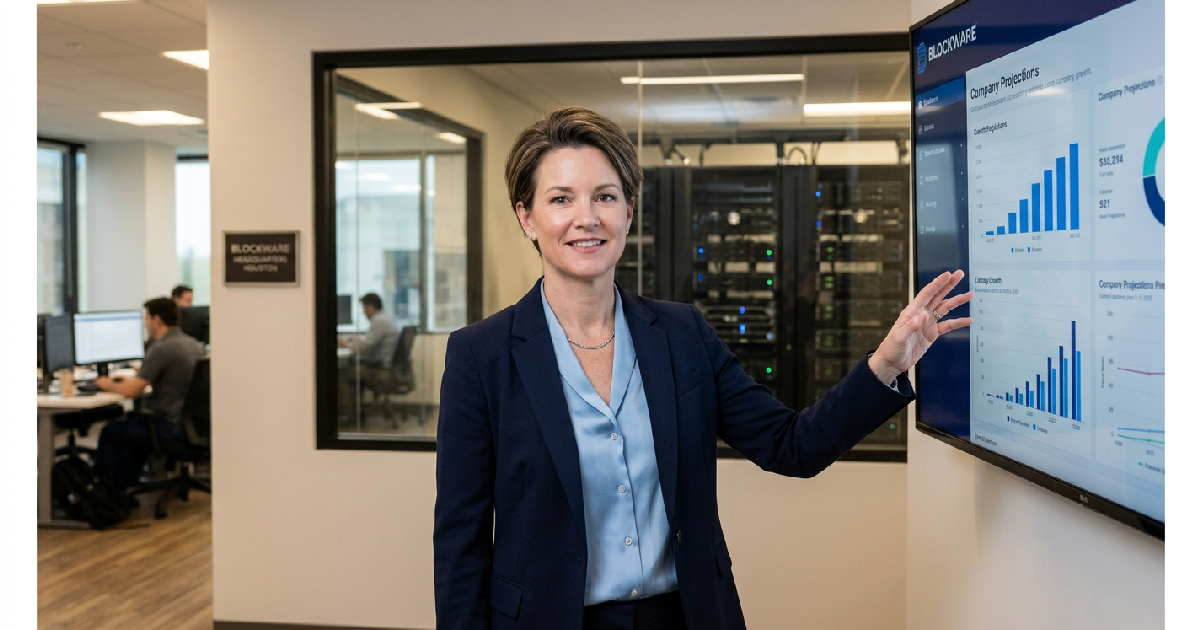

Blockware, a vertically integrated infrastructure platform, appointed Megan Brooks-Anderson as its new Chief Executive Officer on June 3, 2026. The Houston-based company confirmed the leadership change following the board’s removal of co-founder Mason Jappa from the CEO role. In a simultaneous move, co-founder Sam Chwarzynski, formerly the Chief Investment Officer, has been named President.
Megan Brooks-Anderson steps into the leadership position after serving as Blockware’s Chief Strategy Officer. She is widely regarded as one of the architects of the company’s current strategic direction. Her background includes more than 20 years of experience across Bitcoin mining, public and private company operations, risk management, M&A, and internal controls.
This transition occurs as the firm aggressively expands into artificial intelligence (AI) and high-performance computing (HPC) infrastructure. While the Bitcoin exchange supply remains a focal point for many in the industry, Blockware is diversifying its footprint through its subsidiary, Nodestream. The company indicated it will release a formal announcement regarding its AI expansion in July.
Extensive industry expertise at the helm
Megan Brooks-Anderson brings a deep resume to the CEO seat, including her tenure as Chief Operating Officer at Riot Platforms (NASDAQ: RIOT). During her time there, she helped scale one of the largest Bitcoin mining operations in North America. She also previously held roles as Corporate Controller and Vice President of Finance at Riot.
Beyond her operational work, Megan Brooks-Anderson holds a Master’s Certificate of Accountancy from the University of Houston and a B.S. in Finance. Her experience began in the industry trenches, where she worked her way up from a bookkeeper to vice president of operations during her college years. This breadth of technical and financial knowledge is central to her new mandate.
“I’m honored to step into this role at such a pivotal moment for Blockware,” Megan Brooks-Anderson said in a statement. Her immediate focus remains on execution for the company’s investors and partners. This focus is particularly relevant as Bitcoin price analysis shows the importance of efficient infrastructure during periods of market volatility.
Strategic expansion into AI and HPC compute
Blockware is currently operating at an inflection point, pivoting toward a generalized compute model. The company’s platform already manages nearly 1 GW of energized capacity and has sold over 400,000 servers. This existing infrastructure allows for a more efficient transition into AI and HPC workloads through established partnerships.
The company continues to operate two Bitcoin mines in eastern Kentucky, which serve as the backbone of its mining business. Even with the move into AI, management confirmed that existing mining clients will remain a priority. This balanced approach mirrors trends seen where the Ethereum recovery outlook is often tied to diversified network utility.
President Sam Chwarzynski will lead alongside Megan Brooks-Anderson, bringing his background as a proprietary FX trader to the dual-leadership structure. Both executives have emphasized their commitment to the legacy of late co-founder Matt D’Souza. His original vision for the company continues to shape the culture as it scales into new verticals.
Future roadmap for Blockware’s marketplace
In addition to infrastructure hosting, Blockware maintains a strong presence through the Blockware Marketplace. Launched in 2023, the platform facilitates the transparent buying and selling of turnkey ASICs. The marketplace requires six on-chain confirmations, taking roughly one hour, to finalize legal ownership transfers and reward flows.
By combining procurement, site readiness, and marketplace liquidity, the company aims to lower barriers for institutional customers. This vertically integrated model is now being applied to the AI sector. The July announcement is expected to detail how the firm will integrate new High-Performance Computing partnerships into its existing framework.
Blockware has been a fixture in the industry since 2017, growing from hardware sourcing to a multi-market infrastructure provider. With a new leadership team in Houston, the company is positioning itself to capitalize on the increasing overlap between digital assets and compute-heavy AI technologies. The leadership transition marks a definitive shift toward institutional-scale execution.