
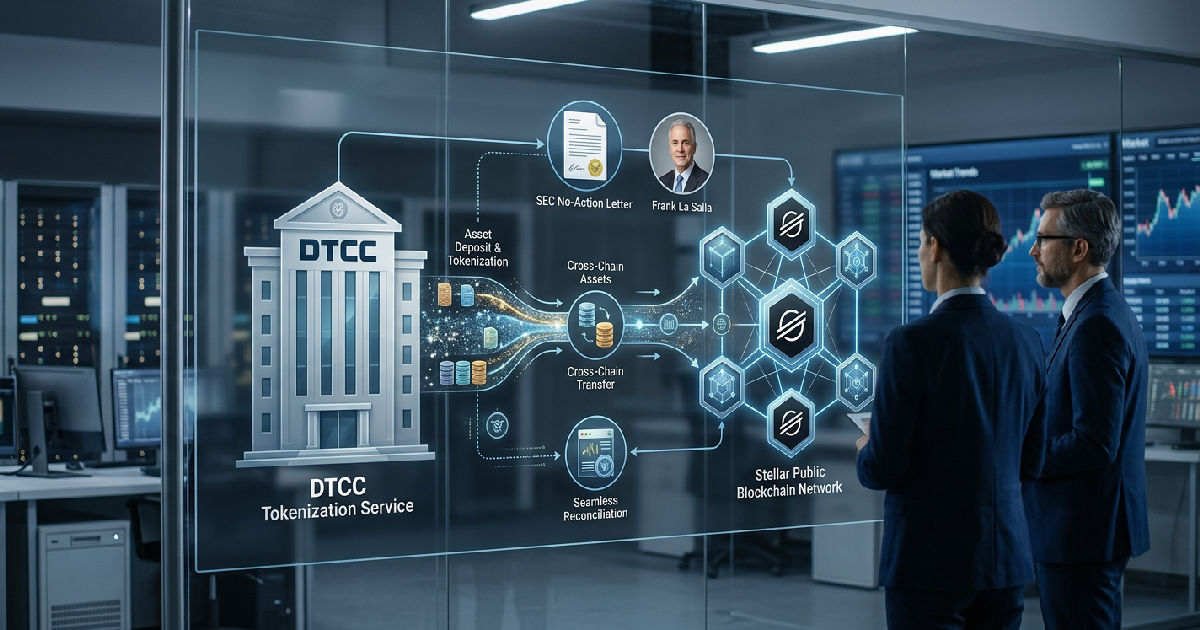

The Depository Trust & Clearing Corporation (DTCC) and the Stellar Development Foundation (SDF) announced on May 27 a partnership to integrate DTCC’s forthcoming tokenization service with the Stellar public blockchain. This initiative focuses on the tokenization of assets custodied by The Depository Trust Company (DTC), a DTCC subsidiary, with an expected deployment in the first half of 2027.
The move marks a departure from private-only networks, as the DTCC seeks to connect traditional market liquidity with digital ecosystems. While many institutional projects remain in sandbox environments, this integration utilizes a multi-chain strategy to bridge regulated U.S. capital markets with public infrastructure.
The DTCC holds a massive footprint in global finance, processing approximately $4.7 quadrillion in securities in 2025 and safeguarding $114 trillion in custody assets. By collaborating with the SDF, the organization aim to allow market participants to leverage traditionally held assets within digital networks while maintaining identical investor protections and safeguards.
This development follows a rise in institutional on-chain activity. Investors are increasingly watching how legacy infrastructure interacts with decentralized platforms, similar to how Bitcoin exchange supply maintains multi-year lows as holders move toward direct custody or institutional vehicles. The DTCC’s multi-chain approach ensures it is not reliant on a single network for future liquidity.
Evaluating use cases for tokenized real-world assets
The partnership targets specific asset classes for its initial evaluations. These include equities in the Russell 1000, ETFs tracking major indices, and various U.S. Treasuries such as bills, notes, and bonds. The service is designed to manage the entire asset lifecycle, ranging from rapid conversion into tokenized form to handling corporate actions and reporting.
Under the leadership of DTCC President and CEO Frank La Salla and SDF CEO Denelle Dixon, the project aims to solve long-standing friction points. Benefits anticipated include accelerated settlement times — potentially moving from days to minutes — and 24/7 trading capabilities. This increased mobility could significantly reduce costs and risks for 150 participating countries.
By bringing these assets to the Stellar network, the DTCC leverages a platform with more than $1.3 billion in real-world assets already on-chain. This aligns with broader market trends where specialized networks gain traction for their transparency and efficiency. For example, as Ethereum network outlook strengthens through its own decentralized growth, other Layer 1 blockchains like Stellar are carving out niches for institutional compliance.
Compliance and the SEC No-Action letter roadmap
The DTCC’s entry into public blockchains is governed by strict regulatory guardrails. The Depository Trust Company received a three-year No-Action letter from the Securities and Exchange Commission (SEC) in December 2025. This letter authorizes the launch of a tokenization service for DTC-custodied assets within a controlled framework.
Compliance is handled through the use of registered wallets and strict Anti-Money Laundering (AML) and Know Your Customer (KYC) requirements. Nadine Chakar, Global Head of DTCC Digital Assets, has highlighted that the goal is to create interoperable digital infrastructure. This ensures that the mobility of assets does not come at the expense of the oversight provided by the core post-trade infrastructure.
While the Stellar integration is slated for 2027, the DTCC’s broader tokenization service is moving faster. Limited production trades are planned for July 2026, ahead of a wider rollout in October 2026. This phased approach mirrors the cautious but steady adoption seen in other sectors, where on-chain signals and whale movements often precede major institutional shifts.
Stellar market reaction and infrastructure capacity
The market responded to the news with a notable price movement for Stellar’s native token, XLM. Following the May 27 announcement, the token’s price jumped between 3% and 8%, trading above $0.16. This price action brought Stellar’s market capitalization to roughly $5.3 billion, making it the 22nd largest cryptocurrency at the time of the report.
Stellar was chosen for its high transaction capacity and cost-effectiveness, alongside building institutional-grade tools for digital asset issuance. The network’s DeFi ecosystem currently holds approximately $170 million in total value locked (TVL), but the addition of DTCC-processed assets could substantially change the liquidity profile of the public chain.
Ultimately, the DTCC is building a bridge between established liquidity and the flexibility of digital networks. As Brian Steele, DTCC Managing Director, noted, the integration intends to allow market participants to access deeper liquidity and achieve greater efficiency. If the first half of 2027 marks a successful deployment, it may provide a permanent blueprint for the modernization of the quadrillion-dollar securities industry.