
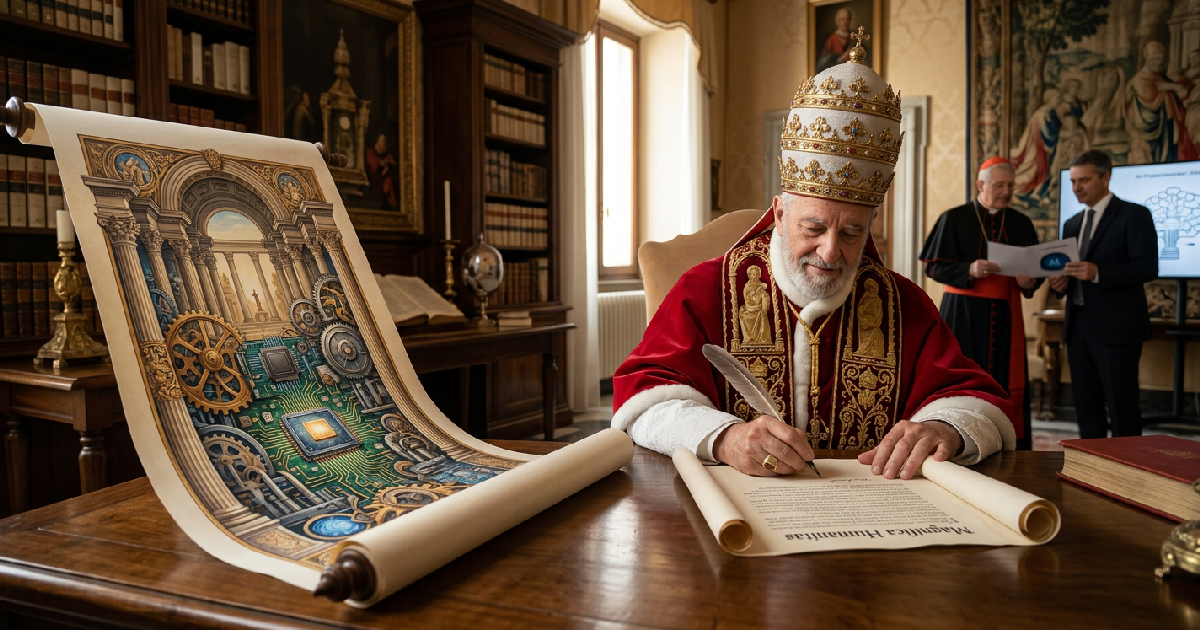

Pope Leo XIV, the first American-born Pope, has officially compared the rise of Artificial Intelligence (AI) to the Industrial Revolution in his first encyclical, “Magnifica Humanitas.” Born Robert Francis Prevost in Chicago, the sovereign of Vatican City signed the document on May 15, 2026, marking the 135th anniversary of “Rerum Novarum,” a landmark 1891 text that addressed the social upheavals of the industrial age.
The new encyclical, released globally around May 25, 2026, warns that the AI industry is in danger of becoming a “new Tower of Babel” dominated by a small number of private companies.
The document offers a moral framework for navigating technological change, stressing that the future of AI cannot be left solely to the “invisible hand” of the market. Pope Leo XIV argues that governments must not abdicate their responsibility to ensure technology serves the common good. Instead, he calls for robust legal frameworks, independent oversight, and informed users to manage the rapid evolution of automated systems.
com/xrp-clarity-act-legislative-progress-analysis-2026/”>legislative progress and regulatory frameworks are becoming central to protecting public interests.
In a symbolic gesture of dialogue between the Church and the tech sector, the encyclical was presented at the Vatican alongside Christopher Olah, a co-founder of the AI firm Anthropic. While the Pope notes that technology is not intrinsically antagonistic to humanity, he warns against ideologies that seek to trade human limits for the “godlike powers of machines.” The document emphasizes that technological development must be guided by ethics rather than the pursuit of maximum profit at any cost.
Pope Leo XIV compares AI to the Industrial Revolution for labor protection
A primary concern in “Magnifica Humanitas” is the potential for AI to displace workers and lead to “forced inactivity.” The Pope asserts that decent jobs are fundamental to a healthy society and that the pursuit of higher profits cannot justify the systematic sacrifice of employment. He echoes the sentiments of his predecessor, Pope Leo XIII, who advocated for the rights of industrial workers. By framing AI through this historical lens, the Pope suggests that today’s digital shift requires a similar commitment to the dignity of labor.
The document specifically highlights the risk of power concentration, noting that a few corporations currently control the most powerful AI technologies. Leo XIV argues that this imbalance threatens to remove human choice from critical areas of life. Just as institutional exposure to new assets often triggers calls for better management, the Vatican is urging for a political system that actively shapes the technological landscape rather than reacting to it. The goal is to induce as many people as possible to remain “owners” of their agency.
Ethical constraints on warfare and misinformation risks
The encyclical expresses deep fear regarding the use of AI in military contexts, stating that “human choice is becoming more removed from the execution of war.” Pope Leo XIV calls for AI in warfare to be subjected to the most rigorous ethical constraints possible. He argues that delegating lethality to automated systems undermines the moral responsibility essential to human conflict and peace-building initiatives.
Misinformation is another urgent pillar of the Vatican’s warning, particularly its impact on children and young people. The Pope raises concerns about how AI-generated content can mislead the vulnerable and calls for increased education to counter these risks. This emphasis on protecting users from manipulated data coincides with a period where fraudulent schemes and misinformation are viewed as major threats to the integrity of global digital ecosystems.
The long-term impact of Magnifica Humanitas on global policy
While “Magnifica Humanitas” is a religious document, its release is intended to influence secular policy and international standards. By comparing AI to the Industrial Revolution, the Pope has positioned the technology as a generational challenge that demands collective political action. He urges governments to establish independent oversight bodies to ensure that private interests do not supersede the public’s right to a stable and ethical digital future.
The Vatican’s stance suggests that the moral and social consequences of AI are now a priority for the Church’s leadership. Pope Leo XIV concludes that while technology can be a positive force, it must remain a tool of “Magnificent Humanity” rather than its replacement. The coming months will likely show how international bodies and tech leaders respond to the Pope’s call for a more human-centric approach to the digital age.