
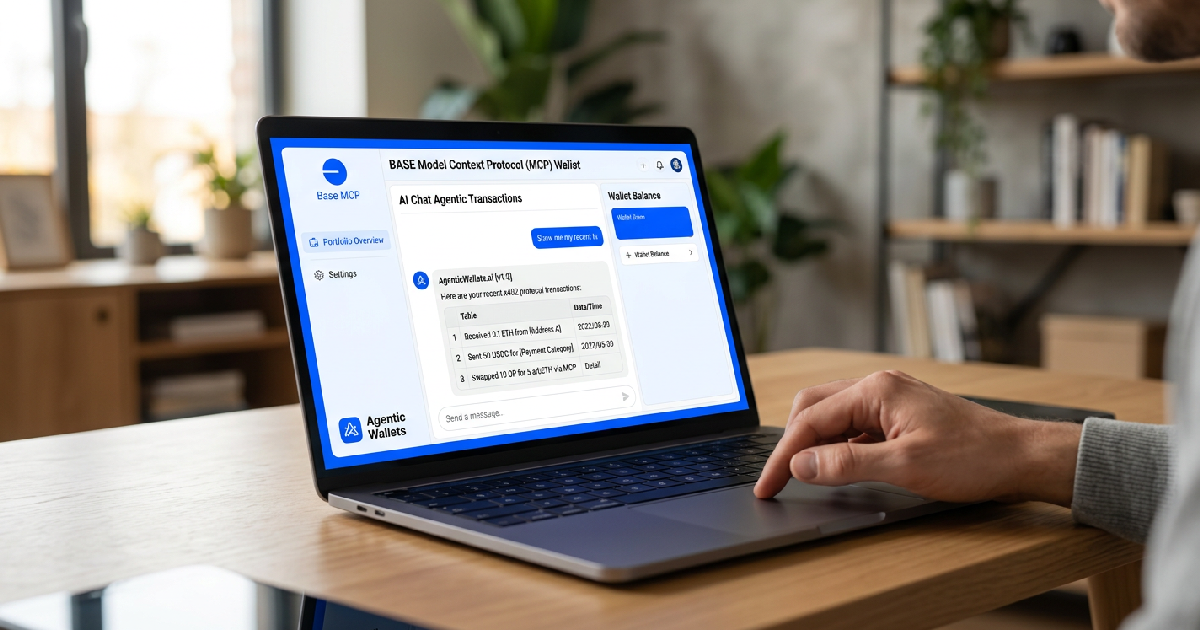

Base, the Ethereum Layer 2 network incubated by Coinbase, launched its new Base MCP (Model Context Protocol) on May 26, 2026, marking a major shift in how artificial intelligence interacts with decentralized finance. The infrastructure allows AI agents to execute transactions, swap tokens, and manage crypto wallets directly via plain-language prompts. Head of AI Product for Coinbase Lincoln Murr confirmed that the system integrates a user’s Base Account across both AI clients and the primary Base application.
The release addresses a long-standing friction point in the digital asset economy: the “human bottleneck.” By utilizing the Model Context Protocol first formalized by Anthropic, Base has created a bridge that allows popular AI models like ChatGPT and Claude to perform financial tasks without requiring a human to manually sign every individual line of code. Instead, users can simply tell an agent to “rebalance my portfolio” or “send 10 USDC to a friend,” and the agent constructs the necessary blockchain request.
This development follows the earlier introduction of Agentic Wallets by Coinbase developers Erik Reppel and Josh Nickerson. These specialized wallets are built on the x402 protocol and Coinbase’s AgentKit, providing a foundation for “agentic commerce.” While the Ethereum network outlook continues to evolve, these Layer 2 innovations are designed to abstract away the technical complexity that often deters mainstream users from entering the on-chain economy.
How Base MCP simplifies AI-driven financial execution
The core of the new infrastructure is the ability for AI agents to “do something that requires money.” This includes paying for their own API keys, purchasing data, or accessing compute resources. By providing “plug-and-play” skills—such as Fund, Trade, and Earn—the Base MCP allows developers to deploy an agent capable of navigating DeFi protocols in under two minutes via a command-line interface.
Automation at this level requires high throughput and low costs, which the Base network provides. Transactions on the Layer 2 network are roughly 95% cheaper than on the Ethereum mainnet. Furthermore, Base maintains a two-second block time, significantly faster than the 12 seconds required on the main chain. These efficiencies have already driven the network to over 400 million total transactions across 8 million unique addresses.
The x402 protocol, which powers these machine-to-machine payments, has seen substantial adoption since its launch in May 2025. According to recent data, the protocol has processed over 50 million transactions. In the 30-day period ending May 27, 2026, the x402 protocol recorded a transaction volume of $1.1 million, signaling growing trust in automated financial flows.
Security protocols and non-custodial safeguards for agents
Coinbase has implemented a rigorous security framework to ensure that giving an AI “wallet access” does not result in a loss of funds. The Base MCP server is entirely non-custodial, meaning it never holds or accesses a user’s private keys. Instead, transactions are constructed locally by the AI agent and stored as pending requests. This is particularly relevant as fraudulent recovery schemes continue to plague the broader crypto ecosystem.
User control remains the priority in this architecture. Every transaction generated by an AI requires an explicit sign-off from the human owner before it is broadcast to the blockchain. To prevent unauthorized spending, the system includes session caps and transaction size limits. Security is further bolstered by OAuth 2.1 authentication, which mimics the familiar “Sign in with Google” experience while keeping keys within secure Coinbase infrastructure.
Beyond manual confirmation, the infrastructure utilizes Trusted Execution Environments and automated Know Your Transaction (KYT) screening. This screening process is designed to automatically block high-risk interactions or known malicious contracts. By building transactions locally within the agent’s environment, Base effectively mitigates common attack vectors like domain hijacking and phishing that often target browser-based wallets.
Bridging the gap between LLMs and DeFi applications
The integration supports various AI clients, including Cursor, Codex, and Anthropic’s Claude. This variety allows developers to choose the large language model (LLM) that best fits their specific use case. The goal is to move away from forcing users to “jump between apps” or interpret complex protocol interfaces. Instead, the AI serves as a personalized navigator for the on-chain world.
The current DeFi landscape on Base is already robust enough to support this transition. The network currently holds approximately 46% of all decentralized finance total value locked (TVL) across Ethereum Layer 2 solutions. As more institutional ETF outflows or shifts in market sentiment occur, the ability for AI to react instantly to market conditions could become a competitive advantage for retail traders.
Looking ahead, the team expects these “Agentic Wallets” to redefine machine-to-machine commerce. As agents become more autonomous, the need for gasless trading and programmatic access will grow. Coinbase’s infrastructure now provides the tools for these agents to not only manage human wealth but to operate as independent economic actors within the global financial system.