
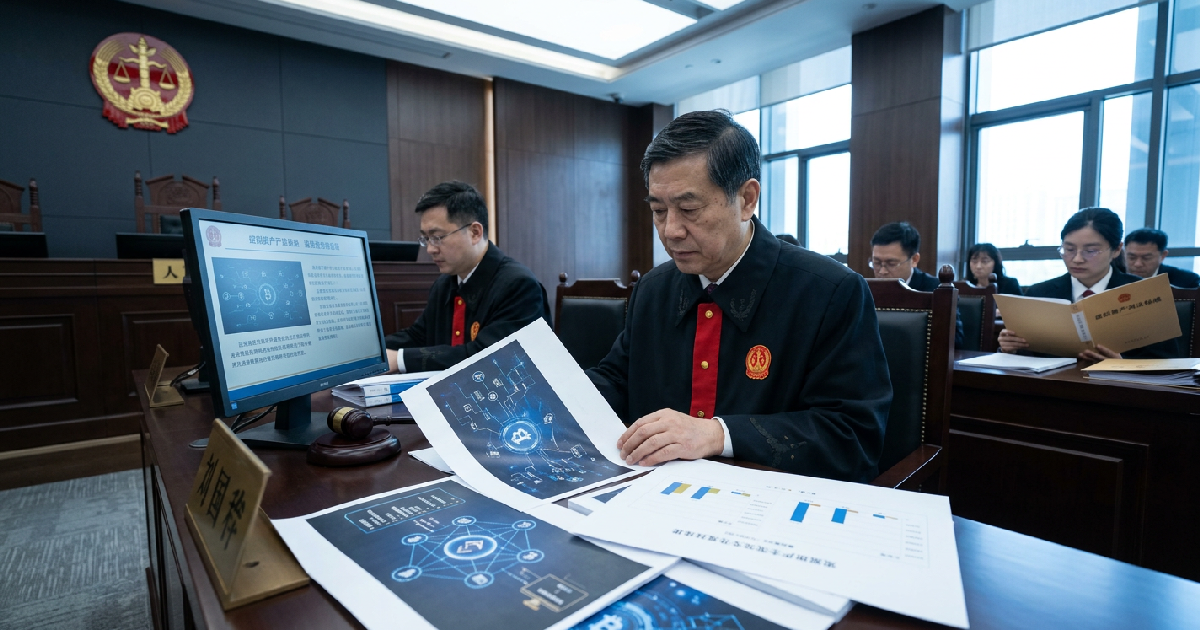

China’s Supreme People’s Court (SPC) is intensifying its research into judicial rules for cryptocurrency and virtual assets following a sharp rise in related legal disputes. During a press briefing in Beijing on May 27, 2026, Liu Guixiang, a member of the SPC’s Judicial Committee and a second-level grand justice, confirmed that the court will conduct in-depth research on adjudication rules for emerging cases involving virtual currencies and cross-border finance.
The initiative forms a core part of China’s 15th Five-Year Plan, which prioritizes the modernization of the legal system to address evolving digital financial activities. While Judge Liu Guixiang detailed the plans for new crypto-related standards, Wang Chuang, the Chief Judge of the SPC’s Second Civil Division, separately stated that Chinese courts have already moved to enhance the regulation of financial trials across the board.
The judiciary aims to establish comprehensive laws that allow for stricter punishments for financial crimes, reducing the regional legal system’s reliance on disparate precedents.
The push for clarity follows staggering data from the previous year. Chinese courts handled over 2.7 million financial cases in 2025, a 1.7% increase from 2024. Within that total, securities-related cases surged by 63.6% to 27,000, while insurance disputes rose 21.3% to 392,000. These figures suggest that while the Bitcoin exchange supply maintains multi-year lows in some global markets, the legal friction involving digital assets within China at the local level is reaching a boiling point.
Addressing crypto-related financial crimes and market fraud
The SPC plans to move quickly to formulate new judicial interpretations specifically regarding civil damages for insider trading and market manipulation. This focus is a direct response to the growth of illegal activities that bypass China’s long-standing prohibition on virtual asset trading. According to research cited by the court, Chinese-language money laundering networks processed approximately 20% of illicit crypto funds globally over the past five years, totaling more than $16 billion in 2025 alone.
Law professor Yang Dong of Renmin University of China is currently leading a research project to assist the judiciary in handling these complex legal cases. The goal is to create unified judicial standards that prevent “court shopping” or inconsistent rulings across different provinces. This unified approach is particularly critical as crypto market liquidation analysis remains a concern for regulators fearing that unregulated digital financial activity could spill over into the broader economy.
The court’s current focus builds on a February 2026 joint notice that expanded enforcement scope. That directive reaffirmed the 2021 ban on crypto trading but added new oversight for real-world asset (RWA) tokenization and offshore yuan-linked stablecoins. By consolidating these rules under the SPC’s guidance, authorities hope to better safeguard China’s economic security and social stability while protecting the interests of small and medium-sized investors who are often targets of ICO-related scams.
Judicial standards for virtual property and investor liability
A persistent point of contention in Chinese law has been the legal status of digital assets. While the central bank banned all trading and mining in September 2021, various local courts have looked at Bitcoin and other tokens as “virtual property” in disputes regarding ownership rights. However, the SPC has reiterated that civil legal acts involving investments in cryptocurrencies are considered invalid. In practice, this means that any resulting losses must be borne by the investors themselves, as the contracts are not legally enforceable.
The court is also exploring strategies to manage disputes involving private equity funds and virtual currencies, which have become more frequent. As the Bitcoin price analysis remains a topic of international interest, China’s judiciary is focused on the practicalities of asset recovery and strengthening cooperation between judicial and regulatory agencies. This includes finding ways to update frameworks that were drafted before the widespread use of blockchain technology.
This mainland tightening stands in contrast to Hong Kong, which continues to position itself as a global hub by issuing stablecoin licenses and finalizing virtual asset management rules. For the Supreme People’s Court, the priority remains creating a robust domestic legal infrastructure that leaves no room for ambiguity. While rumors of a potential easing of the 2021 ban persist, the current judicial momentum indicates a path toward more sophisticated, restrictive regulation rather than a market reopening.