
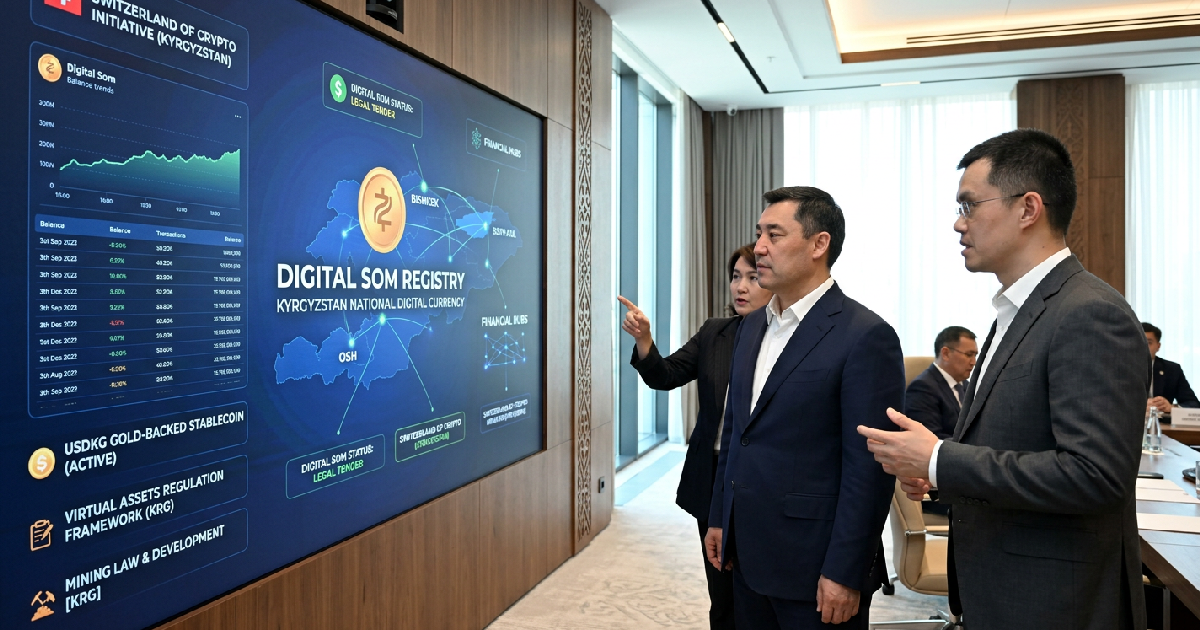

President Sadyr Japarov is spearheading a national strategy to transform Kyrgyzstan into a regional “Switzerland of Crypto,” recently signing legislation and establishing a National Council to integrate digital assets into the state economy. 3 billion) in the first seven months of 2025, according to Minister of Economy and Trade Bakyt Sydykov. This aggressive shift includes the introduction of a national digital som and the recruitment of Binance founder Changpeng Zhao as an official government advisor.
The landlocked Central Asian nation is moving rapidly to formalize a sector that once operated in the shadows. By legalizing cryptocurrency mining and mandating a licensing system for Virtual Asset Service Providers (VASPs), Bishkek aims to diversify its revenue streams. The government had already issued 126 VASP licenses by October 2024, signaling an open-door policy for international digital asset firms. This regulatory clarity is part of a broader trend where top crypto casinos and exchanges are increasingly prioritizing compliance to ensure long-term stability.
The push for legitimacy is backed by stringent financial requirements meant to professionalize the industry. Under new regulations, crypto exchanges operating within the country must maintain at least 10 billion soms (roughly $115,000) in proven capital starting January 1, 2026. This move aligns with recommendations from the International Monetary Fund (IMF) to bolster anti-money laundering measures. For domestic players, this maturation of the market mirrors shifts seen in other regions where Russia lawmakers push to legalize P2P crypto trade to navigate complex financial hurdles.
Strategic advisor role for Changpeng Zhao
A central pillar of the Kyrgyz strategy is its high-profile partnership with Changpeng Zhao, the founder of Binance. In April 2025, President Sadyr Japarov signed a cooperation agreement with Changpeng Zhao, who now holds a Kyrgyz passport and serves as a formal advisor to the presidency. During the first meeting of the National Council on May 3, 2025, the government confirmed that Changpeng Zhao and Binance representative Kirill Khomyakov would help shape the nation’s blockchain policies.
Changpeng Zhao has urged the Kyrgyz government to utilize Bitcoin and BNB as the foundation for its new national cryptocurrency reserve. This proposal aims to hedge against fiat volatility by leveraging global digital assets. The involvement of such high-profile figures reflects the nation’s goal of becoming a hub for tokenized real-world assets. Industry observers note that such moves often follow institutional shifts, such as when potential spot BNB ETF launches gain traction in larger financial markets.
Launching the digital som and USDKG stablecoin
The National Bank of the Kyrgyz Republic (NBKR) is asserting control over the money supply through the development of the “digital som.” President Sadyr Japarov signed legislation giving the digital som legal status in April 2025, following a concept first adopted in May 2022. The NBKR expects to make a final decision on the official issuance of the currency by the end of 2026, with a mandate for retailers to accept it as payment by January 2027.
Parallel to these state efforts, the private sector has introduced its own innovations to the market. In November 2025, a private-sector initiative launched USDKG, a gold-backed stablecoin. This token entered circulation with an initial issue of over 50 million tokens and was listed on the OSL HK exchange in Hong Kong. This private initiative aims to bridge the gap between Kyrgyzstan’s physical gold reserves and digital liquidity without direct state backing for the token itself.
Energy concerns and state-led mining operations
Despite the government’s enthusiasm, domestic critics have raised concerns about the impact on national infrastructure. Dastan Bekeshev, a Member of Parliament, has questioned the risks associated with introducing state mining operations. Dastan Bekeshev noted that the 800,000 KW required to mine a single Bitcoin could power approximately 1,200 apartments for a month, highlighting the tension between crypto ambitions and energy security.
In response, Farhat Iminov, Head of the Secretariat of the National Council, has defended “state mining” as a key element of the national strategy. He argues that formalizing these operations allows for better oversight and economic resilience. The government believes that the revenue potential outweighs the risks, with Minister Bakyt Sydykov reporting that the sector already generated up to 1 billion soms (approximately $11.3 million) in taxes during the first seven months of 2025.
Future outlook for the Kyrgyz crypto hub
The Kyrgyz “Switzerland of Crypto” model is currently focused on balancing rapid growth with the transparency requested by international monitors. While the turnover of exchanges has already hit the 1 trillion som mark, the IMF continues to advise the nation to step up its monitoring of virtual asset services. The success of this strategy hinges on the 2027 retail rollout of the digital som and the continued attraction of foreign capital.
As the administration moves forward, the primary challenge remains the potential for the sector to be used for sanctions circumvention. Western financial monitors are keeping a close eye on Central Asian exchanges to ensure they do not become loopholes for illicit capital flows. For now, Bishkek remains committed to its path, betting that its light-touch regulation and strategic partnerships will secure its place in the global digital economy.