
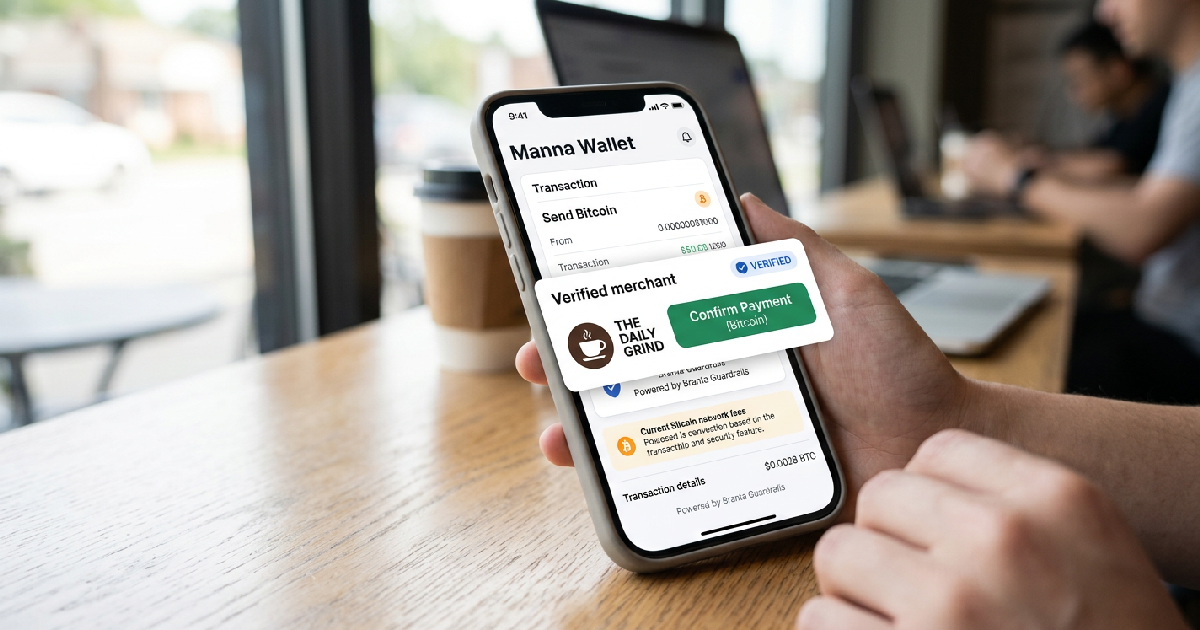

The Bitcoin security firm Branta and self-custodial app Manna Wallet announced a technical integration on May 26, 2026, to allow users to see verified merchant logos and company details before confirming payments. This partnership integrates Branta Guardrails into the Manna Wallet interface, providing a visual verification layer designed to combat transaction anxiety and fraud. By showing exactly who is receiving the funds, the system addresses a major hurdle in retail Bitcoin adoption.
Adam Simecka, CEO of Manna, noted that Bitcoin payments frequently cause user anxiety, which he believes slows down mainstream usage. “Manna now automatically ensures your payments are going to who they say they are,” Adam Simecka said during the announcement. He emphasized a “don’t trust, verify” approach, enabling users to click a link within the app to confirm recipient details for themselves.
The move toward self-custody continues to gain traction as Bitcoin exchange supply maintains multi-year lows, shifting the burden of security from central platforms to individual users. Manna Wallet allows users to manage their own private keys while offering support for on-chain, Lightning Network, and Liquid payments.
Open-source Guardrails protect self-custodial Bitcoin transactions
The core of this security update is Branta’s Guardrails software, which is fully open source. Unlike proprietary security solutions, the open-source nature of the project allows for public auditing of its privacy-centric features. The software uses zero-knowledge proofs to authenticate the connection between a merchant and a client without accessing payment addresses or private invoice data.
Kieth Gardner, co-founder of Branta, told Bitcoin Magazine that the team “went way out of our way” to meet high privacy standards. The system acts as a side channel for authentication, bridging the gap between a sender’s intent and the final immutable transaction. It specifically targets risks like man-in-the-middle attacks and human error, which are common pain points for even experienced users.
This security layer is particularly relevant as fraudulent recovery schemes proliferate across the broader crypto market. While Bitcoin is less susceptible than Ethereum to “poisoned address” attacks — where attackers mimic previous recipients in a user’s history — the risk of simple mistakes remains high without verified metadata.
Streamlining merchant verification through existing invoicing tools
Branta Guardrails is currently live as an API and integrates with popular Bitcoin invoicing software, including BTCPay Server and Zaprite. When a business uses these tools, they can send an encrypted address to the Branta API with a set “Time-To-Live” (TTL), typically lasting one hour or one day. This ensures the verification data remains current and difficult for malicious actors to spoof.
For merchants, this integration provides an opportunity to build brand trust at the point of sale. Merchant logos represent substantial goodwill, and displaying them in a wallet mimics the “green lock” icon that helped secure early web browsing. This branding provides a psychological reassurance that the transaction is legitimate and professional.
Phil Geiger, an advisor to Branta, recently showcased the tech on X.com (formerly Twitter) after testing a live demo. Phil Geiger noted that seeing the verified details “makes me feel much more confident before sending an immutable bitcoin payment.” This automated verification removes the need for users to manually cross-reference long alphanumeric strings.
Privacy and availability for Bitcoin-only users
The Manna Wallet application is available on both the Apple App Store and Google Play Store. It remains a privacy-first tool, requiring no personal data or email addresses for setup. By focusing exclusively on Bitcoin and excluding altcoins or stablecoins, the app seeks to provide a streamlined experience for those following a Bitcoin-only philosophy.
As investors assess market resistance levels and prepare for broader adoption, tools that simplify self-custody become critical. The Manna and Branta integration represents a shift toward making “don’t trust, verify” a deterministic, user-friendly process. Other wallet developers can now integrate Branta’s open-source API into their payment flows without needing direct permission from the company.