
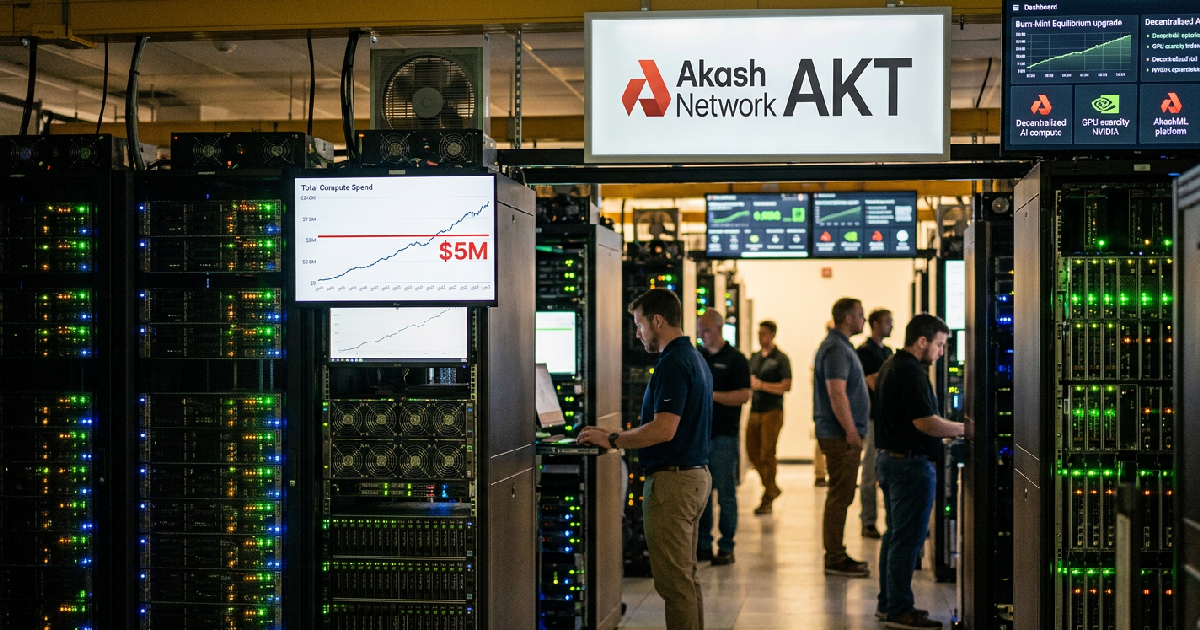

Akash Network (AKT) is trading at approximately $0.90 as of May 26, 2026, as the protocol leverages a surge in decentralized AI adoption and a major tokenomics overhaul to target the $1 valuation mark. The network recently hit a milestone by crossing $5 million in total compute spend during the first 90 days of 2026, supported by the activation of its Burn-Mint Equilibrium (BME) upgrade on March 23. This momentum reflects a broader industry trend where altcoin demand shifts toward new tokens that provide tangible utility in the high-growth artificial intelligence sector.
Price action for AKT has remained volatile in late May. On May 19, a showcase of new AI projects — including autonomous scam detectors and medical chart watchdogs — triggered a 10% intraday price jump. However, this followed a sharp 12% decline on May 17 that saw AKT’s trading volume fall to $9.93 million. These fluctuations occur as the asset remains 88.79% below its all-time high of $8.07, set in April 2021, with a current market capitalization of roughly $263.5 million.
The network’s growth is largely driven by its transition into a “Supercloud” platform for high-density compute. In 2025, Akash maintained a consistent 60% utilization rate for accelerated compute while deployments grew by 466% to more than 3.1 million. This growth came as traditional provider prices rose and NVIDIA H100 GPUs faced 6-12 month wait times, leading developers to seek decentralized alternatives like the AkashML platform launched in late 2025.
Burn-Mint Equilibrium and its impact on AKT tokenomics
The activation of Mainnet 17 on March 23, 2026, introduced the Burn-Mint Equilibrium (BME) mechanism, a fundamental shift designed to create deflationary pressure. Under this system, AKT tokens used for compute services are permanently destroyed, linking the token’s total supply directly to network usage. This move aims to strengthen the internal economy by reducing the circulating supply, which currently stands at 291,410,647 AKT, as demand for decentralized GPU hosting increases.
Financial metrics from the previous year signal that this model is operating against a backdrop of record activity. Daily fees on the network reached all-time highs of over $13,000, while the protocol successfully eliminated eight years of technical debt via Mainnet 14. These fundamental improvements helped secure Akash a spot on Grayscale’s list of high-potential assets for three consecutive quarters during the 2025-2026 period.
Despite these internal successes, external pressures remain a threat to the $1 price target. Large-scale crypto liquidations rise alongside treasury yields, often impacting mid-cap assets like Akash regardless of project-specific news. Investors are currently weighing these macro risks against the protocol’s growing role in AI inference, particularly as the network moves toward hosting Llama 3 70B models on its distributed infrastructure.
GPU scarcity drives decentralized cloud adoption
The global shortage of high-density hardware remains a primary catalyst for the Akash ecosystem. In early 2024, the network reported that 91% of its available A100 GPUs were fully utilized. To address continuing supply constraints, the organization is prioritizing “Akash at Home,” a project that utilizes spare computing power from residential environments to host sensitive AI workloads securely.
Future growth is also being anchored in the Managed Service Market (MSM), which seeks to redistribute value capture more fairly between service providers and the network. By implementing on-chain provider incentives, Akash intends to unlock network-effects-driven growth. This strategy follows successful 2024 pilots where demand for compute was found to increase linearly with available supply.
Ongoing technical migrations are further stabilizing the infrastructure. The migration to Cosmos SDK v0.53 and the implementation of JWT authentication for the Provider API were completed in late 2025 to improve onboarding for large-scale enterprise users. As other assets face hurdles, such as when Ondo Finance approaches critical support amid broader sell-side pressure, Akash is banking on its specialized hardware niche to maintain resilience.
Upcoming summits and the road beyond $0.90
The market is now focused on the Akash Accelerate ’24 summit, scheduled for May 28, 2026, in Austin, Texas. This event will bring together leaders in the decentralized AI sector and is expected to unveil new partnerships for hosting autonomous AI agents. Stronger institutional and developer interest at the summit could provide the liquidity necessary to push AKT past its current 24-hour high of $0.95.
Currently, trading activity is centered on the Kraken exchange, which handled over 29.8 million AKT in volume within the last 24 hours. While the path to $1 remains clear from a technical perspective, the protocol must navigate a competitive field where centralized giants like Amazon and Google are attempting to reclaim market share as hardware availability eventually normalizes. Success will likely depend on maintaining the 60% compute utilization rate that defined its 2025 performance.