
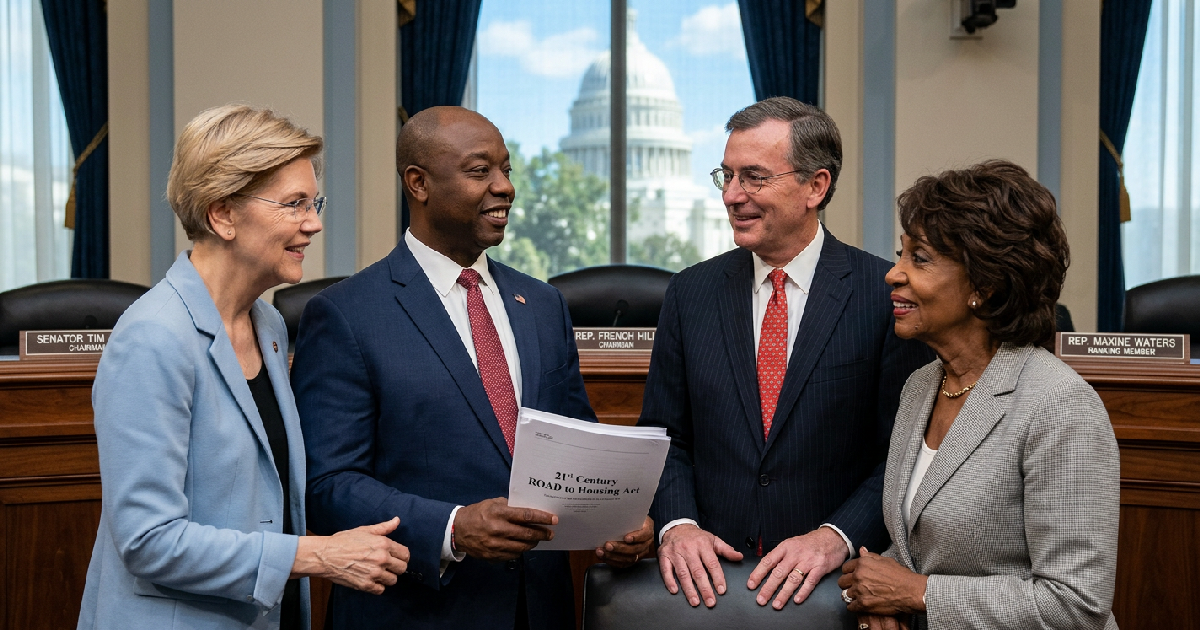

Congressional leaders reached a bicameral agreement on June 16, 2026, for the 21st Century ROAD to Housing Act, a sweeping piece of legislation that includes a temporary ban on the Federal Reserve issuing a central bank digital currency (CBDC) until December 31, 2030.
Senate Banking Chairman Tim Scott (R-SC) and Senate Banking Ranking Member Elizabeth Warren (D-MA), alongside House Financial Services Chair French Hill (R-AR) and House Financial Services Ranking Member Maxine Waters (D-CA), released the updated bill text on Tuesday to address national housing supply while restricting the central bank’s digital reach.
The legislation explicitly states that the Federal Reserve may not, directly or indirectly, issue or create a digital asset that is substantially similar to a central bank digital currency.
While the primary mission of the 21st Century ROAD to Housing Act is to boost housing affordability, the inclusion of the CBDC provision reflects years of bipartisan concern regarding government surveillance. This strategic move to attach the ban to a “must-pass” housing package makes the measure difficult to strip from the final bill.
To provide regulatory clarity for the private sector, the proposal includes a specific exemption for stablecoins. These digital assets are described as dollar-denominated currency that is open, permissionless, and private. This carveout ensures that the ban does not alter the privacy protections already afforded to U.S. coins and physical currency.
As government-backed digital initiatives stall, some players in the private sector continue to bridge the gap; for instance, Tether reveals $141 billion Treasury holdings, further embedding private stablecoins within the U.S. debt framework.
Housing provisions and deregulation in the 21st Century ROAD to Housing Act
Beyond digital finance, the bill targets the nationwide housing shortage through deregulation and supply expansion. It seeks to cut housing costs by easing federal rules and protecting local control over zoning and development.
One of the most significant measures is designed to limit large institutional investors from purchasing single-family properties to rent out, a trend that critics argue has priced many regular Americans out of the market.
The agreement also removes a controversial clause that previously required investors to dispose of post-construction rental properties within seven years. By eliminating this requirement, lawmakers hope to encourage more stable, long-term investment in the rental market.
Furthermore, the bill includes deregulation measures for banks to streamline the lending process and modernize federal housing assistance for veterans, seniors, and families. A new three-year sunset provision for a disaster relief program was also added to the updated text.
The housing package has already seen strong support in previous legislative phases. The Senate passed an earlier version on March 12, 2026, with an 89-10 vote, while the House passed its own amended version 396-13 on May 20.
This broad consensus suggests that the 21st Century ROAD to Housing Act will face little resistance as it moves toward final approval. This legislative stability contrasts with the volatility often seen in digital markets, where Bitcoin signals shifting market structure as traders look for long-term breakout potential.
Administrative stance and the executive order on CBDCs
The current legislative push aligns with the executive branch’s existing stance on digital currencies. U.S. President Donald Trump signed an executive order in January 2025 directing federal agencies to halt all work related to central bank digital currencies.
The order cited concerns regarding national sovereignty, financial stability, and individual privacy as the primary reasons for the suspension. This executive action effectively put the brakes on Fed research initiatives long before the current bill reached its final form.
U.S. Treasury Secretary Scott Bessent has reinforced this position, stating that CBDCs are “off the table” for the administration. Instead, the Treasury plans to focus on the CLARITY Act to provide a framework for private stablecoins.
This shift away from state-issued digital tokens has been welcomed by many in the cryptocurrency industry who feared a retail digital dollar would lead to unprecedented government visibility into private financial transactions. In fact, com/u-s-treasury-cbdc-rejection-scott-bessent-rejects-central-bank-digital/”>Scott Bessent rejects central bank digital currency as a tool of financial surveillance, preferring to let private innovation lead the way.
The CBDC language in the housing bill is also heavily influenced by Representative Tom Emmer’s Anti-CBDC Surveillance State Act. While that standalone legislation passed the House in 2025, it failed to advance in the Senate.
By merging the language into the 21st Century ROAD to Housing Act, proponents of the ban have found a more viable legislative vehicle to amend the Federal Reserve Act and establish the 2030 moratorium.
Procedural votes and the path to the president’s desk
The updated 21st Century ROAD to Housing Act is now heading for its first procedural vote in the Senate. The Senate Majority Leader has expressed confidence that the Senate will pass the bill during the week of June 16, 2026. Following that, the focus will shift back to the House of Representatives.
House Republican leaders have indicated they plan to bring the legislation to a final vote shortly after lawmakers return from their current break on June 23.
Once the House completes its vote, the bill is expected to be sent to the president for signature during the week of June 23, 2026. This timeline would see the temporary ban on a Federal Reserve-issued CBDC become law by the end of the month.
The ban would then remain in effect until the December 31, 2030, expiration date, giving the digital asset market nearly five years of clarity regarding the Federal Reserve’s role in the retail digital space.
While the ban halts the Fed’s direct involvement in digital currency issuance, it does not prevent the continued growth of private alternatives. Market participants will likely watch closely to see if the private sector can fill the void during the moratorium. For now, the combination of housing reform and digital currency restriction represents one of the most significant bipartisan legislative achievements of the current session.