
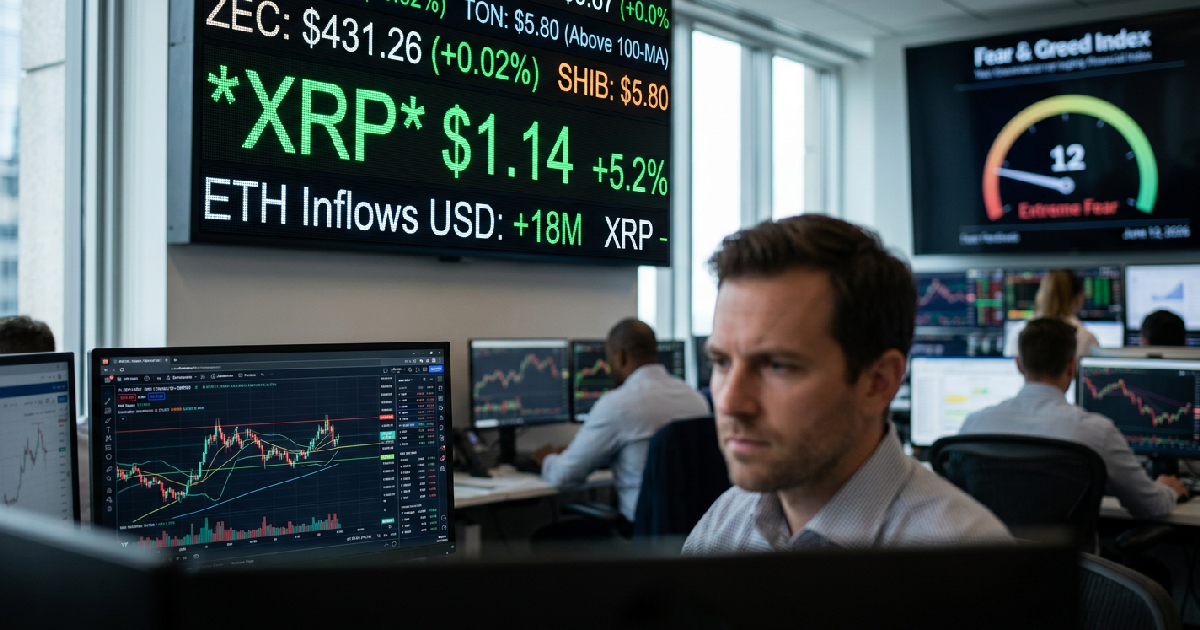

Major digital assets XRP, Zcash (ZEC), Toncoin (TON), and Shiba Inu (SHIB) are navigating a complex recovery phase as of June 13, 2026. While Zcash has demonstrated recent stability with a fractional 0.02% gain over the last 24 hours to reach $431.26, XRP remains technically suppressed near $1.14.
The broader market sentiment is currently characterized by “extreme fear,” with the Fear & Greed Index lingering at a low of 12, according to data from various exchanges.
The divergent paths of these assets highlight a fragmented market structure. XRP search trends have fallen to a value of 24, indicating a cooling of retail interest. However, institutional demand remains visible through XRP exchange-traded products (ETPs), which pulled in $18 million in net inflows this week.
This institutional support provides a crucial baseline as the asset attempts to recover from a significant breakdown below its multi-month support floor of $1.30.
Professional traders are currently focusing on the 200-day moving average, which for XRP sits far above current prices at $1.5898. Why Bitcoin traders care about the 200-day moving average is a sentiment often mirrored in the altcoin market; until an asset reclaims this level, long-term trends are generally viewed as bearish.
For XRP, the gap between the spot price and this long-term indicator underscores the technical damage sustained during recent selloffs.
ZEC shows resilience after market panic
Zcash (ZEC) is currently proving more resilient than many of its peers, trading at $431.26 and outperforming the global market with a 7.10% increase over the last seven days. This stability comes after a period of intense volatility where a discovered bug allowed for unauthorized ZEC generation.
The news triggered aggressive selling and a surge in liquidations, yet buyers stepped in quickly to stabilize the asset above its 200-day moving average of $370.
Market capitalization for ZEC has reached approximately $6.99 billion, ranking it #15 on CoinGecko. Despite a 37% bearish sentiment reported by some analysts, ZEC’s volume rose slightly to $497.8 million in the last 24 hours. The asset is currently consolidating between resistance levels at $450-$500 and support at $400. com/bitcoin-signals-market-structure-analysis-2026/”>Bitcoin signals and market structure analysis suggest that maintaining these levels is vital for confirming a long-term bottom for the privacy-focused coin.
XRP technical indicators point to potential bounce
Technical patterns on the XRP four-hour chart show a potential double bottom formation, often referred to as a “W” pattern. If confirmed, this could lead to a short-term recovery, with XRP first needing to clear the immediate $1.18 resistance level. AI models are currently projecting high probabilities for a move toward $1.
44, though the asset remains an underperformer in the current cycle compared to recent historical highs.
On the downside, fails to maintain the $1.13 support zone could lead to a test of the psychological $1.00 level. Traders are also monitoring the Ripple-SEC dispute resolution, which has helped keep spot prices above the $0.70 floor seen in earlier predictions. com/xrp-market-dominance-analyst-prediction-31-percent-path/”>XRP market dominance path predictions continue to be a focal point for investors assessing whether the asset can regain its previous market share amid shifting capital flows into Shiba Inu and other high-beta tokens.
Toncoin looks for guidance as volatility subsides
Toncoin (TON) has entered a period of relative calm following the explosive price action seen in May. Sellers regained control after the rally above $2.80, pushing the price into a correction that has now stabilized near the 100-day moving average at $1.68.
The Relative Strength Index (RSI) for TON is currently near the middle of its range, indicating a neutral momentum as the market waits for a definitive catalyst or guidance.
The resistance zone between $1.80 and $1.85 remains the primary hurdle for TON bulls. A successful breakout above this cluster could open the path toward the psychologically important $2.00 mark. Conversely, should the $1.68 support fail, a retest of the $1.50 lows is probable.
Volume has decreased significantly since the May peak, suggesting that the panic-selling phase may be concluding even if a clear uptrend has not yet emerged.