
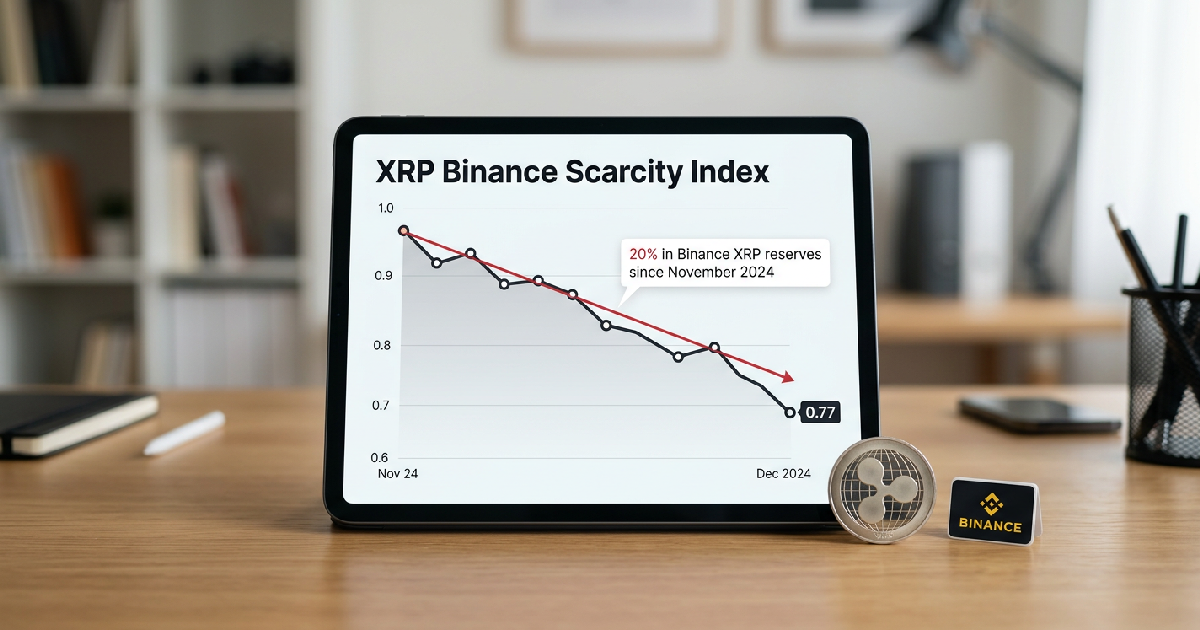

The XRP Binance scarcity index hit a two-year high of 0.77 this week, indicating a significant decrease in XRP’s available supply on Binance. 77 this week, signaling a sharp reduction in the available supply of Ripple’s native token on the world’s largest cryptocurrency exchange.
According to reports updated on July 6, 2026, the index climb aligns with a steady reduction in Binance XRP reserves, which have fallen by approximately 20% since November 2024. This supply shift occurs while XRP trades near the $1.13 mark, suggesting that sell-side pressure is dissipating as holders increasingly move assets off the platform.
Binance XRP reserves decline by 20 percent since 2024
Analysts identify the high index reading as a sign of long-term accumulation and a structural change in the supply balance on Binance. A rising scarcity index typically indicates that fewer coins are available for immediate sale, which can mitigate downward price pressure.
This trend is driven by a drop-off in both retail and institutional deposit activity on the exchange, coupled with a steady stream of user withdrawals into long-term private wallets or institutional custody solutions.
Exchange data confirms a significant withdrawal trend that has seen roughly 650 million XRP leave Binance over the last 20 months. In November 2024, the exchange held approximately 3.27 billion XRP; current reserves have since drifted to near 2.6 billion. This contraction in Bitcoin exchange supply maintains multi-year lows and similar patterns in altcoins suggest a broader investor shift toward self-custody or long-term storage options.
CryptoQuant analyst ArabxChain noted that the current data reflects a “structural shift in the supply balance,” making the asset scarcer on the platform than in previous months. Historically, the index has shown extreme volatility; in December 2024, it collapsed as holders flooded Binance with deposits to take profits during a rally toward $3.
The current reading of 0.77 stands in stark contrast to late June 2026, when the index fell to approximately 0.34, its lowest level in over three months.
Market positioning around the one-dollar floor
While spot supply has tightened, the derivatives market has recently faced a crowded bearish trade. Funding data shows that short sellers were “squeezed” as the price approached the $1 bottom in late June.
At that time, aggressive negative funding clusters appeared as shorts paid to maintain their positions against a market that was hitting multi-year holder pain levels. This XRP speculative activity around the psychological $1 floor eventually forced a rebound to the current $1.13 level.
Despite the bounce, market participants remain cautious. Trading volume has declined throughout the recent recovery, a signal that spot buyers have not fully embraced the move. However, interest appears to be shifting toward other venues and products.
XRP volume recently topped Bitcoin on the South Korean exchange Upbit, and seasonal strength is frequently cited as a potential tailwind for the asset during the second week of July.
Technical resistance at one dollar twenty cents remains key hurdle
The recovery from the $1.00–$1.04 support zone now faces its next major test at the $1.20 resistance. This level is viewed by analysts as a critical inflection point. Macro analyst SUNCOAST observed that XRP has spent months trading inside a “falling wedge,” a technical pattern often associated with bullish reversals once a breakout occurs.
If the price successfully tests $1.20, it would mark the first meaningful break above mid-June highs.
The tightening supply on Binance provides bulls with leverage above the current floor. However, the lack of substantial spot volume remains a vulnerability. If the $1.20 level holds as resistance, the asset could retest lower liquidity levels. Conversely, the market is currently supported by Bitcoin price analysis assessing resistance and general market stability, providing some breathing room for altcoins to consolidate their recent gains.
Broader context of supply and holder behavior
The long-term outlook for XRP is increasingly defined by these supply-side mechanics. Unlike the profit-taking frenzy of late 2024, current holder behavior suggests a reluctance to sell at current valuations.
The steady reduction from 3.27 billion to 2.6 billion XRP in Binance reserves illustrates a market that is slowly becoming less liquid on the sell side. While scarcity alone does not guarantee a price surge, it creates a environment where lower demand can achieve higher price impacts.
Should XRP fall back below the $1.00 mark, analysts warn the current recovery structure would be invalidated. For now, the combination of a two-year high in scarcity and the clearing of aggressive short positions has provided the asset with its strongest technical footing since the rallies seen in 2025.
Investors are now watching to see if the shrinking inventory on Binance translates into a sustained break of the $1.20 barrier.