
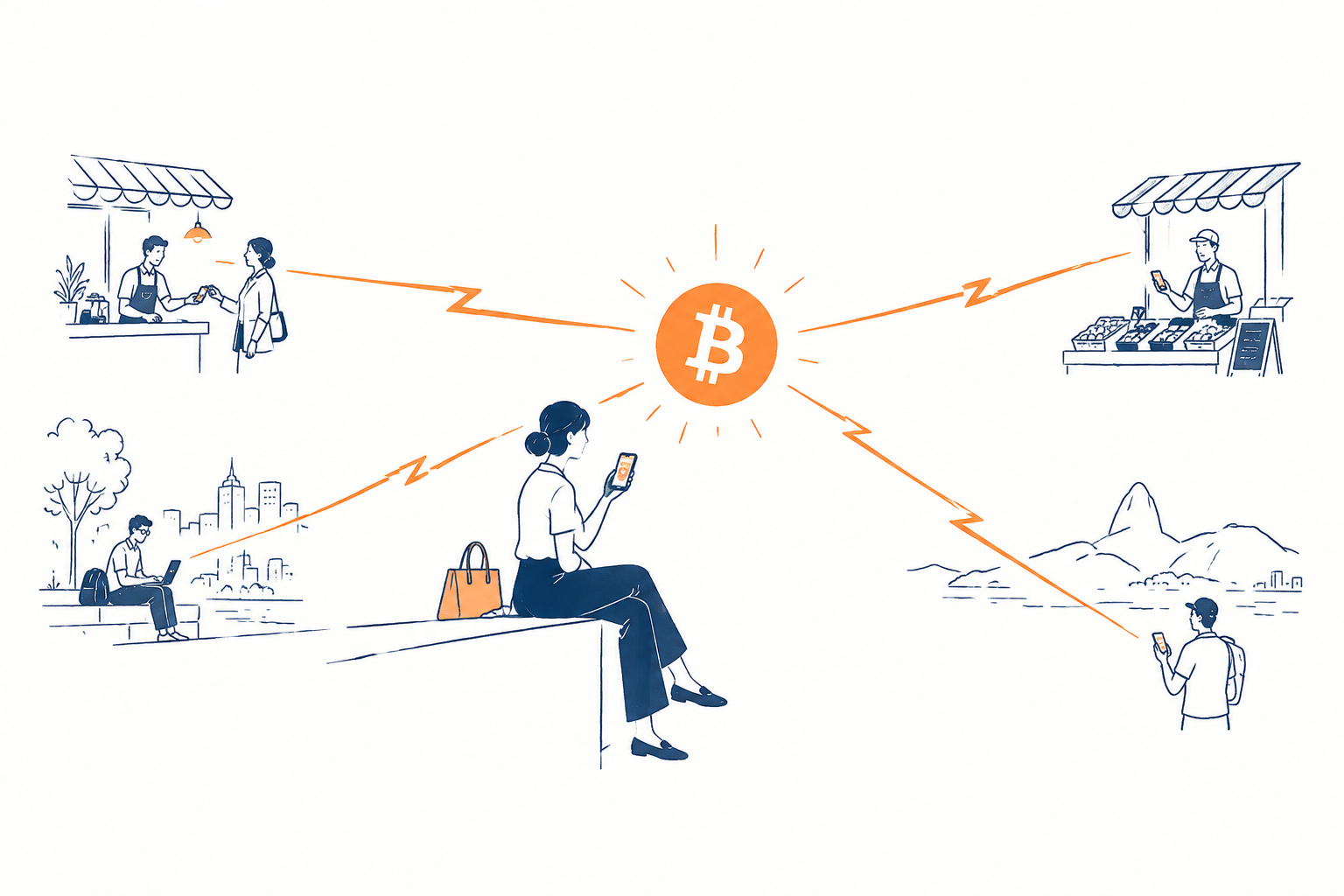

A Bitcoin payment can take place without becoming a new entry on the Bitcoin blockchain every time.
That distinction is the key to understanding the Lightning Network.
The Bitcoin network is designed to provide a secure, decentralised record of ownership and transactions. But asking the base layer to handle every small payment individually creates an obvious constraint: blocks have limited space, and every transaction competes for it.
The Lightning Network takes a different approach. Instead of replacing Bitcoin’s blockchain, it moves much of the activity somewhere else.
The result is a second layer designed for frequent payments, while the main blockchain remains the place where funds can ultimately be secured and settled.
The Lightning Network changes where payments happen
The Lightning Network is a Layer 2 built on top of Bitcoin. Its purpose is to allow multiple payments to take place without requiring each one to be recorded directly on the blockchain.
The basic mechanism is a payment channel.
Two participants can open a channel by committing Bitcoin to it through an on-chain transaction. Once the channel exists, they can exchange payments and update their respective balances without publishing a new Bitcoin transaction each time.
Imagine two people who regularly make small payments to one another over the course of a week. Recording every transfer independently on Bitcoin would use blockchain space for each one.
With a Lightning channel, the intermediate payments can remain off-chain. What ultimately matters to Bitcoin is the final state when the channel is closed or otherwise settled.
That changes the role of the blockchain. It does not become faster. It simply does less work for each individual payment.
This is the central idea behind the network: use Bitcoin’s base layer for settlement, and another layer for payment activity that does not need to be recorded there immediately.
Payment channels turn one settlement into many payments
A channel is effectively a shared financial state that its participants can update according to the rules of the protocol.
When a channel is opened, the Bitcoin blockchain records the funds committed to it. After that, the participants can transact between themselves by creating updated states that reflect who should control how much of the channel’s balance.
The blockchain does not need to see every change.
This is why the Lightning Network can support a large number of payments without consuming the same amount of blockchain capacity that those payments would require individually on-chain.
There is still a cost to interacting with Bitcoin’s base layer, however. Opening and closing channels involves on-chain transactions, which means normal Bitcoin fees can still matter.
The Lightning Network is therefore not “Bitcoin without the blockchain”. It is better understood as a way of reducing how often the blockchain needs to be involved.
A Lightning payment does not need a direct connection
A network made entirely of direct channels would quickly become impractical.
If every person needed a separate channel with every merchant, friend or service they might ever pay, the infrastructure would become cumbersome. Lightning avoids that by allowing payments to travel through existing channels.
Suppose Alice has a channel with Bob, while Bob has another channel with a shop. Alice can potentially pay the shop by routing the transaction through Bob, without opening her own direct channel with the merchant.
This is where Lightning becomes a network rather than simply a collection of private payment agreements.
The protocol uses cryptographic conditions to make this routing possible. One important mechanism is the Hashed Timelock Contract, or HTLC, which can make a payment conditional on the correct secret being revealed within a specified time.
The important point for a user is simpler: participants can help route payments without needing to establish personal trust relationships with everyone else in the path.
From the outside, the transaction may look like a straightforward Bitcoin payment. Underneath, it can involve multiple channels, routing decisions and liquidity constraints.
And that last point matters more than it first appears.
Lightning can be fast, but Bitcoin liquidity still has to move
Owning Bitcoin does not automatically mean being able to send or receive a Lightning payment whenever you want.
The network depends on liquidity — Bitcoin that is positioned in channels in a way that allows payments to move through them.
That means the experience depends partly on the structure of the network.
A route may exist but lack enough usable liquidity for a particular payment. Another route may be available but involve additional costs or less efficient connections. The user does not necessarily see any of this complexity directly, especially when a wallet handles routing automatically, but the infrastructure still has to solve the problem.
This is one of the most important differences between Lightning and a conventional wallet transaction on Bitcoin.
On the base layer, the blockchain itself is the mechanism used to settle the payment.
On Lightning, the payment depends on a functioning network of channels that can carry the value where it needs to go.
That is the trade-off created by moving activity away from the blockchain.
Why moving payments off-chain can reduce costs and improve the user experience
If every small payment needed its own on-chain transaction, users would repeatedly compete for limited block space.
Lightning changes that economics by allowing multiple payments to occur between settlements. That makes the architecture particularly relevant to smaller, more frequent transactions, where making a separate blockchain transaction each time may be inefficient.
The network can also offer privacy advantages in some situations because payments taking place within channels are not individually written into Bitcoin’s public blockchain.
That should not be confused with complete anonymity.
The Lightning Network introduces a different transaction environment, with its own information that may potentially be observed or analysed. Privacy is improved in certain respects, but the system does not make participants invisible by default.
The same distinction applies to fees. Lightning can make repeated small payments more efficient, but it does not eliminate fees altogether. Channel management and routing still involve costs, while moving funds between Lightning and the Bitcoin base layer can require on-chain transactions.
The technology is not removing economic constraints so much as moving where they are handled.
Does the Lightning Network create a new centralisation risk?
This is where the architecture becomes more interesting than the simple claim that Lightning is “faster Bitcoin”.
A network built around channels depends on participants being sufficiently connected and funded to route payments. That can give well-connected nodes, particularly those with significant liquidity, a more important role in the payment flow.
That does not automatically make Lightning centralised.
Bitcoin itself is already a network in which some participants have more influence, resources or connectivity than others. The more relevant question is whether the payment infrastructure becomes so concentrated that a relatively small number of nodes control a disproportionate share of routing activity.
In other words, decentralisation is not only about how many nodes exist.
It can also involve where liquidity sits, how payments are routed and how dependent users become on particular pieces of infrastructure.
This creates a subtle trade-off. The more efficiently Lightning can move payments through well-connected channels, the more valuable those connections may become.
A network optimised purely for efficiency could therefore end up looking different from one optimised purely for broad participation.
There are operational risks as well. A channel can face liquidity constraints, software can fail, routing can break down and a service provider can become unavailable even while the underlying Bitcoin blockchain continues operating normally.
Lightning adds another layer of infrastructure — and therefore another layer that needs to work.
The Lightning Network’s real job is not to replace Bitcoin
The most useful way to think about the Lightning Network is not as a faster version of Bitcoin, but as a different layer with a different job.
Bitcoin’s blockchain is designed for final settlement and a highly secure public record. Lightning is designed to handle payment activity that benefits from being faster and more frequent without requiring every intermediate movement to consume blockchain space.
That division of labour is what makes the architecture compelling.
But it also explains why the Lightning Network comes with problems of its own. Once payments move off-chain, the network must deal with channels, liquidity, routing and infrastructure that do not exist in quite the same form in a direct Bitcoin transaction.
So the central question is not whether Lightning “solves Bitcoin’s scaling problem” in the abstract.
It is whether Bitcoin really needs every payment to be settled on the same layer.
For a blockchain whose greatest strength is secure settlement, making the base layer responsible for every cup of coffee, recurring payment or small transfer may be an unnecessarily expensive use of that infrastructure.
The Lightning Network’s answer is to separate those functions.
Bitcoin remains the settlement layer. Lightning becomes the payment layer sitting above it.
The long-term test is whether that separation can deliver a smoother payment experience while keeping liquidity broad enough, routing resilient enough and infrastructure decentralised enough that the extra layer does not simply replace one bottleneck with another.