
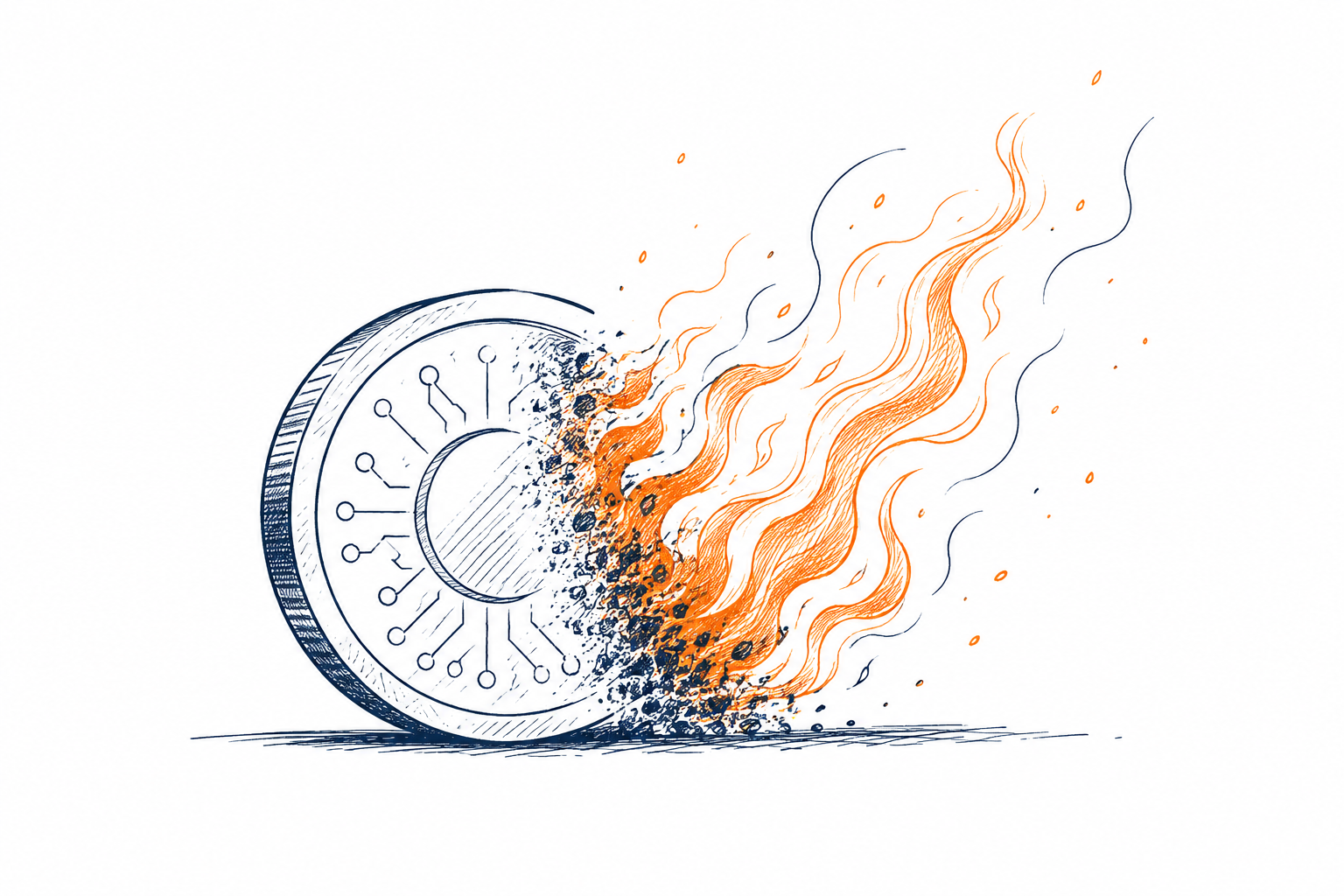

A cryptocurrency can disappear from circulation without disappearing from the blockchain. That is the basic idea behind crypto burning: tokens are permanently removed from use, usually by sending them to an address that no one can control or by building the destruction directly into a network’s rules.
The appeal is easy to understand. If there are fewer tokens available, shouldn’t each remaining token become more valuable?
Not necessarily.
A burn changes the supply side of a market, but it does not create demand for the asset. That distinction is the key to understanding why some token burns matter economically while others barely change the picture.
Why a crypto burn changes supply without deleting the blockchain record
The simplest form of token burning involves sending coins to an address for which nobody has the private key needed to move the funds again. The blockchain still records the transaction and the balance, but those assets are effectively unusable.
The important point is that the blockchain does not erase the burned tokens. It preserves the history of what happened. What changes is the amount that remains available to be transferred, spent or traded.
Other systems do not rely on a burn address at all. The destruction can be part of the protocol itself. In those cases, burning is not an occasional decision by a project team; it is a rule applied whenever certain network conditions are met.
That distinction matters because “burn” describes the outcome, not one universal mechanism.
Not every token burn exists to support the price
This is where crypto burning is often oversimplified. A project can burn tokens for reasons that have little to do with trying to make the asset more expensive.
Ethereum is a useful example. Its protocol burns the base fee paid in transactions. In simple terms, part of the fee is permanently removed from circulation whenever a transaction is included in a block. The amount burned therefore depends on network activity and the fee mechanism, rather than on a company deciding that it is time for a token buyback. Ethereum’s documentation describes the base fee as being burned and notes that, when demand is high, the network can burn more ether than it issues through rewards.
The XRP Ledger uses burning for a different reason. Every validated transaction destroys a small amount of XRP as a transaction cost. The purpose is mainly defensive: making it expensive to flood the network with spam or denial-of-service traffic. The minimum standard transaction cost is 0.00001 XRP, and the amount can rise when the network is under heavier load. The fee is not paid to a validator or another party; it is destroyed.
BNB provides a third model. Its ecosystem combines a scheduled Auto-Burn, designed to reduce BNB’s supply over time, with a real-time mechanism that burns part of gas fees. The Auto-Burn is formula-driven, while the gas-fee mechanism links part of the burn directly to network activity.
The three cases look similar on the surface because units are destroyed in all of them. Economically, however, they are doing different jobs.
This is why comparing burn figures without understanding the mechanism can be misleading.
Does burning cryptocurrency actually increase its price?
Only if the change in supply matters relative to demand.
Imagine a token with one billion units in circulation. A project removes 100 million, leaving 900 million. The supply has fallen by 10%. That is a real change in the asset’s structure, but it does not mathematically require the market price to rise.
For that to happen, buyers still need a reason to want the remaining tokens.
If demand stays stable while supply falls, the reduction can become economically meaningful. But if users lose interest in the project, trading activity dries up or demand falls by even more, the burn may have little positive effect on price.
That is why “less supply” and “higher price” should never be treated as interchangeable statements.
A token burn can also happen alongside continued issuance. Ethereum illustrates this particularly well: ether is burned through transaction fees, but ETH is also issued through the network’s reward system. The resulting supply can move in different directions depending on how much is issued and how much is burned.
The number burned is not the number that matters most
Crypto headlines often focus on the absolute number of tokens destroyed because large figures are easy to market. But the more useful question is how much of the economically relevant supply was actually removed.
Consider four things.
First, look at the percentage, not just the raw number. Burning 10 million tokens means very different things for a token with 50 million units than for one with 50 billion.
Second, ask whether the tokens were actually circulating. Removing tokens that were already locked, reserved or otherwise unavailable to the market is not the same as taking actively traded supply out of circulation.
Third, check whether new tokens continue to enter the market. A large burn can be partly offset by ongoing issuance, emissions or unlocks.
Finally, look at why the burn happens. A recurring network rule, such as Ethereum’s base-fee burn, has a different economic meaning from a one-off announcement made by a project hoping to attract attention.
The headline may say “millions of tokens burned”. The useful analysis starts with what changed underneath that headline.
Why token scarcity is not the same as token value
Burning is often described through the idea of scarcity. Remove units and the remaining supply becomes scarcer.
That part is true. The mistake is assuming scarcity creates value on its own.
Value also depends on what people can do with the asset and whether they want to hold or use it. A token can become progressively scarcer while its ecosystem loses users, liquidity and relevance. In that situation, the supply curve may be moving in one direction while demand moves in the other.
This is the central paradox of crypto burning: a protocol can make an asset harder to come by without making anyone more interested in owning it.
That does not make burns pointless. It means their importance depends on context.
A burn can be structurally significant when it is large relative to supply, linked to genuine network usage, or part of a clear and durable monetary design. It can also be mostly cosmetic when the amount removed is tiny, the tokens were not meaningfully circulating, or the project continues to issue new units at a faster pace.
How to read a token-burn announcement without getting distracted by the headline
The most useful way to assess a burn is to treat it as an economic change, not as a signal by itself.
Ask what was destroyed, where those tokens came from, how much of the circulating supply that represents, whether new tokens are still being issued and what mechanism caused the burn.
Then ask the harder question: has anything changed on the demand side?
If the answer is no, the burn may have made the asset scarcer without changing its underlying appeal.
That is why Ethereum, XRP and BNB are useful examples. They show that the same word can describe very different systems: one tied to transaction fees and network activity, one designed primarily as an anti-spam measure, and one built around a deliberate supply-reduction policy.
The practical takeaway is simple. When a project announces a token burn, do not stop at the number burned. The better question is what changed in the relationship between supply, demand and the way the network actually works.
A burn can remove tokens. It cannot, by itself, manufacture a reason for the market to want the ones left behind.