
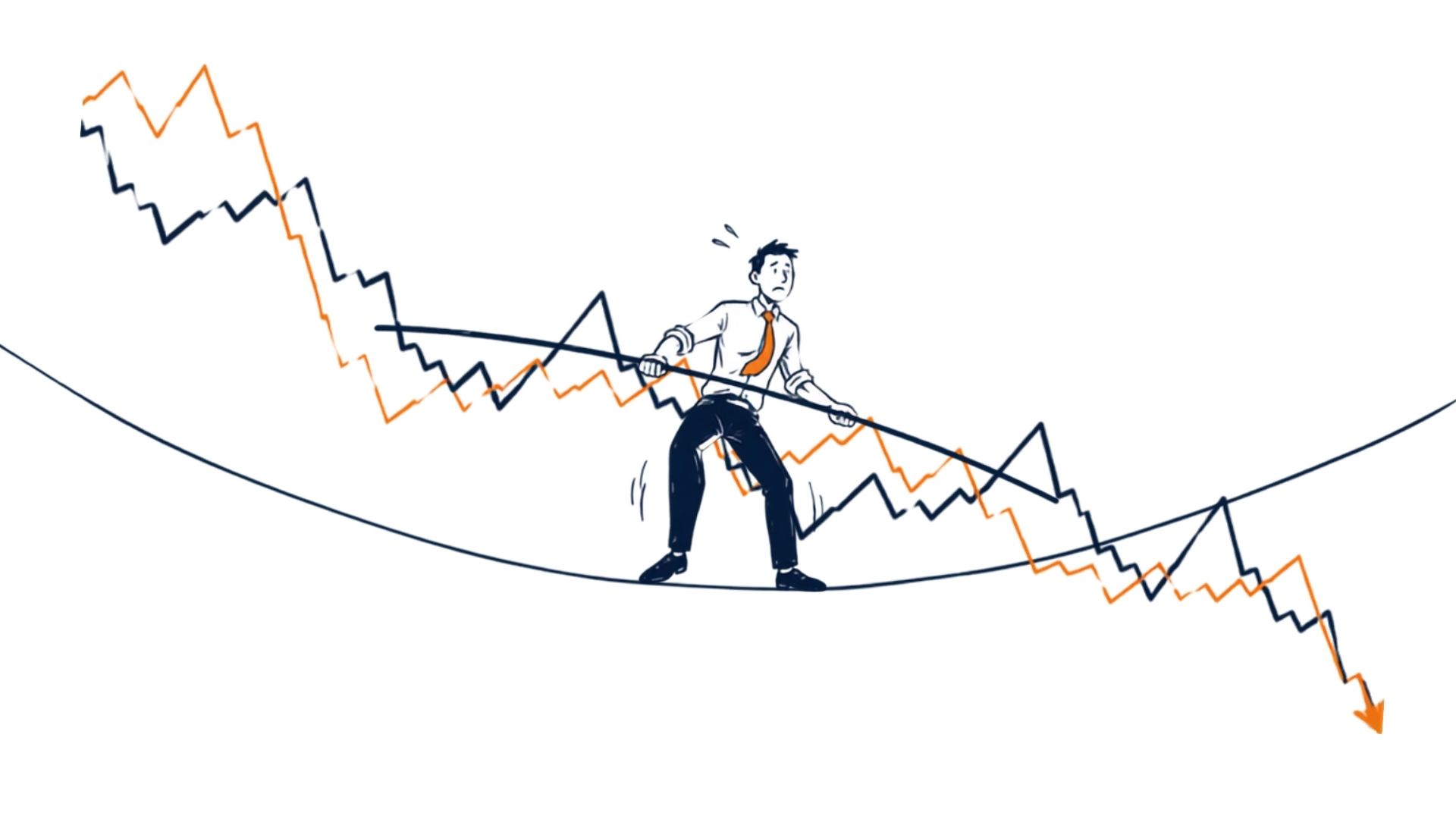

A leveraged position can look perfectly manageable right up until the moment the exchange signals that the collateral supporting it is no longer sufficient.
That warning is a margin call. It does not necessarily mean the position has already been closed. Instead, it signals that losses have eaten into the financial buffer supporting the trade, leaving less room for the market to move in the wrong direction.
That distinction matters because margin calls and liquidation are often treated as if they were the same thing. They are not. A margin call is part of the process that can eventually lead to forced closure.
The real risk of leverage is not simply that losses become larger. It is that the room available to absorb those losses becomes smaller.
What is a margin call in crypto?
A margin call happens when the equity supporting a leveraged position falls towards, or below, the level required by the trading platform to keep that position open.
To understand why, two types of margin matter.
Initial margin is the amount of capital required to open the position. Maintenance margin is the minimum amount of equity that must remain available for the position to stay open.
The difference between those figures is part of what gives a leveraged trade its breathing room.
Imagine a trader opens a US$10,000 position using US$1,000 of their own capital and 10x leverage. The trader is controlling an exposure ten times larger than the amount initially posted as margin.
If the asset moves against the position, the loss is measured against the US$10,000 exposure, not merely against the US$1,000 initially committed.
That is where leverage changes the equation. A relatively modest move in the underlying asset can represent a much larger percentage change in the capital supporting the trade.
As losses accumulate, the account moves closer to its maintenance margin requirement. A margin call is essentially a signal that the buffer is becoming too thin.
Why does leverage make a margin call happen faster?
Leverage does not change the direction of the market. It changes how much of the trader’s capital is exposed to that movement.
Suppose an unleveraged position falls by 5%. Before fees and other costs, the loss is roughly 5% of the capital invested.
With 10x leverage, a 5% move against the position can represent a loss equivalent to around half of the initial margin.
That does not mean every 10x position will automatically be liquidated after a 5% move. The exact threshold depends on the platform, maintenance margin requirements, fees and the way the position is structured.
The important point is simpler: higher leverage leaves less room for an adverse move before the position becomes vulnerable to liquidation.
This is why looking only at the entry price can be misleading. Two traders can enter the same asset at the same price, yet have completely different levels of risk depending on their position size and margin.
The leverage ratio tells only part of the story. The more useful question is how much adverse price movement the position can absorb before its collateral becomes insufficient.
Is a margin call the same as liquidation?
No.
A margin call is a warning or trigger point associated with insufficient margin. Liquidation is the forced closing of the position when the platform’s requirements are no longer met.
The distinction is easier to see as a sequence.
A trader opens a leveraged position. The market moves against it. Losses reduce the equity supporting the trade. The position approaches its maintenance margin requirement. A margin call may then require the trader to add collateral or reduce exposure, depending on the platform’s rules.
If the position continues moving against the trader and the required margin is no longer maintained, the exchange can liquidate it automatically.
That final step exists to prevent the position from accumulating losses beyond the collateral available to support it.
There is an important practical detail here: not every platform handles margin calls in exactly the same way. Some systems may liquidate positions quickly once specific thresholds are reached, while others can provide different mechanisms for managing margin.
For that reason, the rules of the exchange or derivatives platform matter as much as the basic concept.
Where does the liquidation price fit in?
The liquidation price is the estimated price at which a leveraged position becomes unsustainable under the platform’s margin rules.
For a long position, the danger comes from the asset falling. For a short position, the danger comes from it rising.
The higher the leverage, the closer the liquidation level tends to be to the entry price, all else being equal.
But it would be a mistake to treat a liquidation price as a universal number that can be calculated from leverage alone.
The actual level can be affected by the size of the position, maintenance margin requirements, account equity and costs associated with the trade. Some platforms can also update the displayed liquidation price when the account balance or margin changes.
This is why the liquidation price shown by an exchange is more useful than a generic rule such as “10x leverage means a 10% move causes liquidation”.
There is no single formula that applies identically across every crypto trading platform.
Does isolated or cross margin change the risk?
It can change which capital is exposed when a position starts losing money.
With isolated margin, a specific amount of collateral is assigned to the position. The risk is therefore more contained within that allocation.
With cross margin, eligible funds elsewhere in the account can potentially be used to support the position.
That can give a losing trade more room before liquidation, but it also changes the scale of the risk. A position that might have consumed only its allocated collateral under isolated margin can, under cross margin rules, draw on a broader pool of capital.
This creates an important distinction between having more room before liquidation and having less risk overall. They are not necessarily the same thing.
For a beginner, that is arguably more useful to understand than memorising which margin mode is “safer”. The answer depends on how much of the account can ultimately be exposed to the position.
What happens when several positions receive margin calls?
A margin call usually begins as an individual account problem. In a highly leveraged market, however, many such positions can reach critical levels at roughly the same time.
Imagine a sharp decline in an asset with a large number of leveraged long positions. As prices fall, the most vulnerable trades approach liquidation first. Forced closures can create additional selling pressure, pushing prices lower and bringing other leveraged positions closer to their own thresholds.
The result can be a cascade of liquidations.
The same mechanism works in reverse when a market rises and heavily leveraged short positions are forced to close. Those liquidations can generate buying pressure and accelerate the move.
This does not mean that every dramatic crypto move is caused by leverage. Market news, spot demand, liquidity and other factors can all drive prices.
But leverage can amplify an existing move by forcing positions to be closed at precisely the moment the market is already under pressure.
That is the wider significance of margin calls: what looks like a risk contained inside one trading account can, when repeated across thousands of positions, become part of the market’s price dynamics.
The important risk appears before the margin call
The easiest way to misunderstand a margin call is to think of it as the moment when the real damage begins.
In reality, the important decision was made earlier, when the size of the position was determined relative to the available collateral.
The margin call simply makes the shrinking safety buffer visible.
That is why the most useful numbers to examine before opening a leveraged trade are not just the potential profit or the entry price. Position size, maintenance margin and liquidation price all help answer the more practical question: how far can the market move against this position before the structure stops being sustainable?
Leverage can make a relatively small market move feel enormous because the trade is being carried by a much smaller amount of actual capital.
A margin call is therefore less a sudden event than the final warning in a process that has been developing since the position was opened. By the time the alert appears, the market has already consumed much of the room that leverage created — and there may be very little left to absorb another move in the wrong direction.