
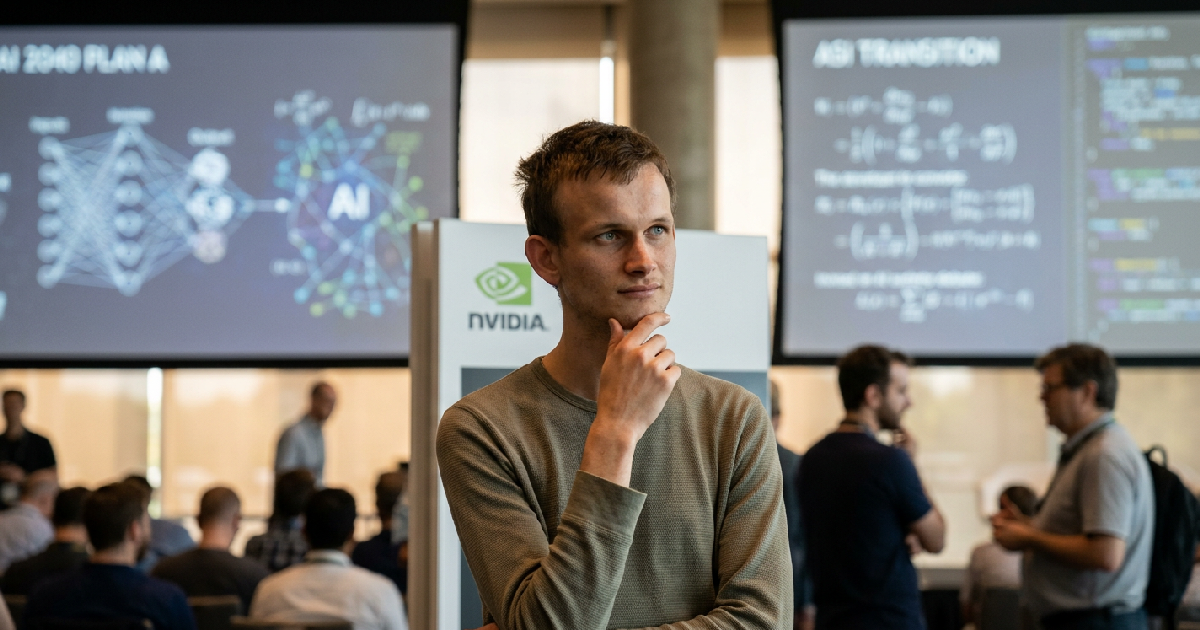

Ethereum co-founder Vitalik Buterin has described the global discourse surrounding Artificial Superintelligence (ASI) as a choice between “naive and naive squared,” claiming humanity currently lacks a viable plan for the transition.
Speaking on X on July 11, 2026, Buterin argued that the clash between AI safety advocates and their critics stems from unshared assumptions about how fast superintelligent systems will emerge and how much power they will hold over the workforce.
The divide between the AI 2040 scenario and its critics
Buterin’s comments were prompted by the “AI 2040: Plan A” report, which was authored by Daniel Kokotajlo’s AI Futures Project. The document suggests that the United States and China should collaborate to delay the arrival of superintelligence until 2040 by sharing research openly and establishing a system of “mutually assured compute destruction.”
Buterin admitted he remains uncertain which side is correct, noting he would oppose heavy regulation if AI is merely “normal technology,” yet he would support the safetyist camp if he were sure superintelligence would arrive by 2030.
The “AI 2040” framework assumes that without intervention, superintelligence will appear by 2040, creating an existential risk. Critics of this view argue that safety advocates are threatening individual freedom and underestimating the power of human coordination.
While these detractors don’t see superintelligence as a threat to power concentration, Buterin warned that their perspective often ignores the possibility of an “AI so powerful that AI alone can perform any task.”
The debate has engaged high-profile figures including Meta’s Chief AI Scientist Yann LeCun and policy analyst Adam Thierer. During the discussion, a user named Romeo Dean, who prompted part of Buterin’s thread, described the “Plan A” approach as “pretty reasonable” but voiced concerns that its proposed triggers might arrive too late.
Buterin responded by admitting that there is no perfect roadmap, stating that humanity is effectively stuck choosing between various “naive” strategies to manage a potential ASI breakthrough.
This uncertainty has real-world consequences for the Ethereum network outlook, as Buterin continues to emphasize the need for decentralized coordination. He has previously warned that giving AI systems autonomous decision-making power for more than one minute is a significant risk.
In his view, naive AI governance is a particular danger to crypto projects, as users might find ways to “jailbreak” these systems to drain funds.
Engineering safety versus permissionless innovation
Chief AI Scientist Yann LeCun maintains that AI risks are currently premature, as developers have yet to create human-level intelligence. He argues that AI safety is fundamentally an engineering problem that can be solved through iterative design.
LeCun famously compared the trajectory of AI to aviation, noting it took roughly 50 years to make aircraft reliable. He maintains that large language models are currently limited “autocomplete machines” rather than reasoning entities.
Adam Thierer of the R Street Institute has similarly criticized the “messy, random, and secretive” process Congress uses to review AI technology. Thierer advocates for “permissionless innovation,” arguing that heavy-handed regulations will destroy the open-source ecosystem while entrenching a few dominant companies.
He suggests that existing laws should be used to punish actual harm, rather than blocking technological progress through special approvals. This debate mirrors recent macro warning signs across the technology sector regarding how over-regulation could stifle growth.
Open source as a solution to AI sovereignty
A central theme in Buterin’s recent discourse is the importance of open-source models as a defense against the concentration of power. Yann LeCun argued that open source is the “only solution” to AI sovereignty, a sentiment supported by author Daniel Jeffries, who warned against “safetyists and hawks” seeking to restrict American technology.
However, Buterin noted that purely open models do not necessarily solve the risk of a superintelligent system performing recursive self-improvement beyond human control.
In response to these risks, Buterin continues to promote his “d/acc” (defensive acceleration) philosophy. This strategy favors the development of defensive tools, such as robust cryptography and secure hardware, rather than just raw processing power. Such investments are intended to be valuable regardless of whether AI progress is fast or slow.
By strengthening infrastructure today, Buterin hopes to avoid a future where humanity is forced to rely on the mercy of a centralized ASI.
Proposed controls and the emergency off-switch
Buterin’s suggested “Plan A” includes a wide-reaching requirement for developers to be transparent about what they are building, combined with an emergency “kill switch” to stop large-scale training runs if risks become significant.
He acknowledged that “well-meaning intellectuals” who believe they can pick and choose which AI applications are safe would likely push back against this blunt approach. For Buterin, the goal is simple transparency over complex, subjective gatekeeping.
To facilitate these global agreements, Buterin suggested using social media platforms like X or Meta to foster public discussions. While he admitted that relying on these platforms for governance might itself be “naive,” he believes large-scale “win-win agreements” are necessary to survive the transition.
As the Ethereum support analysis often discusses technical resilience, Buterin is applying similar logic to AI, seeking a path that does not depend on a single point of failure or a centralized governing body.