
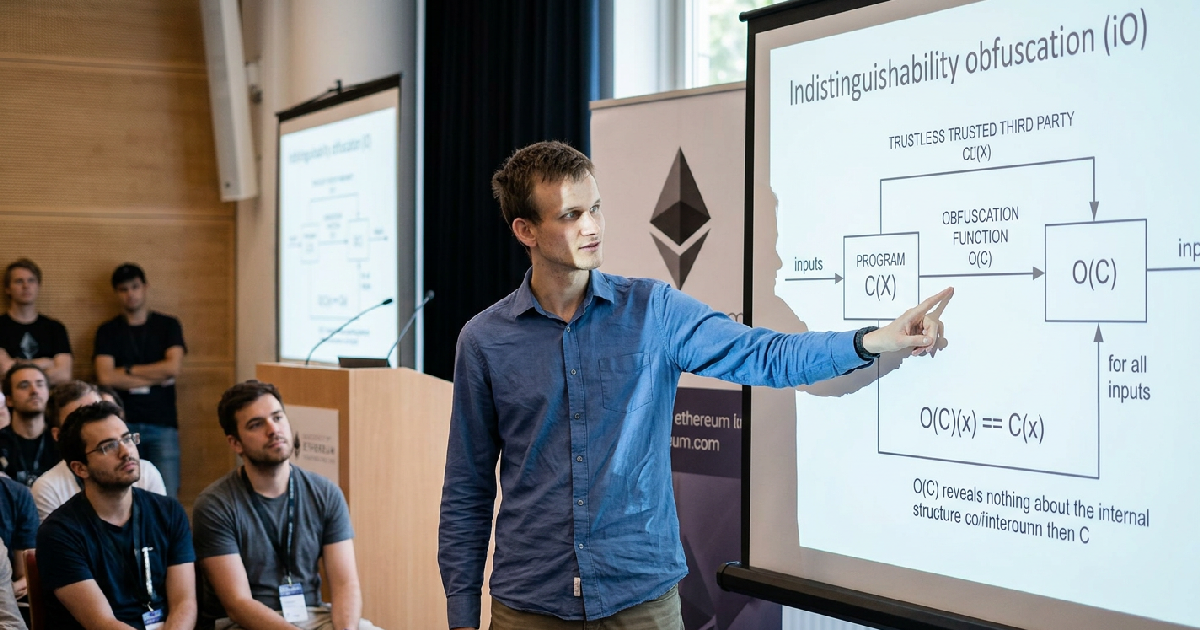

Ethereum co-founder Vitalik Buterin published the first part of a new technical series on June 29, 2026, describing cryptographic obfuscation as the “final boss of cryptography.”
The essay, titled “Obfuscation: building the final boss of cryptography (Part I),” characterizes indistinguishability obfuscation (iO) as the most powerful primitive conceived in the field, capable of creating an idealized “trustless trusted third party” that eliminates the need for honest human middlemen.
The 20-year quest for indistinguishability obfuscation
In the post released at 7:04 pm EST, Buterin argued that iO provides a way to hide the code of a program while allowing it to run normally and produce correct results.
While the technology is currently too slow for practical use, he suggested it could eventually support high-level applications such as collusion-resistant voting systems and private decentralized finance (DeFi) strategies. This essay marks an extension of his work on the Ethereum privacy roadmap and the Kohaku toolkit.
Cryptographic obfuscation allows a developer to transform a program into an encrypted version that hides its internal logic while maintaining its functional outputs. Researchers have chased this goal for decades, though a 2001 result proved that an “ideal” form of obfuscation was impossible.
Key details
This setback redirected the industry’s focus toward indistinguishability obfuscation (iO), which ensures that two functionally identical programs, when obfuscated, cannot be told apart by an observer.
Buterin frames iO as a tool that “hides the code, not the data.” If the technology becomes usable, it would allow complex protocols to run based on mathematical guarantees rather than relying on a trusted committee or agent. This development would bolster the Ethereum network outlook regarding privacy-preserving tools.
Buterin likened the current state of iO to that of zk-SNARKs in 2010, suggesting that while it is currently inefficient, the path toward feasibility is now established.
Solving the challenge of galactic computational overhead
The primary obstacle to modern obfuscation is its massive performance requirement. Buterin noted that while iO is achievable under “reasonable security assumptions,” current schemes have “literally galactic” runtimes. Some conservative choices for parameters result in programs that would take longer than the lifetime of the universe to execute.
He believes that researchers and AI tools may now be able to chip away at these inefficiencies to bring runtimes within a practical range.
If optimized, Buterin suggested that runtimes could eventually drop to roughly “about a day on a high-end GPU.” Achieving this would effectively solve the problem of trust in digital protocols. To support these and other privacy-focused goals, the Ethereum co-founder has already committed significant resources.
On January 30, 2026, he earmarked 16,384 Ether (ETH), worth approximately $45 million at the time, to fund open infrastructure and self-sovereign tools.
Building the technical tree for lattice-based primitives
The construction of modern iO involves a complex “stacking” of mathematical primitives. Unlike the polynomials and hashes typical in other scaling solutions, the underlying math for iO relies on lattices, vectors, and matrices. According to Buterin, the construction of lattice-based iO requires several layers:
- Fully Homomorphic Encryption (FHE)
- Attribute-Based Encryption (ABE)
- Obfuscated circuits and Functional Encryption (FE)
- XiO, a slightly relaxed form of iO
Why blockchains are necessary for cryptographic obfuscation
Despite its power, obfuscation has a significant limitation: it cannot prevent a program from being copied. Buterin identified this as the specific gap that blockchains are designed to fill. Because obfuscated programs cannot independently manage stateful operations like money, a blockchain is required to handle “state” while the obfuscated code handles the logic execution.
This combination ensures that private logic can interact with an immutable ledger without compromising security.
Future installments of Buterin’s series are expected to examine specific candidates for efficient iO, including “diamond iO” and “local mixing obfuscation.” These posts will continue to detail the technical paths toward making this “final boss” primitive a usable part of the global digital infrastructure. Successful implementation would mean any protocol that currently requires a trusted third party could eventually be built securely through code alone.