
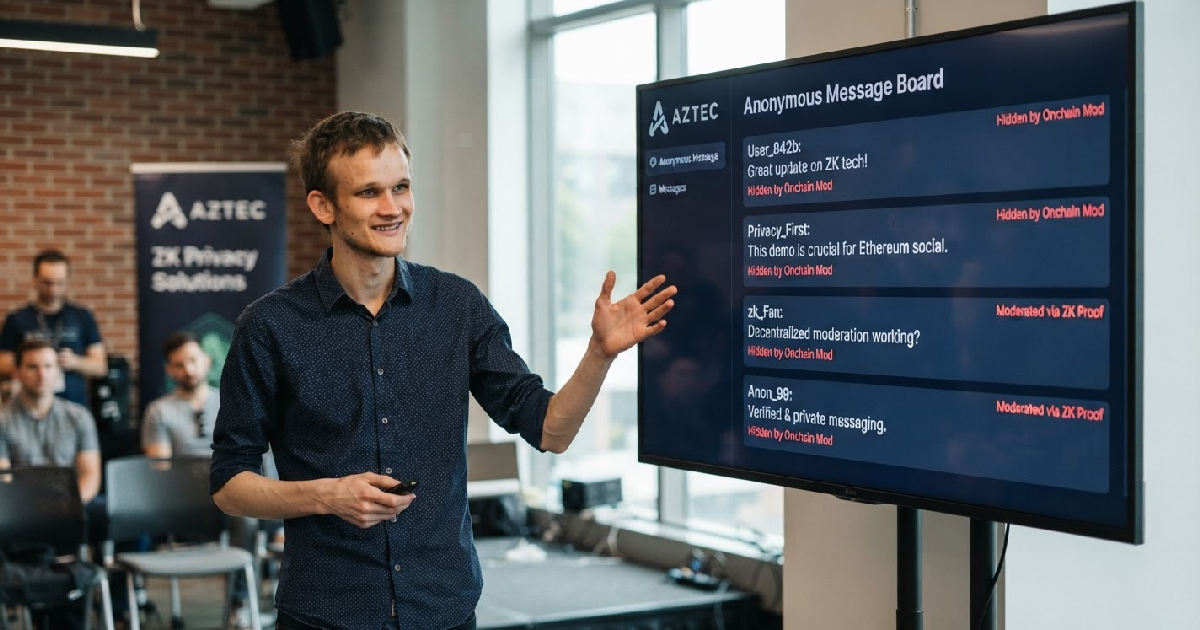

Vitaly Dmitrievich Buterin, co-founder of Ethereum, has publicly unveiled a working demonstration of an anonymous message board on the Aztec Network. Shared via Farcaster on Sunday, July 19, 2026, this “vibe-coded” project aims to prove that anonymous online publishing can effectively coexist with enforceable onchain moderation.
News of the demo emerged on Monday, July 20, 2026, highlighting a significant step in developing Ethereum’s privacy infrastructure. The code is readily available on GitHub under Buterin’s vbuterin account, specifically within the vbuterin/aztec_experiments repository.
Balancing anonymity and onchain moderation with the Vitalik Buterin Aztec demo
Buterin’s demo addresses a long-standing challenge in decentralized systems: how to preserve user privacy while preventing misuse. It showcases a system where users can post messages anonymously on Aztec’s Layer 2, a privacy-focused solution for Ethereum, after depositing Ether (ETH) on Ethereum’s Layer 1.
The design ensures that posts never expose the sender’s address in public call data, making it impossible to publicly link messages back to their original deposits. This core anonymity is protected through zero-knowledge proofs and Poseidon2 hashing for cryptographic nullifiers.
How anonymous posting works on Aztec
Users initiate the process by depositing ETH onto Ethereum’s mainnet. These funds then enable anonymous posting on Aztec’s Layer 2, with the amount deposited determining a user’s posting frequency.
For instance, a 0.001 ETH deposit allows for one post per hour, while a 0.01 ETH deposit grants ten posts an hour. Later, users can withdraw their ETH back to Layer 1 without compromising their posting anonymity.
Implementing enforceable content controls
Crucially, the system integrates robust moderation capabilities directly onchain. A pre-defined “censor role,” set at the time of deployment, can flag posts deemed “immoral.” This action hides them from the default feed and imposes a time-lock penalty on the poster’s subsequent messages.
Adding another layer of oversight, a local Large Language Model (LLM) daemon actively monitors the board. This AI evaluates posts against an onchain moderation policy, automatically flagging violations as they occur.
The role of AI and formal verification
The onchain moderation policy, which can be up to 1488 bytes in size, is accessible and readable by the application, a command-line interface (CLI), and the LLM daemon. This setup allows for automated and transparent content governance within the anonymous environment.
Security is paramount, and Buterin’s team has rigorously tested the system. Formal verification in Lean 4 / Verity confirmed key security properties, including rate limits, censorship screening, privacy, and deposit safety, with 70 proven theorems and zero unproven gaps. The GitHub repository also includes 23 unit tests and 14 integration tests.
Buterin’s Enduring Vision for Moderated Anonymity
This demo isn’t a sudden inspiration; it revives a concept Buterin first detailed in a 2022 blog post advocating for an “anon billboard with moderation.” His latest work brings that theoretical framework closer to practical application.
Buterin described the project as a “vibe-coded” toy version, indicating its experimental and rapidly prototyped nature. He noted on Farcaster that the demo already performs “very interesting nontrivial stuff,” underscoring its potential.
Aztec Network’s growing maturity
The choice of Aztec Network is strategic. It’s a privacy-focused Layer 2 solution for Ethereum that utilizes zero-knowledge proofs to enable confidential transactions and smart contracts. Buterin highlighted that Aztec has reached “stage 2” on the Layer 2 maturity scale, its most decentralized tier, reinforcing its suitability for such a project.
Aztec, founded in 2017, has been building out its privacy infrastructure, including the Noir zero-knowledge programming language. Its mainnet launch as Ethereum’s first decentralized privacy Layer 2 is scheduled for February 12, 2026, marking a significant milestone for the ecosystem.
“Vibe-coding” as a development paradigm
Buterin’s use of the term “vibe-coded” is also noteworthy. It refers to an emerging software development methodology where conversational AI assistants help programmers generate, explain, and iterate on code using natural language prompts. This approach facilitates rapid prototyping and exploration.
Buterin has previously commented on the transformative potential of AI “vibe coding” to accelerate the Ethereum roadmap. This demo serves as a tangible example of how these new development techniques can contribute to core blockchain innovation.
Implications for Decentralized Social Media and Beyond
This experimental billboard carries significant implications for the future of decentralized applications, especially those requiring both privacy and effective governance. It offers a glimpse into how Web3 platforms could foster free expression without descending into unmoderated chaos.
The demo underscores the ongoing evolution of Ethereum’s privacy infrastructure. As Layer 2 solutions like Aztec mature, they provide the necessary scalability and confidentiality layers for more complex and user-friendly decentralized applications to emerge.
Addressing Web3’s persistent governance challenges
One of the crypto industry’s persistent challenges has been balancing decentralization with the need for responsible content moderation. Buterin’s demo suggests a pathway to achieve this balance through programmable, onchain policies and AI assistance, rather than relying solely on centralized entities.
While still an early-stage experiment with acknowledged open items like access-control issues and untested browser flows, the project provides a concrete, working model. It challenges the notion that privacy and moderation are inherently antithetical in decentralized environments.
What comes next for privacy infrastructure
The demo is not intended as a polished consumer product but rather as a foundational proof of concept. Its public availability on GitHub means other developers can inspect, learn from, and build upon Buterin’s work.
This iteration signals continued progress in making Ethereum a more versatile and privacy-preserving platform. It will likely inspire further exploration into how zero-knowledge technology and onchain AI can shape the next generation of decentralized communication tools.