
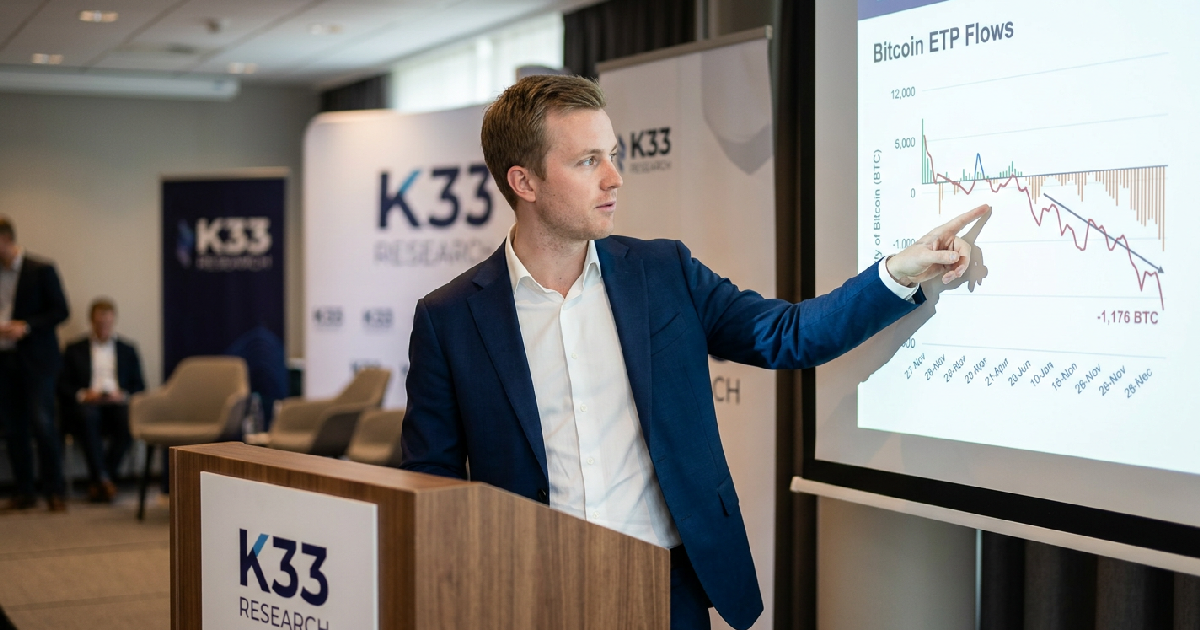

Bitcoin exchange-traded product (ETP) flows have turned negative on a rolling one-year basis for the first time since late 2023, according to a June report from K33 Research. Vetle Lunde, Head of Research at the Norwegian firm, noted that as of June 18, 2026, one-year notional flows across global Bitcoin ETPs and related vehicles reached -1,176 BTC.
This development marks a notable shift in institutional demand, as annual flows have not entered negative territory since November 4, 2023. The previous occurrence before that was on October 21, 2022, which immediately preceded a specific Bitcoin market bottom. The current trend reflects a record drawdown for the category, with global holdings falling by 127,774 BTC—an 8% decline from their peak.
Record drawdown in Bitcoin ETP holdings signals institutional fatigue
The 8% decline in total holdings represents the largest relative drawdown on record for the sector. Despite this, investors have retained 92% of their peak holdings even as Bitcoin’s price has softened significantly from last year’s highs. This data suggests that while the “easy money” may be exiting, a core base of professional investors is maintaining exposure through regulated products.
While the broader flow picture remains under pressure, the intensity of selling appears to be fading. K33 Research highlighted that daily outflows have decelerated to approximately 625 BTC per day over the last two weeks. This is a sharp contrast to the “heavy selling period” between May 11 and June 5, when daily outflows averaged approximately 4,462 BTC.
ETP flows are essential for market analysts because they provide a transparent view of regulated demand, distinct from the often “noisy” spot market order books. A sustained return to positive daily flows is now being watched by traders as a potential confirmation signal.
Without consistent ETP demand, spot buyers must absorb more supply, making prices increasingly sensitive to macro headlines and rising crypto liquidations that can occur during leverage resets.
Market stabilization driven by lighter positioning and cleaner leverage
Bitcoin’s price recently stabilized near $62,000, though it fell below the $60,000 mark on Wednesday, June 24. This stabilization is not due to an influx of new buyers but rather what K33 Research describes as “lighter positioning and cleaner leverage.” The report states that the “funnels aren’t turning,” indicating that the market is essentially absorbing existing selling pressure rather than attracting fresh capital.
The “low-conviction environment” is further evidenced by spot trading volumes lingering near multi-year lows. Vetle Lunde noted that the subsiding outflows have been a “critically important factor” in allowing prices to find a steady level. However, he cautioned that the current scenario differs from the 2022 bottom, when capital was largely locked in structures like the Grayscale Bitcoin Trust (GBTC) rather than actual redemptions.
Institutional participation remains subdued, leaving the market more vulnerable to short-term trader positioning. Recent Bitcoin price analysis has focused on how these volume dips impact volatility. As long as ETP flows remain stagnant or negative, the digital asset may struggle to establish a durable upside trend without a external shift in market sentiment.
Impact on corporate treasury and preferred share stability
Beyond global ETPs, K33 Research flagged mounting pressure regarding Strategy Inc. (NASDAQ: MSTR). The company’s preferred-share complex has faced strain as prices for these instruments have recently fallen below par. This development potentially limits the firm’s ability to raise fresh capital for additional Bitcoin purchases in the immediate future.
Following a recent $300 million capital raise, Strategy Inc. currently holds enough US dollar reserves to cover roughly 10 months of preferred-share dividend payments. While some analysts worry about a forced selling spiral, K33 Research believes the probability of the company suspending dividend payments is higher than it liquidating its core Bitcoin holdings.
This situation adds another layer of complexity to the reduced liquidity environment currently seen on major exchanges.
The next few trading sessions will be vital for determining whether institutional investors are merely de-risking or if a more permanent capital withdrawal is underway. If outflows continue to slow and daily flows turn positive, it could signal the end of this low-conviction phase. Conversely, if the record drawdown deepens, it will confirm that the broad-based reduction among ETP investors is not yet over.