
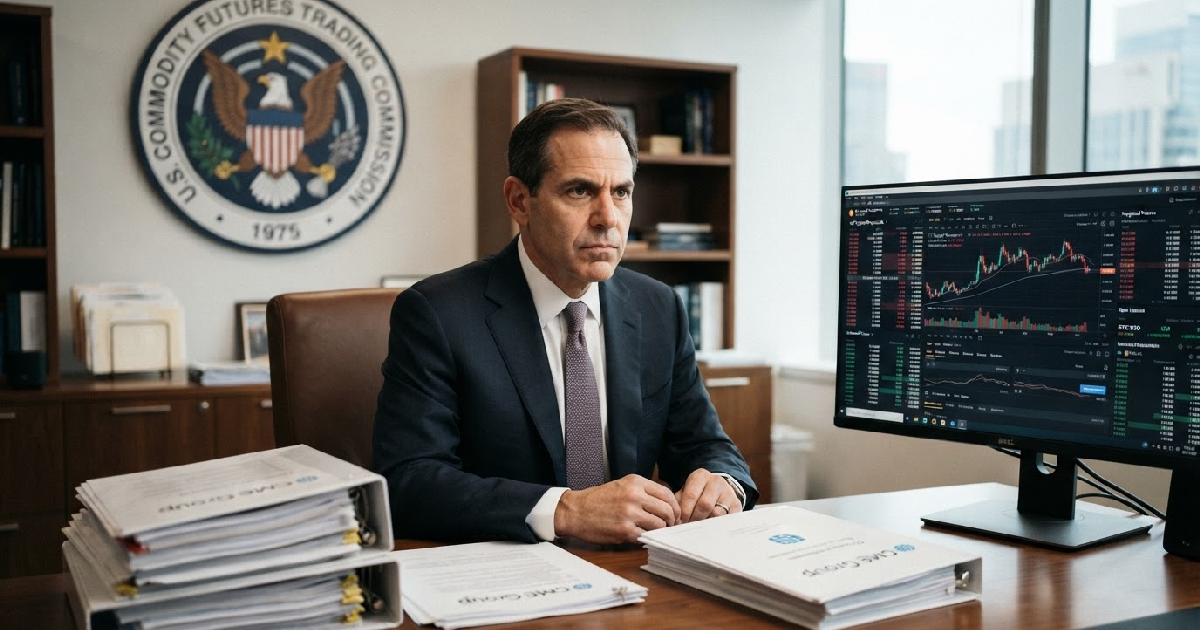

CME Group, the world’s largest traditional futures exchange, has filed a federal lawsuit against the Commodity Futures Trading Commission (CFTC) and its Chairman Michael Selig in the District of Columbia. The suit challenges the agency’s recent approval of perpetual-style crypto futures products by companies like KalshiEX LLC (Kalshi) and Coinbase.
These products, which drive a significant portion of global crypto derivatives trading, were, in CME Group’s view, improperly introduced to the US market. This high-stakes legal challenge could fundamentally reshape the regulatory framework for digital assets nationwide, determining the future of US crypto perpetual futures.
The battle over crypto’s leverage engine
Perpetual-style futures, long a staple of offshore cryptocurrency trading, represent upwards of 90% of derivatives volume, with derivatives themselves making up approximately 80% of all crypto trading activity. Until recently, American traders accessed these continuous leverage products, which feature automatic liquidations and funding payments, predominantly through platforms operating outside US regulatory oversight.
Their formal entry into the domestic market marks a significant shift in how crypto assets are traded and regulated within the United States. It brings onshore a financial mechanism previously responsible for setting global crypto price discovery.
The barrier to onshore availability began to break on May 29, when the CFTC approved KalshiEX LLC’s BTCPERP, a Bitcoin perpetual futures contract, and issued a policy statement inviting similar offerings. On June 12, the agency further provided a conditional route for designated contract markets to convert existing perpetual-style crypto futures into genuine no-expiry contracts.
CME Group’s lawsuit targets regulatory framework
CME Group’s lawsuit, filed on June 18, directly targets the CFTC’s decisions, asking a federal judge to vacate the KalshiEX LLC order and its accompanying policy statement. The exchange contends that Chairman Michael Selig, the agency’s sole confirmed commissioner, overrode Congress’s definition of a swap and circumvented the established regulatory framework for such derivatives by approving KalshiEX LLC’s application in a single day.
According to CME Group, perpetuals align with the statutory definition of swaps under the Commodity Exchange Act. If categorized as swaps, these products would fall under a much stricter regulatory regime, requiring more extensive dealer registration, capital rules, and reporting standards. This reclassification would likely direct benchmark licensing back towards established incumbents like CME Group, significantly impacting the crypto derivatives market.
The CFTC isn’t backing down, though. A spokesperson for the agency accused CME Group of engaging in “lawfare” and attempting to stifle the administration’s “pro-innovation agenda.” They characterized the suit as frivolous and pledged to seek its dismissal, underscoring the fierce competitive landscape now emerging for digital asset derivatives.
The financial stakes are substantial. CME Group’s complaint notes KalshiEX LLC has already self-certified more than a dozen additional crypto perpetuals under the CFTC’s new framework, with trading volume quickly surpassing $1 billion. This rapid expansion highlights the commercial incentive for market participants and the urgency of the legal clarity sought by CME Group.
Varied approaches to onshore crypto derivatives
The US market for these new perpetual products isn’t monolithic; two distinct structures are emerging under the same general label. KalshiEX LLC’s BTCPERP offers a genuine no-expiry perpetual, built to run indefinitely, using recurring funding payments to keep its price tethered to spot.
Coinbase, conversely, has structured its offerings—nano Bitcoin and nano Ether contracts—as long-dated futures with five-year expirations. These contracts employ an hourly funding rate, settled twice daily, effectively mirroring perpetual behavior while technically operating within existing futures rules. The CFTC’s June conversion route aims to allow these long-dated contracts to eventually shed their expiration dates and become true no-expiry perpetuals.
This divergence means US regulators are now overseeing several perpetual markets simultaneously. KalshiEX LLC has already expanded its true perps beyond Bitcoin to Ether, XRP, and other tokens.
Coinbase also established a regulated channel on May 29 for US clients to access global perpetual and options liquidity via its Deribit affiliate, a major player with over $31 billion in Bitcoin options open interest in late May.
Even traditional players like CME Group are adapting to the evolving landscape. On May 29, the same day as KalshiEX LLC’s approval, CME Group transitioned its dated crypto futures and options to 24/7 trading, eliminating the weekend gap that previously separated it from spot markets.
This move brings its operations closer to the continuous nature of crypto. However, these varied approaches lead to different contract structures, leverage, clearing, and collateral requirements across platforms.
The interplay of funding, liquidations, and price discovery
Funding payments, often described as fees, act as a real-time indicator of where leverage is concentrated within the perpetual market. When demand for leveraged long positions pushes a perpetual contract above its spot price, longs typically pay shorts, which incentivizes selling and helps bring the price back into equilibrium.
This mechanism is crucial because large-scale perpetual positioning can significantly influence the very spot market it aims to track. The introduction of a liquid US perpetual market would create a domestic funding curve, offering a regulated gauge of leveraged demand that could either align with or diverge from existing offshore rates.
Any persistent gap could reveal fundamental differences in customer behavior or capital mobility between the two systems.
Leverage amplifies both gains and losses; a small amount of collateral can control a much larger position. This inherent characteristic means even modest price movements can trigger automatic liquidations once an account’s margin falls below maintenance levels. These forced market sells or buys can then cascade, driving prices further into other traders’ liquidation thresholds, potentially amplifying market volatility.
While regulated venues offer important safeguards like segregated customer funds, disclosed contract specifications, market surveillance, and legal recourse, they don’t eliminate the inherent volatility or the risk of mass liquidations. A fully regulated perpetual contract can still automatically liquidate a trader, illustrating the fundamental nature of these high-stakes products.
Future of collateral and market efficiency
The next phase of competition in the burgeoning crypto derivatives market will likely center on capital efficiency. Currently, collateral is often fragmented across various platforms—spot accounts, futures commission merchants, clearinghouses, and offshore exchanges—creating inefficiencies and additional funding costs for traders.
Addressing this, Coinbase Derivatives and the clearinghouse Nodal Clear, part of Deutsche Börse’s EEX Group, are working towards accepting Circle’s USDC stablecoin as collateral for US futures. This initiative, which requires CFTC approval, would mark the first regulated use of a stablecoin as margin in the American futures system.
It would allow traders to post crypto-native cash directly against regulated positions without first converting to fiat. Such developments could significantly reduce the cost of bridging price gaps between different platforms, offering a more impactful competitive advantage than merely listing additional assets.
However, the true resilience of these new US perpetual products will be tested during periods of high Bitcoin volatility. That test will determine if domestic perps can absorb market movements, lead them, or inadvertently amplify them. Moreover, the fundamental legal definition of these contracts—whether they are ultimately classified as futures or swaps—remains in the hands of a federal judge.
That ruling will either solidify the onshore market the industry has spent months building or force it back through a more restrictive regulatory pathway, as CME Group advocates. The outcome will have profound implications for the structure and accessibility of crypto derivatives in the United States.