
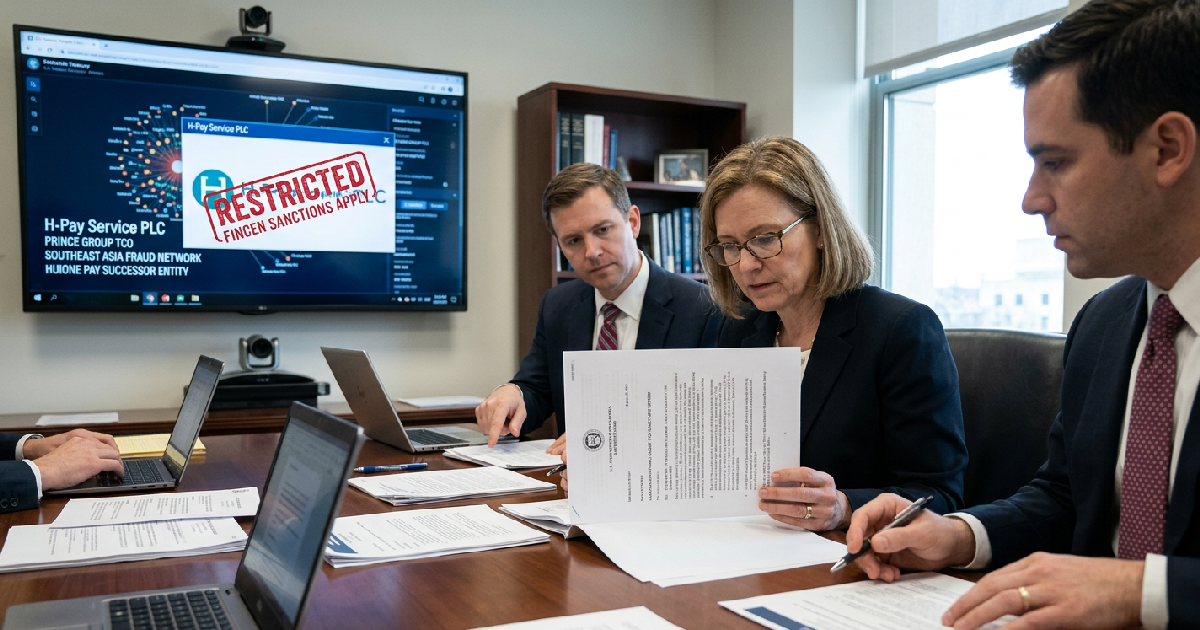

The U.S. Treasury Department expanded its enforcement actions against a Southeast Asian fraud network on 23 June, sanctioning 35 targets and proposing new restrictions on a payment firm allegedly used to bypass existing bans. The Office of Foreign Assets Control (OFAC) sanctioned nine individuals and 26 entities tied to the Prince Group Transnational Criminal Organization (TCO), a Cambodia-based network accused of running scam compounds and laundering crypto investment fraud proceeds.
Simultaneously, the Financial Crimes Enforcement Network (FinCEN) moved to crack down on H-Pay Service PLC, a firm regulators claim was established to replace the notorious Huione Group. These actions represent a major push by the U.S. government to dismantle the financial infrastructure that facilitates industrial-scale cybercrime targeting American citizens. Secretary of the Treasury Scott Bessent stated that the administration will use every tool available to stop these overseas criminal enterprises.
FinCEN identifies H-Pay as a workaround for sanctioned Huione Pay
FinCEN is formally proposing to amend its existing restrictions on the Huione Group to explicitly include H-Pay Service PLC and any future successor entities. According to a 34-page proposal from the agency, H-Pay effectively assumed the role of Huione Pay after the latter lost its Cambodian payment services license. This move is designed to ensure the group cannot simply rebranded to evade U.S. sanctions.
The federal agency argues that H-Pay inherited Huione Pay’s entire operational footprint, including its physical branches, customer base, and branding elements. Investigators even cited reports of H-Pay signage physically replacing Huione Pay logos at multiple locations. By amending a rule from October 2025, the Treasury aims to bar U.S. financial institutions from maintaining correspondent accounts for H-Pay, effectively cutting it off from the American financial system.
This level of scrutiny is becoming more common as regulators look for transparency in digital asset flows. While the Treasury targets illicit actors, other segments of the industry are seeing increased institutional interest, such as when Italy’s largest bank reported over $200 million in Bitcoin exposure through regulated ETFs. However, for firms like H-Pay, the path toward legitimacy appears permanently blocked by their alleged ties to criminal syndicates.
Rising financial toll of Southeast Asian crypto investment scams
The Treasury’s aggressive stance follows a staggering rise in the financial damage caused by Southeast Asian fraud operations. Americans lost at least $10 billion to these schemes in 2024 alone, marking a 66% increase from the previous year. Many of these losses stem from crypto investment scams where fraudsters build trust with victims online before directing them to fake investment platforms.
Authorities allege the Huione Group served as a primary node for laundering proceeds from these virtual currency scams and various cyber heists. The Prince Group reportedly used this network to transfer and consolidate stolen assets. This systematic laundering process makes it difficult for victims to recover funds, especially as fraudulent recovery schemes often proliferate shortly after a theft is reported, further victimizing those who have already lost money.
The scale of these operations is rarely limited to digital assets; they often involve physical infrastructure known as “scam compounds.” The Treasury noted that its latest action was coordinated with international partners to target the infrastructure facilitating these crimes. By squeezing the payment processors, the U.S. hopes to disrupt the economic incentive behind these large-scale fraud operations.
Broadening the pressure on the Prince Group criminal network
The OFAC sanctions specifically target a broad range of senior figures, investors, and companies linked to the Prince Group enterprise. This action builds on previous measures taken in October 2025 as part of a long-term strategy to protect U.S. victims from overseas fraud. The designation of the Prince Group as a Transnational Criminal Organization (TCO) allows for broader international cooperation in seizing assets and disrupting operations.
By blacklisting 26 entities, the Treasury is attempting to dismantle the complex web of companies the group uses to mask its activities. This enforcement comes at a time when digital asset markets are experiencing significant volatility and shifting sentiment. For instance, while regulators hunt for scam proceeds, Bitcoin’s exchange supply has reached multi-year lows, suggesting that legitimate holders are moving assets into private storage despite the surrounding regulatory turbulence.
The proposed transition of restrictions from Huione to H-Pay signals a more proactive “successor entity” policy. Regulators are no longer waiting for a new brand to mature before acting; they are following the physical signs of rebranding—like the changing signboards in Cambodia—to maintain the integrity of their sanctions. This approach aims to prevent criminal organizations from using simple shell games to maintain their access to global finance.