
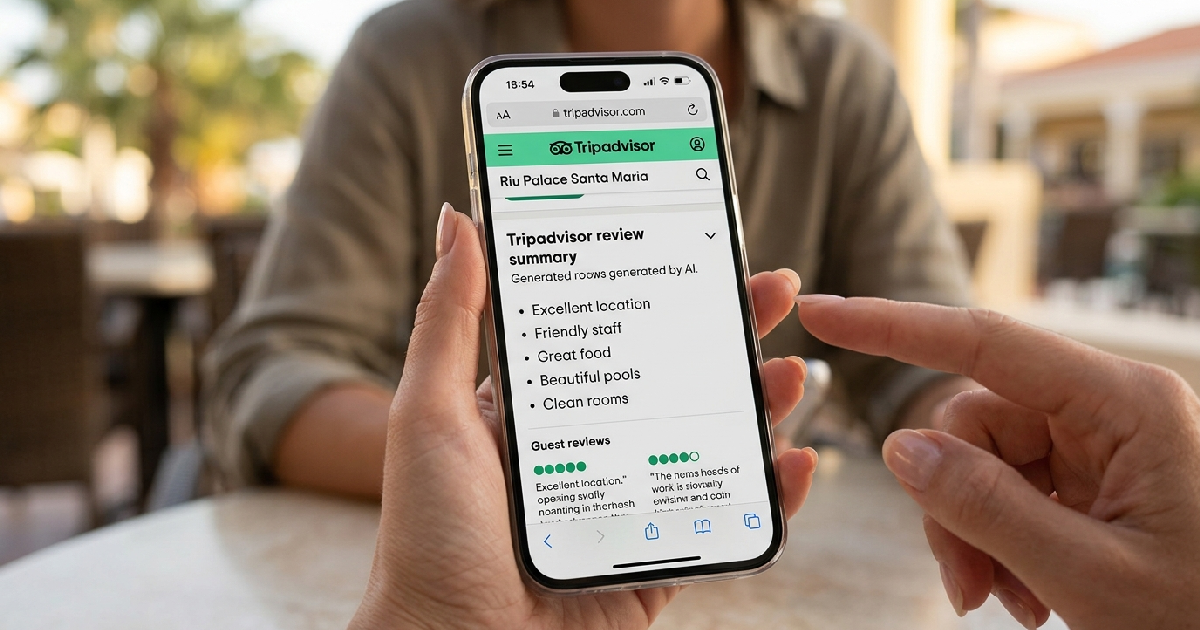

AI-generated summaries of Tripadvisor hotel reviews are frequently understating or omitting serious safety complaints, according to an investigation by the consumer organization Which?. The study found that these automated tools often mask reports of sexual harassment, mass food poisoning, and significant hygiene failures.
Rory Boland, the editor of Which? Travel, described the failure to surface critical safety information as “unacceptable and potentially life-threatening.” The findings, reported on July 2, 2026, suggest that travelers may receive a dangerously sanitized impression of high-risk properties when relying on the platform’s automated features.
Tripadvisor review summaries fail to highlight safety issues
Tripadvisor’s AI review summary tool and its travel assistant, “Ollie,” place these snippets at the top of hotel listings. This prominent placement can lead travelers to trust the summaries over individual guest warnings. As market shifts toward transparency influence digital platforms, the accuracy of automated content remains a critical concern for consumer safety.
The investigation revealed that AI-generated snippets often present a glowing picture that directly contradicts individual guest experiences. While travelers reported horrific hygiene failures, the AI frequently highlighted “spacious rooms” or “diverse restaurants.”
This discrepancy is particularly troubling because the summaries occupy the most visible space on hotel pages. By prioritizing general praise over warnings of hospitalization, the platform may lead guests into hazardous situations. The automated tool appears to prioritize a positive tone over factual warnings.
Which? researchers found that the AI tool frequently “toned down” negative feedback from guests. Instead of mentioning severe safety risks, it focused on superficial amenities. This failure to highlight dangers has sparked a debate about the responsibilities of tech platforms using generative AI.
Documented safety failures at the Riu Palace Santa Maria
One of the most concerning examples cited in the investigation involves the Riu Palace Santa Maria in Cape Verde. The AI summary described the resort as “popular” and “spotless” despite hundreds of reports of severe illness.
In reality, the hotel is currently facing a High Court lawsuit representing at least 412 holidaymakers who allege illness linked to poor hygiene. Guests shared photographs of flies on the buffet and even “dead little roasted mice” in sitting areas. Which? identified 102 mentions of food poisoning linked to the resort in March alone.
When the AI chatbot “Ollie” was asked directly about the risk of food poisoning at this location, it claimed such an event was “quite unlikely.” It further asserted that the resort maintained a “strong reputation for high hygiene standards,” despite seven reported deaths since 2023.
The failure of the chatbot to recognize documented safety risks highlights the potential dangers of unverified automation. Changes in shifting investor sentiment toward tech companies often hinge on how these brands handle data integrity and user trust. Currently, the Cape Verde summary is no longer available.
Automated systems overlook harassment and hygiene gaps
The Riu Palace was not an isolated case in the Which? study. At a hotel in Turkey, guests reported feeling unsafe due to repeated sexual harassment from male staff members. However, the AI summary merely noted that service was “friendly” with minor “lapses.”
Similarly, a hotel in the Dominican Republic received praise from the AI for its “abundant” amenities. The summary failed to mention that guests were forced to shower with bottled water because mains taps had run dry. It also ignored reports that every other person in a large wedding party had fallen ill during their stay.
A resort in Cancun, Mexico, also saw its safety issues glossed over by the automation. While the AI boasted of “immaculate cleanliness,” several guests had reported falling ill over the past year. These gaps suggest that the current algorithms may be ill-equipped to handle high-stakes safety data.
When platforms fail to highlight these macro warning signs, consumers are left to navigate potential hazards on their own. The investigation proves that automated complexity does not always equate to accuracy in consumer-facing applications.
Expert analysis on the risk of sanitized AI feedback
Duncan Brumby, a professor of Human-Computer Interaction at University College London, provided insight into why these errors occur. He explained that AI often “sanitises and rubs off the edges” of sharp criticisms found in training data.
Professor Brumby noted that because the majority of online reviews are bland or positive, the AI tends to default to a polite tone. It effectively “decides” to tone down negative experiences to match the statistical average of its dataset. This results in a summary that sounds professional but remains factually misleading.
Interestingly, Google’s AI-generated hotel overviews performed better in the Which? study. Google’s tool accurately flagged “outbreaks of illness” and “concerns over birds in the buffet areas” at the same Cape Verde resort. This suggests that the issues at Tripadvisor may relate to internal safety filters.
Tripadvisor defends its technology amid Which findings
Tripadvisor has fundamentally disagreed with the premise of the Which? investigation. The company stated it is “monitoring and refining” its tools but maintains they deliver exactly what they were designed to do. They emphasized that summaries do not replace full reviews.
The company asserted that users have the “common sense” to check AI advice against its billion-plus reviews. They also claimed to have safeguards that automatically suppress summaries when reports of death or sexual assault are detected. However, Which? found that these filters failed in several cases.
RIU Hotels & Resorts, the operator of the Riu Palace Santa Maria, also responded to the findings. The chain insisted that it operates with the highest standards of professionalism. It stated that hygienic-sanitary safety remains its top priority despite the ongoing litigation in the High Court.
As AI continues to be integrated into travel planning, the burden of proof for accuracy remains with the platforms. Rory Boland has advised travelers to scroll past AI summaries and focus on one-star ratings. For now, reading individual experiences remains the most reliable way to ensure a safe holiday.