
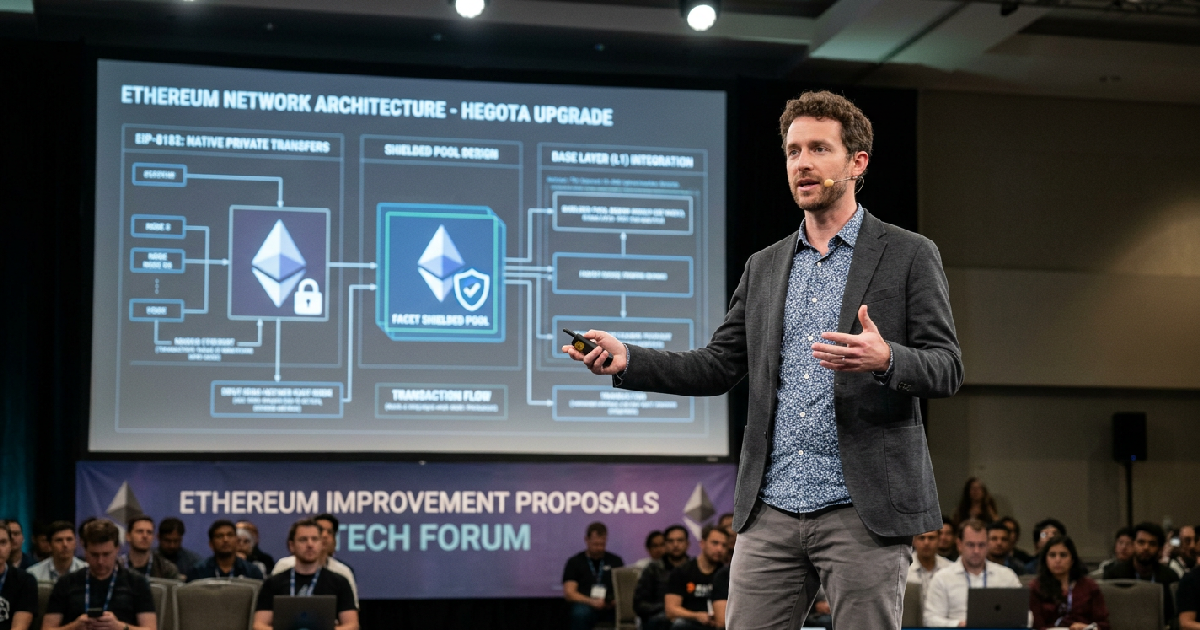

Tom Lehman, the co-founder of Layer 2 network Facet, pitched Ethereum Improvement Proposal (EIP) 8182 last Friday for inclusion in the upcoming Hegota hard fork. Initially introduced in March 2026, the proposal aims to integrate a native, protocol-managed shielded pool directly into the Ethereum base layer. This design would enable private ETH and ERC-20 transfers without relying on third-party applications or fragmented anonymity sets.
The push for native privacy comes as network data reveals a persistent lack of confidentiality on-chain. Despite a market capitalization exceeding $250 billion, fewer than 1 in 10,000 Ethereum transactions were private in 2025. This figure remains below the peak levels recorded in 2020.
Lehman argues that existing privacy solutions suffer from a “chicken-and-egg” problem where low user counts discourage privacy-seeking participants, further thinning the anonymity set. com/ethereum-price-prediction-analysis-dex-growth-trends/”>Ethereum network outlook strengthens through increased decentralized exchange activity, the demand for integrated privacy features has become a central focus for developers.
Hegota is scheduled for the second half of 2026 and represents a portmanteau of the “Bogota” execution layer and “Heze” consensus layer updates. The upgrade follows the “Glamsterdam” fork planned for the first half of the year. Beyond privacy, Hegota will introduce Verkle Trees to reduce the storage burden on node operators by approximately 90% and FOCIL (Fork-choice Optimality and Censorship-resistance via In-protocol Liveness) to bolster network neutrality.
EIP-8182 mechanism and unified anonymity sets
The core of EIP-8182 is a single, protocol-managed shielded pool that would connect every wallet and application to the same anonymity set. The system would utilize a Unspent Transaction Output (UTXO) design deployed as a system contract at a fixed address. To ensure trustlessness, the contract would feature no admin keys, no proxy controls, and no pause mechanisms, meaning changes could only be implemented through a network-wide hard fork.
Unlike current tools that require specific address formats, EIP-8182 allows private transfers to any standard Ethereum address or Ethereum Name Service (ENS) name. It also supports atomic “de-sensitization-interaction-re-privatization” cycles. This lets a user deposit into the pool, interact with a public contract, and re-shield the funds in a single sequence. This level of technical depth is essential as the Ethereum market reacts to institutional demand for more sophisticated privacy and compliance tools.
Privacy-focused EIPs targeting the Hegota upgrade
EIP-8182 is one of three specific proposals currently vying for inclusion in the Hegota upgrade to transform privacy into a first-class feature. These include EIP-8141, which enables privacy pools to pay withdrawal fees directly from the withdrawn assets, and EIP-8250, which introduces keyed nonces to unblock shared-sender privacy designs. These efforts align with the near-term roadmap recently outlined by Vitalik Buterin to move privacy away from third-party add-ons.
The technical implementation relies on a fork-managed Groth16 BN254 proof for spend verification. A companion Zero-Knowledge (ZK) proof-verification precompile would allow clients to efficiently verify these transfers at the protocol layer (L1). By embedding these components, developers aim to solve the fragmentation that has plagued third-party protocols like Tornado, Railgun, and Aztec, providing a unified layer for both individual users and institutional participants.
Institutional compliance and the Ethereum roadmap
The move toward native privacy is also a strategic play for institutional adoption. By integrating with Zero-Knowledge and Fully Homomorphic Encryption (FHE) contracts, such as those from Zama, the protocol could support private transfers that still meet regulatory transparency needs. This balance is critical for organizations that require confidentiality for proprietary trades but must remain within legal frameworks.
The Hegota upgrade signals a shift in Ethereum’s development philosophy toward a faster cadence of two hard forks per year. While the primary objectives of the 2026 roadmap focus on scalability and decentralization through statelessness, the inclusion of EIP-8182 would represent a major milestone in making the base layer natively private. As macro warning signs emerge in the broader financial sector, Ethereum’s focus on hardening its core infrastructure may define its long-term resilience.