
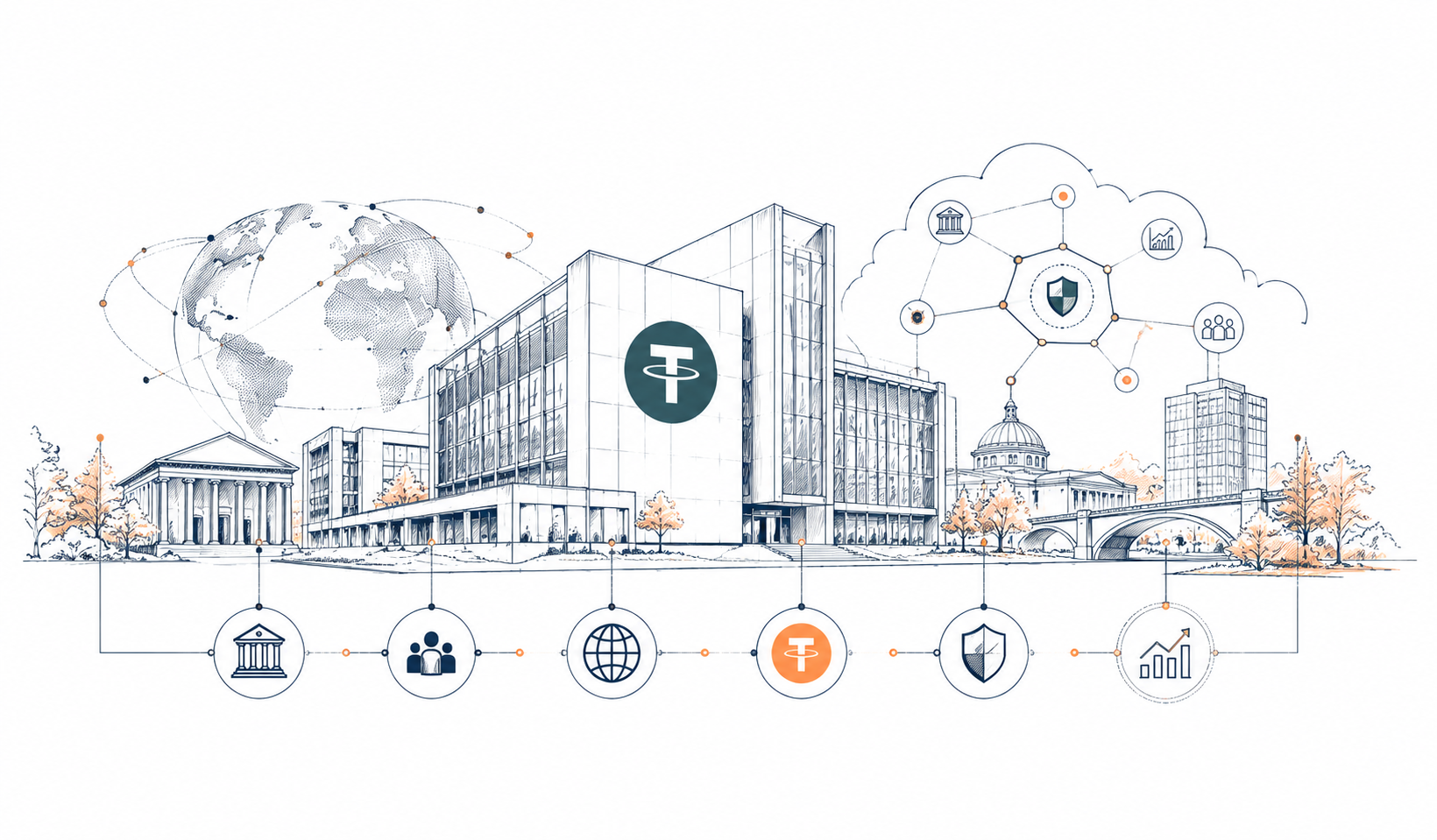

Tether began with a relatively simple function. For every USDT put into circulation, the company needed to hold enough assets to ensure that the token could continue to be redeemed for one dollar. The larger the stablecoin became, the larger the reserve required to support it.
That relationship still exists. But USDT’s scale has begun to create something that extends far beyond the token itself.
In the first half of 2026, Tether purchased more than 27 metric tons of gold, a volume comparable to Kazakhstan’s purchases and exceeded only by Poland, Uzbekistan and China among the central banks tracked over the period. Another 14 tons were added in the second quarter alone, bringing the company’s physical gold holdings to more than 146 tons.
The figure is striking because this is not a central bank, a sovereign wealth fund or a century-old financial institution. It is a private company that started by issuing digital dollars.
USDT’s growth has created a financial machine much larger than the stablecoin sitting in users’ wallets. Tether now manages nearly $190 billion in assets, holds one of the largest private exposures to U.S. government debt and has accumulated gold on a scale that increasingly puts it alongside countries when reserve holdings are compared.
The question, then, is no longer simply what sits behind every USDT.
It is what Tether is building with the financial scale USDT has created.
USDT Has Created a Massive Capital Machine
The economics of a stablecoin appear simple because the product itself is simple.
A user provides a dollar. The company issues an equivalent token. That money is invested in liquid, high-quality assets so the token can be redeemed when necessary.
But when that model reaches hundreds of billions of dollars, something important happens: the assets backing the stablecoin begin generating substantial income of their own.
Tether ended the first quarter of 2026 with approximately $192 billion in assets and $183.5 billion in liabilities. Much of its reserve remains concentrated in short-term instruments tied to U.S. government debt, generating interest while USDT remains in circulation.
In the second quarter, the company generated approximately $1.5 billion in net operating profit, following another $1.04 billion in the first quarter.
That mechanism has created an unusual dynamic.
The larger USDT becomes, the larger the asset base managed by Tether. And the larger that asset base becomes, the more income the assets supporting the stablecoin can potentially generate.
Not all of those profits need to remain inside the reserve.
That is where the story begins to change.
Tether’s Reserves and Tether’s Capital Are No Longer the Same Thing
There is a fundamental distinction required to understand what is happening.
Not every asset controlled by Tether exists to back USDT.
The company itself separates the reserves covering tokens in circulation from investments made through Tether Investments. According to its disclosures, those investments are funded with excess capital and company profits and are segregated from the reserves supporting the stablecoin.
USDT’s growth has therefore created two parallel structures.
On one side is the reserve, whose purpose is to ensure that tokens can be redeemed. On the other is a growing pool of proprietary capital that Tether can allocate to other assets and businesses.
It is this second structure that is beginning to transform the company.
Tether has acquired a controlling 70% stake in Adecoagro, an agriculture and energy company with operations across South America. It invested $150 million in Gold.com. It has exposure to technology and infrastructure companies and has deployed capital across sectors ranging from artificial intelligence and telecommunications to energy and healthcare.
Those assets do not exist simply to ensure that one USDT remains worth one dollar.
They belong to a broader capital allocation strategy built from the profits generated by the stablecoin ecosystem.
Gold Reveals the Scale of the Transformation
It is within this context that Tether’s gold purchases take on a different meaning.
The company is not merely diversifying a reserve. It is becoming a significant participant in a market historically dominated by central banks, commercial banks and major investment funds.
The scale of that presence is already attracting attention. Jefferies analysts have estimated that Tether’s demand contributed to recent moves in the gold market, while the pace of its purchases is increasingly being tracked alongside acquisitions by monetary authorities.
The comparison requires caution.
Tether is not a central bank. It does not issue sovereign currency, set interest rates, conduct monetary policy or act as a lender of last resort to an economy.
But comparisons of scale are becoming difficult to ignore.
A private company is managing tens of billions of dollars across sovereign debt, gold, Bitcoin and strategic investments while deciding how to allocate capital generated by a digital currency used around the world.
That combination barely existed before stablecoins.
The Largest Stablecoin Created Something That Wasn’t in the Original Blueprint
USDT remains the economic center of Tether.
But describing the company simply as “the issuer of USDT” may no longer capture what it has become.
The stablecoin created an enormous asset base. That asset base generates income. The income produces profits. And those profits are increasingly being converted into gold, Bitcoin, corporate stakes, infrastructure and long-term investments.
There is a compounding effect embedded in this structure.
The larger USDT becomes, the larger the reserve can become. The larger the reserve, the more income its assets can potentially generate. And the more profits Tether accumulates, the greater its ability to invest beyond the stablecoin itself.
That turns USDT into something more than a product.
It becomes the financial engine behind an increasingly large capital structure.
The Risks Are Growing in Scale Too
None of this means Tether has become immune to risk. The second quarter demonstrated precisely the opposite.
Despite generating $1.5 billion in operating profit, the company ended June with roughly $4.1 billion in excess reserves, down from $8.23 billion three months earlier. Changes in the value of assets such as gold and Bitcoin can affect the size of that buffer even while the underlying business continues to generate profits.
As the structure grows larger and more diversified, distinguishing between liquid assets intended to support USDT redemptions and investments made with Tether’s own capital becomes increasingly important.
The two portfolios serve different purposes.
One exists to support confidence and liquidity. The other exists to generate returns and build long-term value.
Conflating them would make Tether appear either riskier or safer than it actually is.
A New Kind of Financial Institution Is Emerging
This may be the most consequential part of the transformation.
Tether does not fit neatly into the categories that existed before it.
It is not a bank, although it manages sovereign debt holdings on a scale comparable to major financial institutions.
It is not a central bank, although its gold holdings rival those of some countries.
It is not an investment fund, although it deploys billions of dollars of proprietary capital to acquire companies and finance infrastructure.
And it is no longer simply a crypto company, even though USDT remains the source of its scale.
Stablecoins have created an unusual financial model: private companies capable of accumulating enormous pools of assets because millions of users choose to hold digital representations of traditional currencies.
In Tether’s case, that scale has begun to produce a consequence that may not have been obvious when the first USDT was issued.
The company needed to build a reserve to support its stablecoin.
It ended up building a capital machine capable of buying gold on the scale of countries, financing companies and investing in infrastructure around the world.
USDT remains the product.
But the financial institution emerging behind it may ultimately become the much bigger story.