
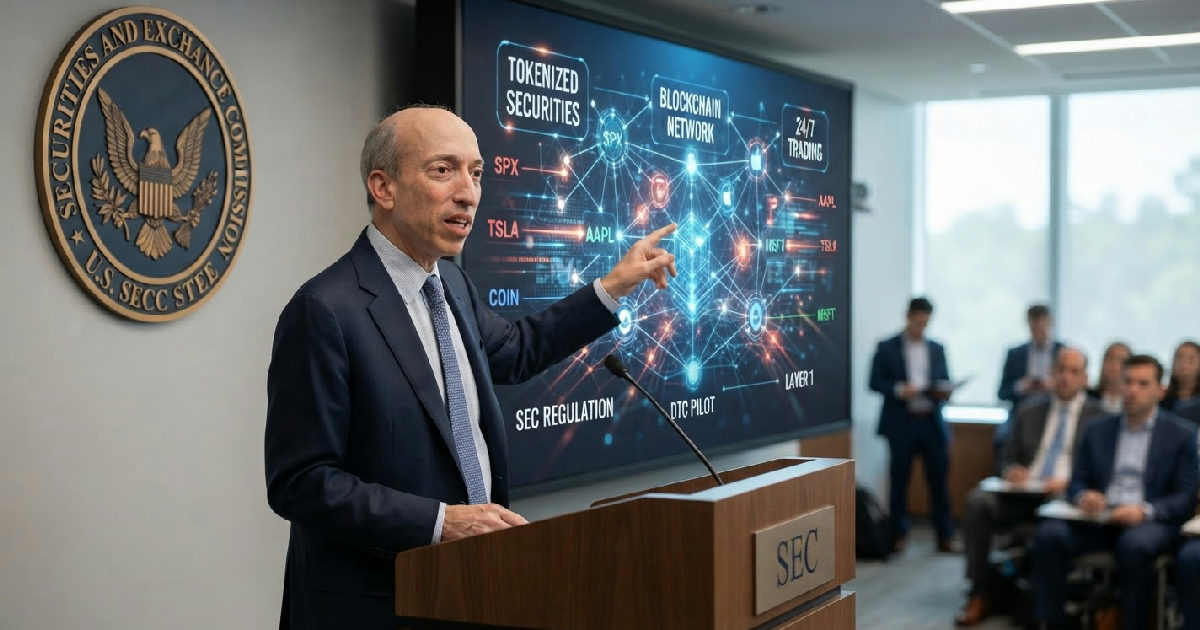

The SEC is advancing an innovation exemption for tokenized listed securities, aiming to enable 24/7 stock trading on blockchain networks. S. Securities and Exchange Commission (SEC) is actively advancing an “innovation exemption” for tokenized listed securities, a move poised to fundamentally reshape how traditional equities interact with digital assets.
This SEC tokenization initiative aims to pave the way for 24/7 stock trading on blockchain networks, providing investors unprecedented access to markets outside conventional hours.
It marks a critical juncture for both Wall Street and the burgeoning cryptocurrency ecosystem.
Navigating the SEC’s Innovation Exemption Framework
As the SEC prepares to potentially unveil further details at an open meeting this Friday, August 15, 2026, market participants are keenly watching its implications. This regulatory shift could significantly boost liquidity and trading activity on-chain, creating new growth opportunities for various Layer 1 (L1) blockchains and integrating traditional finance (TradFi) more deeply with crypto.
At the heart of this evolving landscape is the SEC’s “innovation exemption,” a framework designed to allow market participants to test tokenized securities under defined regulatory conditions. This approach seeks to enable compliant on-chain trading while the Commission develops comprehensive long-term rules. It signals a pragmatic, albeit cautious, step towards integrating blockchain technology into mainstream finance.
SEC Chairman Paul Atkins has been a vocal proponent, describing the exemption as “forthcoming” since April and highlighting crypto rulemaking as an agency priority. Similarly, SEC Commissioner Hester Peirce emphasized that “Tokenized securities are still securities” in March, asserting that digital format doesn’t alter an asset’s legal obligations, but supporting an exemption for “limited trading.”
Parallel to the exemption, The Depository Trust Company (DTC) received a no-action letter from SEC staff on December 11, 2025, for a three-year pilot program. This program allows for the tokenization of certain highly liquid securities, effectively creating tokenized entitlements in blockchain wallets registered with DTC.
Nasdaq also amended its proposed rules on January 20, 2026, to support tokenized securities trading on its exchange and align with the DTC pilot.
The Two-Track System: TradFi Integration vs. Crypto-Native Rails
The SEC’s dual approach, encompassing both the “innovation exemption” and the DTC pilot, appears to be fostering two distinct pathways for tokenized equities. One path leans into integrating tokenization within existing Wall Street infrastructure, exemplified by Nasdaq and DTC’s initiatives. The other, under the “innovation exemption,” could establish a crypto-native rail.
This potential bifurcation raises questions about market fragmentation and investor rights. Some industry observers suggest the “innovation exemption” could permit unaffiliated entities to wrap publicly listed stocks without the issuer’s direct consent, potentially relaxing certain disclosure and compliance requirements. Such an environment could lead to differing investor protections across the two systems.
We’ve already seen crypto-native platforms forging ahead. Bullish Exchange, for instance, launched tokenized equity trading on August 12, 2026, delivering 24/7 access with near-instant settlement. Liquidity providers Wintermute, Qube Research & Technologies, Annamite, Fasanara Digital, and Star Beta Technologies all support this new venture, underscoring the growing demand for continuous digital asset trading.
Layer 1 Blockchains Vie for Tokenized Equity Market Share
The expansion of tokenized equities presents a significant growth opportunity, particularly for Layer 1 blockchains. While traditional markets dwarf the current tokenized sector, retail investors saw a total value locked of $412 million in tokenized public stocks by September 2025. This indicates an emerging market with substantial potential for growth if even a fraction of traditional assets move on-chain.
Data from Token Terminal reveals an emerging competition among major L1s to capture this market. Various Layer 1s, including Binance Smart Chain (BSC), Ethereum, and Solana, are actively vying for market share in tokenized stocks. This push highlights the intense race to attract trading activity, liquidity, and user demand in this nascent sector.
Should tokenized stocks become a primary bridge between TradFi and crypto, L1s capable of handling the increased transaction volume and providing robust infrastructure stand to benefit immensely. Their ability to offer efficient, low-cost, and secure environments will be crucial in drawing in new capital and users through the latter half of 2026 and beyond.
Operational Hurdles and Investor Protection in a 24/7 Market
While the allure of 24/7 trading and enhanced accessibility is strong, the shift introduces a host of operational and regulatory challenges. Traditional markets are accustomed to specific operating hours, allowing for back-office processing and daily settlements. Moving to a continuous trading model demands significant technological upgrades and a redesign of existing end-of-day processes.
One primary concern revolves around liquidity. Trading outside standard market hours often sees lower volumes, which can lead to wider bid-ask spreads and increased price volatility. This dynamic could make it more challenging for investors to execute trades at desired prices, potentially exacerbating market swings in response to sudden news events.
Investor protection also remains a critical area of focus. If the “innovation exemption” relaxes certain disclosure and compliance requirements for crypto-native platforms, it raises questions about how adequately retail investors will be shielded. Ensuring consistent standards for transparency and accountability across both traditional and tokenized markets will be paramount to maintaining market integrity and public trust.
The existing T+1 settlement cycle in U.S. stock markets also poses a challenge for seamless 24/7 trading. While tokenization inherently offers near-instant settlement, reconciling this with traditional market settlement cycles requires careful integration. The SEC’s public roundtable scheduled for September 17, 2026, to discuss preparations for 24-hour trading, acknowledges these complexities, focusing on infrastructure, market operations, and resiliency.
The Road Ahead for Tokenized Equities and Crypto Integration
The SEC’s active pursuit of tokenized securities and 24/7 trading signifies a pivotal moment for both traditional finance and the crypto industry. It’s a clear indication that regulators are grappling with how to incorporate blockchain’s efficiencies into established market structures, rather than ignoring them. The forthcoming “innovation exemption” will be a key determinant of how quickly and broadly this integration takes hold.
For crypto, this could mean a substantial influx of institutional capital and a validation of blockchain as a foundational technology for financial markets. However, success hinges on the details of regulatory implementation, particularly how the SEC balances innovation with robust investor protections and market stability.
The next few months, especially with the SEC’s scheduled meeting this Friday, will likely set the tone for this critical evolution in financial markets.