
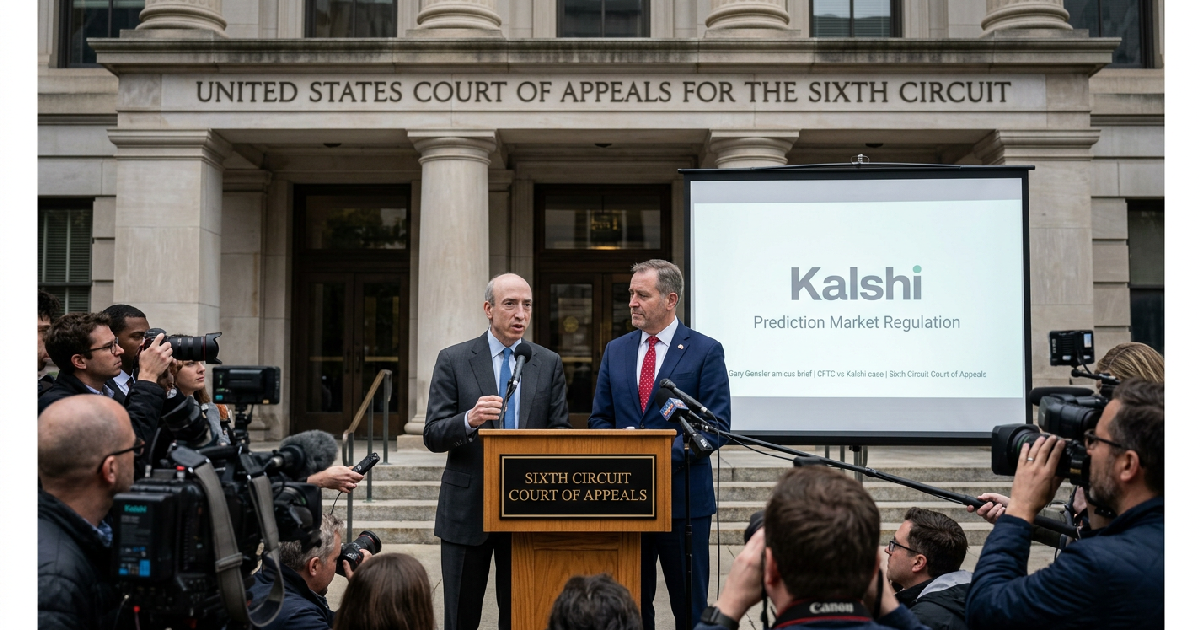

Gary Gensler, the former Chair of the Securities and Exchange Commission (SEC), has stepped into a high-stakes legal feud by filing an amicus brief supporting several states in their challenge against the Commodity Futures Trading Commission (CFTC).
On Thursday, June 11, 2026, Gary Gensler submitted the filing to the Sixth Circuit Court of Appeals, arguing that the federal government lacks the authority to oversee sports-related prediction markets.
He specifically backed the State of Ohio in its attempt to enforce state-level gambling regulations against the prediction platform Kalshi, asserting that these contracts do not meet the legal definition of swaps under the Dodd-Frank Act.
The intervention by Gary Gensler puts him in direct opposition to Current CFTC Chairman Mike Selig, who has argued that event contracts fall squarely under federal derivatives law. Ohio is joined by Nevada, Utah, New Jersey, Maryland, Montana, and Illinois in a collective effort to maintain state oversight of gaming and protect local tax revenues.
Gary Gensler’s brief contends that the Dodd-Frank Act of 2010 was never intended to federalize sports betting, which he describes as gambling rather than a legitimate tool for hedging economic risk.
This legal battle intensified after Federal District Judge Sarah Morrison denied a request from Kalshi for a preliminary injunction in March 2026. The platform had sought to block state cease-and-desist orders that could effectively shut down its operations in those jurisdictions.
By siding with the states, Gary Gensler is leveraging his experience as a former head of both the SEC and the CFTC to suggest that federal overreach is threatening the established rights of state regulators to manage local gaming markets.
Defending state authority over prediction market regulation
The core of Gary Gensler’s argument rests on a narrow interpretation of the Commodity Exchange Act. He stated that sports betting contracts do not fit the statutory language of a “swap” because they are rarely used for managing financial exposure.
“Sports bets are very rarely, if ever, about hedging,” Gary Gensler wrote in his brief, noting that the lawmakers who crafted the Dodd-Frank Act never discussed or envisioned the CFTC taking control of this sector.
States fear that if the CFTC succeeds in claiming exclusive jurisdiction, they will lose millions of dollars in licensing fees and tax revenue. This is particularly relevant as Bitcoin signals market structure analysis shows that digital asset volatility often drives users toward alternative speculative markets.
If federal regulators prevail, the fragmented system of state gambling licenses could be replaced by a single federal standard, stripping states of their historical “police powers” over wagering.
The dispute has also galvanized Native American interests. Thirty Native American tribes and 11 tribal associations filed their own amicus curiae brief in support of Ohio, alongside the Indian Gaming Association and the American Gaming Association. Gaming attorney Daniel Wallach highlighted these filings as a sign of how broadly this case could impact tribal gaming rights and state-sanctioned sportsbooks across the country.
Conflict between current and former federal regulators
Current CFTC Chairman Mike Selig has wasted no time mounting a defense of his agency’s position. Appearing on CNBC Squawk Box on Monday, June 8, 2026, Mike Selig emphasized that event contracts—whether they involve sports, politics, or commodities—are firmly within the agency’s remit.
He argued that the modern financial landscape requires a centralized regulator to ensure market integrity, especially as Bitcoin traders prioritise moving averages and other technical indicators to navigate increasingly complex speculative environments.
Gary Gensler’s pushback is a notable reversal for a man who led approximately 100 crypto enforcement actions during his tenure at the SEC. While he was often seen as an advocate for broad federal oversight in the digital asset space, he appears to draw a firm line at sports gambling.
He maintains that while the CFTC oversees commodities and derivatives, it has no business regulating a “win-loss” bet on a baseball game or a political election.
Impacted organizations like Better Markets have also supported the states’ position, arguing that the CFTC’s limited resources should be focused on preventing systemic shocks in traditional financial markets. They argue that clogging the federal agency’s docket with gambling oversight could distract from its primary mission of protecting the broader economy from derivatives-related collapses.
Future implications for the gaming industry and the Supreme Court
The outcome of this appeal in the Sixth Circuit will have immediate consequences for platforms like Kalshi. If the court rules in favor of the states, prediction markets will likely be forced to register and comply with the specific laws of every state in which they operate.
This could lead to a patchwork of compliance requirements and, in some cases, criminal charges for platforms that fail to secure state-level approval before launching.
Gary Gensler himself has predicted that “this is going to end up in the Supreme Court.” The high court has shown a recent tendency to limit the power of federal agencies through the “major questions doctrine,” which suggests that agencies cannot claim vast new powers without explicit authorization from Congress.
If the Supreme Court ultimately hears the case, it could set a major precedent for the division of power between state and federal regulators.
For now, the gaming industry remains in a state of legal limbo. Operators must navigate these conflicting jurisdictions while watching whether the federal court system agrees with Gary Gensler’s view of congressional intent. The final decision will determine whether the future of prediction markets looks more like the regulated world of Wall Street or the existing landscape of state-controlled gambling and casinos.