
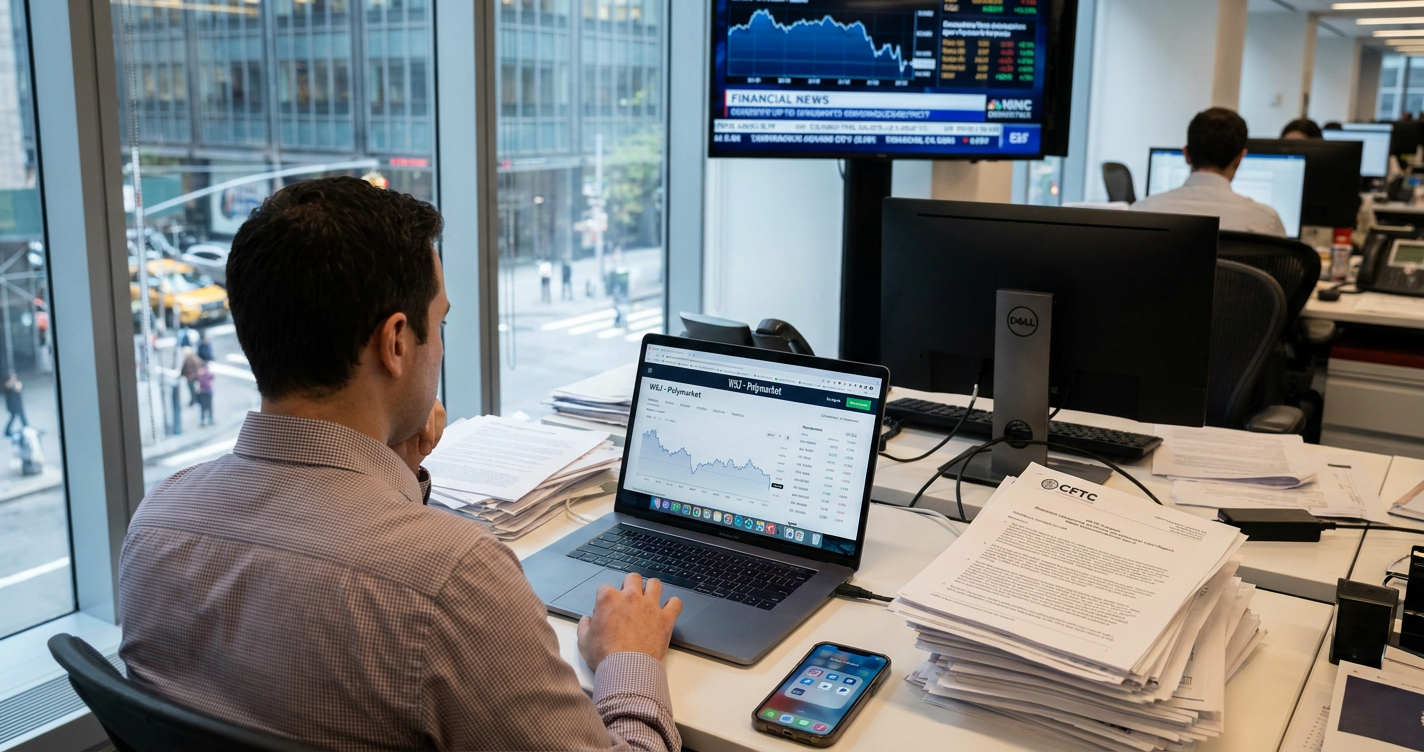

A Wall Street Journal (WSJ) investigation published on June 21, 2026, reveals that Polymarket, a prominent crypto-based prediction market, paid dozens of social media creators to showcase $1.9 million in fake bets and fabricated winnings.
The report, which reviewed 1,105 videos from 10 specific creators posted since December 2025, found that approximately 70% of the clips featured wagers that never actually occurred. These staged events were reportedly designed to generate hype and attract U.S. users to the platform despite existing regulatory restrictions.
Staged winnings and replica domains used to drive engagement
The campaign used near-identical copies of the official website to simulate high-stakes gambling without real financial risk. Polymarket stated it is “committed to maintaining accurate, fair, and transparent markets” and plans a comprehensive review of its promotional content in response to the findings.
However, the revelation comes at a difficult time as the company faces intensifying scrutiny from state regulators and federal lawmakers over its operations and marketing tactics.
The investigation uncovered that many creators filmed their content on imitation sites, including one at the misspelled domain “poiymarket.com.” A source familiar with the matter revealed the dummy site was built by Polymarket, while other videos indicated the environments were originally test-beds for the company’s engineers.
Key details
On these platforms, influencers appeared to enter massive trades and celebrate victories that did not exist on the public blockchain. This shift away from on-chain transparency stands in contrast to how top crypto casinos and legitimate prediction markets typically operate.
One specific case highlighted involves George Makihara, a college student who posted a January video celebrating a $100,000 “win” on a bet that U.S. President Donald Trump would say “McDonald’s” that month. The WSJ found the footage Makihara reacted to was actually recorded two months prior.
While Makihara showcased nearly $410,000 in fake wagers across 145 videos, real users who placed the same McDonald’s bet in January all lost. From December to mid-May, creators collectively touted nearly $900,000 in fabricated winnings on positions that would have actually lost over $166,000 if they were real.
Marketing tactics and non-disclosure agreements under scrutiny
Polymarket reportedly orchestrated this “social-media army” through the marketing firm Virality. Creators were paid between $2,000 and $3,000 monthly and instructed not to disclose their financial ties to the company, though some added “@polymarket partner” to their bios after the WSJ began its inquiry.
This hidden compensation model follows a June 5, 2026, report from Politico stating that Polymarket Chief Marketing Officer Matthew Modabber used a personal PayPal account to compensate creators for content on X. Over $2.5 million reportedly flowed through his account to more than 800 recipients for various promotions.
The campaign specifically sought to reach American audiences, with the WSJ reporting that “clippers” were only paid if at least 60% of their viewers were based in the U.S.
This focus on American users is notable because Polymarket’s primary platform remains geoblocked in the United States following a 2022 settlement with the Commodity Futures Trading Commission (CFTC). While the platform recently sought a regulated return to the U.S.
market, the discovery of a shadow marketing campaign using fake data could complicate its path toward mainstream legitimacy as market resistance to unregulated crypto products remains high.
Legal challenges and jurisdictional battles in the United States
Polymarket’s marketing strategies are surfacing amidst a broader legal war over prediction markets. On June 18, 2026, Kentucky Attorney General Russell Coleman filed a lawsuit against Polymarket and its competitor Kalshi, alleging they offered unlicensed sports betting. This legal action follows a ban in Minnesota and similar charges in Arizona and Nevada.
While the Trump administration has sued several states to defend the CFTC’s exclusive oversight of the sector, critics like Senator Elizabeth Warren argue the agency has been “steamrolled” by the industry.
As federal and state authorities clash over jurisdiction, the internal mechanics of prediction markets are also facing technical scrutiny. Unlike the fake promotional videos, real Polymarket trades run on the Polygon blockchain and settle in USDC, with outcomes verified through UMA’s oracle.
However, current crypto market liquidation analysis suggests that trust in these platforms is fragile. With TikTok and YouTube now restricting accounts linked to the marketing network due to disclosure violations, Polymarket must reconcile its claims of transparency with the million-dollar campaign that successfully faked it.