
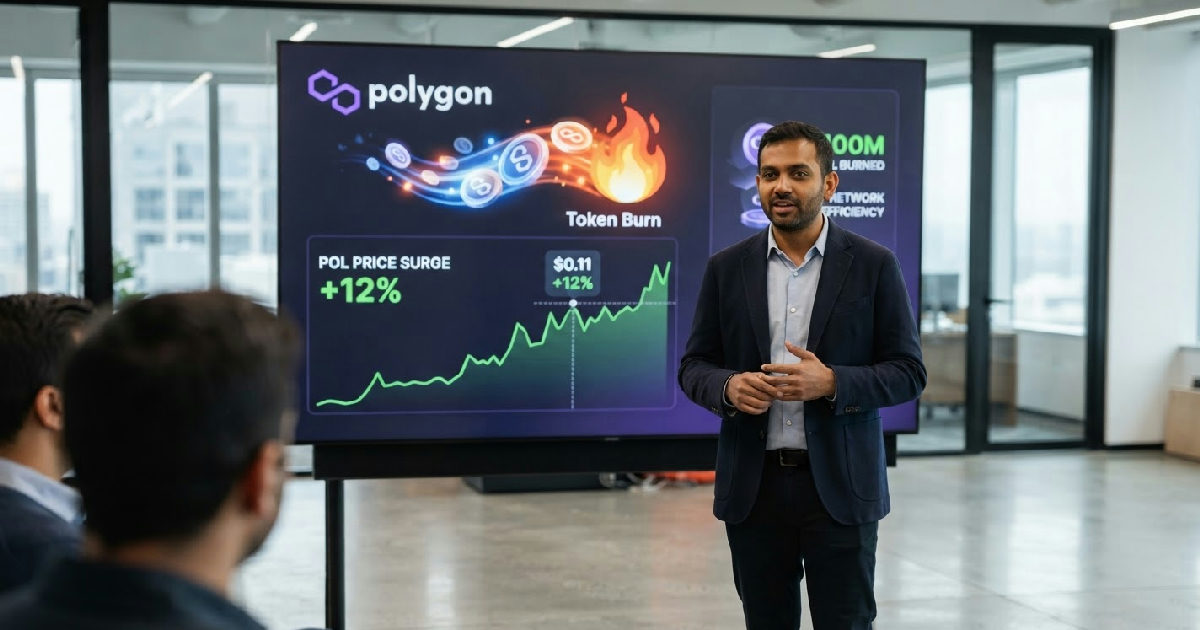

The Polygon (POL) token has rallied by nearly 12% since September 23, 2026, when the network permanently removed 100 million tokens from circulation. This significant Ethereum scaling solution move, confirmed by Polygon Foundation CEO Sandeep Nailwal, aims to enhance scarcity for the digital asset.
The burn effectively took approximately 1% of POL’s total supply out of circulation, valued at around $10.22 million at the time. The price climbed to about $0.113, prompting market observers to watch if the token can sustain its upward momentum past immediate resistance.
Polygon POL token burn reshapes tokenomics
Polygon’s decision to permanently remove 100 million POL tokens was driven by accumulated network fees within its EIP-1559 base-fee mechanism. These tokens were transferred to an unspendable Ethereum address, ensuring their permanent removal from the supply.
The core principle behind such token burns is to create scarcity. By reducing the available supply, the remaining tokens could theoretically become more valuable if demand remains stable or increases. This particular event also introduces a framework for future community-triggered, fee-funded burns, which are planned quarterly.
This initiative significantly strengthens POL’s tokenomics, linking supply reduction directly to network activity and revenue generation. According to Nailwal, POL has maintained a net deflationary status since January 2026, indicating a broader trend towards supply management.
The burn followed Polygon’s transition from MATIC to POL, which officially occurred on September 4, 2024. This 1:1 migration established POL as the native gas and staking token for the Polygon PoS network, solidifying its central role in the ecosystem.
POL Price Faces Critical Resistance Levels
Following the September 23 burn, the Polygon POL token reacted with an 11.6% ascent from its pre-burn levels, pushing its price to approximately $0.113. This rapid upward movement has placed the token at a crucial juncture, facing immediate tests at higher price points.
The token briefly touched the $0.11497 mark during the latest session but failed to establish a firm foothold above the $0.115 resistance level. This specific price area now represents the nearest significant challenge for buyers looking to solidify the recent gains.
A sustained breach above $0.115 could potentially clear the path towards the $0.12 price level. However, the region between $0.12 and $0.125 previously saw a sharp rejection for POL earlier in September, indicating it might prove a more formidable barrier for sustained growth.
Maintaining a price above the $0.11 level remains a key objective, offering encouragement that buyers are actively defending the post-burn recovery. The asset had experienced a previous POL decline before this recent rebound, underscoring the importance of current support.
Should the price falter from current levels, initial support is anticipated to emerge between the $0.107 and $0.110 price areas. Holding this range would signal continued underlying buyer interest and a resilient recovery.
Conversely, a decisive fall below this critical support could see POL retrace towards the $0.102 area. This level is close to where the latest post-burn advance began, marking a potential full reversal of the recent gains.
Polygon Network’s Foundation and Future Outlook
The 100 million Polygon POL token burn is more than just a momentary price catalyst; it reflects a deliberate move to reinforce the network’s economic foundation. This strategic action builds upon Polygon’s already strong performance metrics.
The network boasts impressive year-to-date (YTD) revenue for 2026, reaching $24.5 million. This figure significantly outperforms competitors like Arbitrum, which recorded $8.41 million, and NEAR, with $5.6 million, highlighting Polygon’s robust economic activity.
Such substantial revenue generation implies a healthy and active ecosystem, which in turn fuels the very fee-collection system from which burned tokens originated. Daily revenue and fees have stabilized above $200,000, with application fees often exceeding $500,000.
Beyond its financial performance, Polygon’s technical infrastructure supports this growth, with its Transaction Per Second (TPS) scaled to 5,000. Its agent payment system handles an impressive 11 million payment updates per second, demonstrating its capacity for high-volume operations.
The burn provides Polygon with a stronger supply-reduction narrative, but it doesn’t guarantee sustained price increases in isolation. POL must still attract sufficient demand to defend and build upon its recent progress.
The initiative signals a long-term commitment to enhancing POL’s value proposition through managed supply. This structural change, coupled with the network’s fundamental strength, positions POL to potentially overcome future resistance levels, including the $0.12 to $0.125 range.