
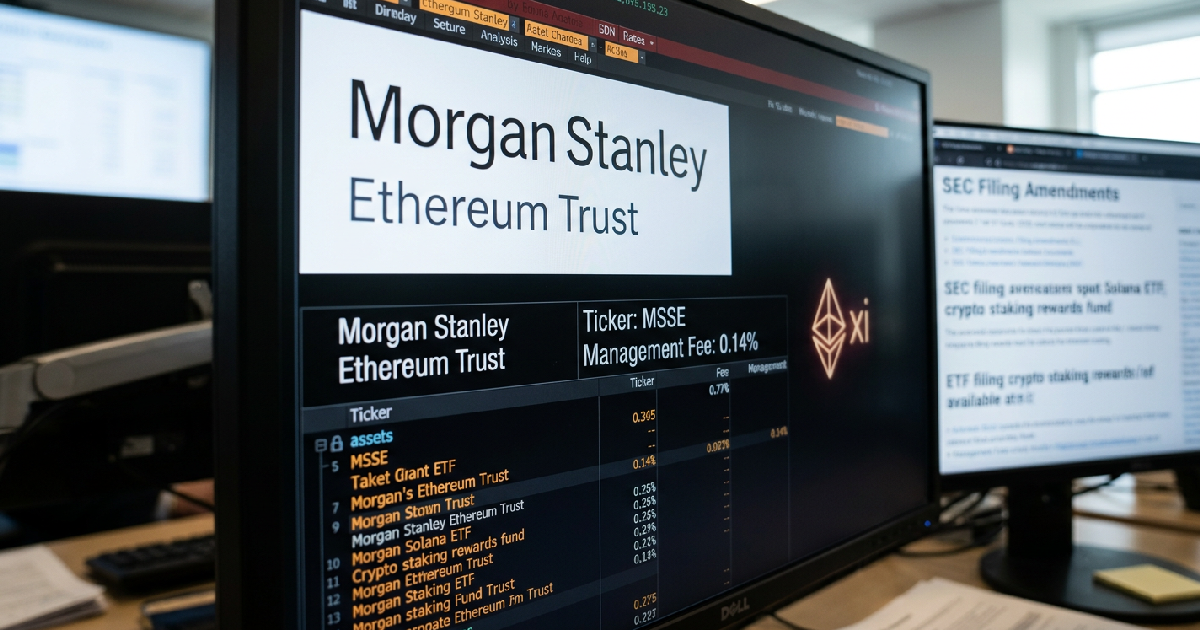

Morgan Stanley submitted second-amended S-1 registration statements to the U.S. Securities and Exchange Commission (SEC) on Thursday, June 19, 2026, for its proposed spot Ethereum and Solana exchange-traded funds.
The Wall Street giant updated its filings for the Morgan Stanley Ethereum Trust (MSSE) and the Morgan Stanley Solana Trust (MSOL) to include specific staking provisions and an industry-leading fee structure. By introducing a 0.14% annual sponsor fee, the bank is positioning itself to undercut established competitors in the digital asset market.
The move represents a major escalation in the race for institutional crypto dominance. While most issuers have struggled with the regulatory hurdles of including staking rewards within an ETF wrapper, Morgan Stanley has outlined a transparent distribution model.
Morgan Stanley sets competitive 0.14 percent fees for MSSE and MSOL
The firm plans to allow 95% of staking rewards to remain within the trusts for the benefit of shareholders, while the remaining 5% will cover compensation for staking service providers and custodians. This structure ensures the bank does not profit directly from the staking yield beyond its stated management fee.
These filings follow a year of increasing institutional appetite for diversified crypto exposure. Morgan Stanley first entered the spot crypto ETF arena in January 2026 with its Bitcoin Trust (MSBT), which has already attracted approximately $300.7 million in cumulative net inflows.
The decision to expand into Ethereum and Solana suggests the bank sees long-term value in proof-of-stake networks, even as Ethereum price outlook weakens following recent technical breakdowns and broader market outflows.
The proposed 0.14% annual sponsor fee is the cornerstone of Morgan Stanley’s market strategy. If the SEC approves the registrations, these funds would become the most affordable spot Ethereum and Solana ETFs available to U.S. investors. This pricing strategy specifically targets the Grayscale Mini Ethereum Trust, which carries a 0.
15% fee, and Franklin Templeton’s SOEZ, which currently sits at 0.19%. The bank’s willingness to compete on razor-thin margins mirrors the fee wars seen during the initial Bitcoin ETF launches.
According to the filings, the sponsor fee will be accrued daily and paid monthly. This low-cost approach is likely intended to capture retail and institutional capital that remains sensitive to the “drag” of high expense ratios on long-term returns. Investors are increasingly looking for ways to maximize yield, particularly as Ethereum network outlook strengthens through increased decentralized exchange activity and broader protocol adoption.
The timing of these amendments is also telling. Morgan Stanley broadened crypto fund access to its entire client base, including retirement accounts, in late 2025. By offering the lowest fees in the sector, the firm can leverage its massive distribution network to channel existing client capital into these new digital asset vehicles.
This could provide a significant liquidity boost to both the Ethereum and Solana ecosystems at a time when traditional finance integration is accelerating.
Staking mechanics and third-party provider selections for the trusts
A key differentiator in these amended filings is the granular detail regarding how staking will function. Morgan Stanley has named Figment Inc., Galaxy Blockchain Infrastructure LLC, and Coinbase Canada Inc. as the primary staking service providers.
These entities will operate the validators on behalf of the trusts, while custodians such as BNY Mellon and Coinbase Custody Trust Company will manage the underlying assets. Notably, the staking custodians will not have control over the private keys of the Solana tokens they stake.
For the Ethereum Trust, the process involves depositing ETH into staking smart contracts. However, investors face specific protocol-level constraints that the bank has detailed for transparency. As of May 18, 2026, roughly 3.64 million ETH was queued for validator activation.
Because the network limits new stakers to 56 per epoch—roughly 57,600 ETH per day—Morgan Stanley estimates a waiting period of approximately 63 days before newly staked ETH can begin earning rewards.
The Solana filing differs by not disclosing a maximum daily staking limit, though it confirms that providers will act as delegated validators. This distinction highlights the different architectural approaches of the two blockchains. While the lure of staking rewards is high, it comes with risks.
The filings explicitly warn that staked assets remain exposed to “slashing” penalties if third-party validators fail to meet network requirements or violate protocol rules, a risk that investors must weigh against the potential 95% reward pass-through.
Market reaction and the path to SEC approval
The market has shown early signs of optimism following the June 19 filings. Solana-focused investment products recorded $2.99 million in inflows on Thursday alone, pushing weekly totals to $7.11 million. This uptick in activity suggests that institutional investors are front-running a potential approval, particularly as Russia lawmakers push to legalize Solana and other assets, signaling a global shift toward normalizing these digital tokens.
Repeated amendments to S-1 filings are generally viewed by analysts as a sign of productive dialogue between the issuer and the SEC. By addressing complex issues like reward distribution and slashing risks upfront, Morgan Stanley is attempting to clear the regulatory hurdles that have stalled previous attempts at “staking-enabled” ETFs.
If approved, the MSSE and MSOL tickers could set a new standard for how traditional financial institutions package and sell crypto assets to the public.
For now, the certificates remain in the “proposed” stage. The SEC’s decision will likely hinge on whether it views Morgan Stanley’s third-party validator disclosures as sufficient to protect retail investors from the technical volatilities inherent in proof-of-stake protocols.
As the 63-day waiting period for Ethereum staking yields illustrates, these products are far more complex than their Bitcoin counterparts, requiring a higher level of operational sophistication from both the sponsor and the regulators.