
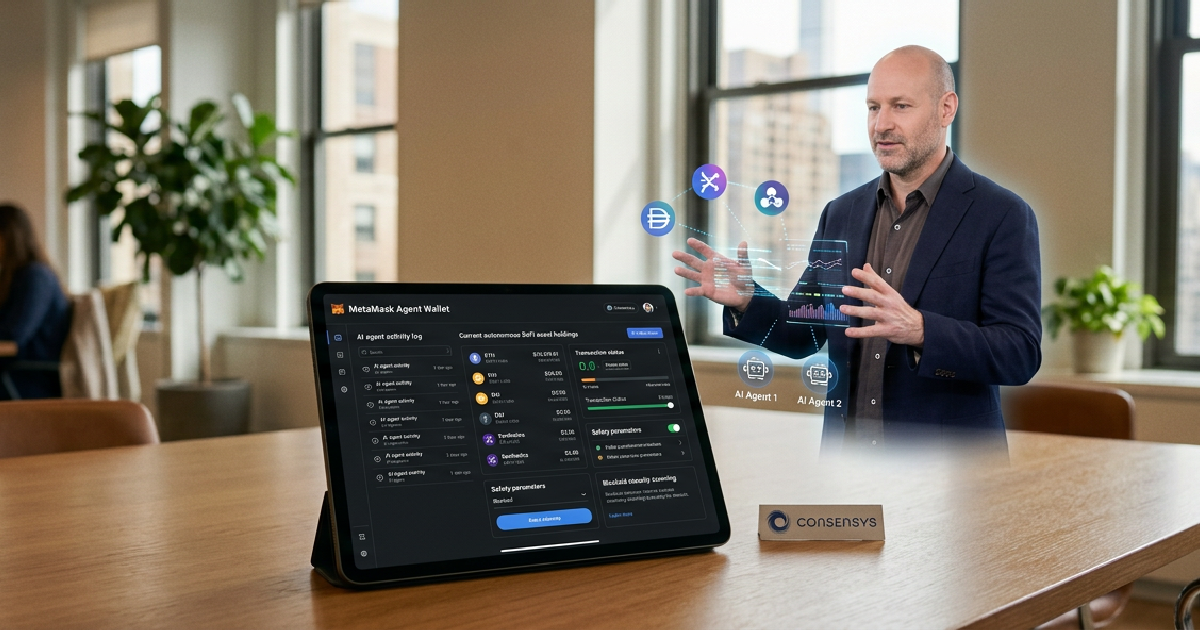

Consensys officially launched its MetaMask Agent Wallet on June 8, 2026, in New York, introducing a self-custodial solution specifically engineered for autonomous AI agents. The tool allows these digital entities to trade across decentralized finance (DeFi) protocols and manage real capital without requiring human approval for every individual transaction.
By integrating threat scanning from Blockaid and mandatory security checks, MetaMask aims to secure an emerging market where AI agents are expected to handle billions in assets.
The product arrives at a time when the crossover between artificial intelligence and blockchain is moving from theoretical research to daily utility. Industry leaders like Joe Lubin, the Founder and CEO of Consensys and Co-Founder of Ethereum, argue that the next phase of the on-chain economy will be spearheaded by autonomous software.
Lubin noted that because agents will manage real capital and make financial decisions, the underlying infrastructure must be inherently secure and capable of scaling without sacrificing user control.
Currently, the MetaMask Agent Wallet is available through a limited early-access program via a command-line interface (CLI), with approximately 200 users already participating. A broader general release is scheduled for later in the summer of 2026. This development reflects a shift in how market structure analysis is performed, as automated agents begin to take over high-frequency tasks previously reserved for human traders.
Establishing security guardrails for autonomous DeFi trading
A primary concern for the industry is the potential for AI agents to be exploited by malicious code or unforeseen logic errors. Gartner has projected that by 2028, one in four enterprise breaches could originate from the exploitation of AI agents.
To counter this, MetaMask has implemented a “leash” system that ensures users remain the ultimate authority over their funds, even when delegating complex financial tasks to an AI.
The wallet operates with two distinct settings: Guard Mode and Beast Mode. Guard Mode is the default setting, where users pre-define specific spending limits, approved protocols, and allowlisted addresses. Any operation that falls outside these parameters immediately triggers a two-factor authentication (2FA) request for the human owner. This prevents an agent from draining a wallet due to a bug or a directed hack.
For more experienced users, Beast Mode reduces approval friction while maintaining a baseline of security. Even in this high-performance setting, the system routes potentially malicious transactions to human review. All transactions, regardless of the mode, undergo simulation and threat scanning powered by Blockaid to identify risks before the transaction is broadcast to the network.
Extending reach across the EVM ecosystem
The MetaMask Agent Wallet is designed to be highly versatile, supporting more than 25 Ethereum Virtual Machine (EVM) compatible blockchains. This includes major networks such as Ethereum, Linea, Arbitrum, Avalanche, Optimism, Base, Polygon, and BSC. It also extends support to newer high-performance environments like Hyperliquid, which has recently gained attention as a significant target for automated trading.
This wide-ranging compatibility allows AI agents to engage in a variety of DeFi activities beyond simple token swaps. Agents can manage perpetual contracts, participate in prediction markets, and provide liquidity across multiple chains simultaneously. Crucially, private keys are stored in a secure enclave that is inaccessible to both Consensys and the MetaMask software, maintaining the principles of self-custody.
The wallet is also built to be framework-agnostic. It integrates seamlessly with popular developer tools and AI models, including OpenAI Codex, Claude Code, and the Nous Research Hermes Agent. This flexibility ensures that developers can choose the best “brain” for their AI while relying on MetaMask to provide the financial “limbs” and security oversight.
Future projections and the growing agentic economy
The financial stakes of this technological intersection are substantial. Projections suggest the global AI agent market could grow from $5.4 billion in 2024 to a staggering $236 billion by 2034. As market confidence grows in autonomous systems, the demand for secure “agentic” wallets is expected to surge among both retail power users and institutional players.
MetaMask is not alone in identifying this trend. Competitors like Coinbase and Fireblocks have recently introduced their own versions of agentic payment suites and wallets. However, MetaMask is banking on its comprehensive security stack and its vast existing user base to maintain dominance.
One notable feature is a $10,000 guarantee against losses for transactions deemed “safe” by the system, providing a safety net for early adopters.
As the “summer of 2026” release date approaches, the industry will be watching closely to see if AI agents can navigate the complexities of DeFi without the catastrophic errors that have plagued earlier automated trading attempts. For now, the “leash” provided by the MetaMask Agent Wallet represents a necessary compromise between the speed of AI and the essential human need for asset protection.