
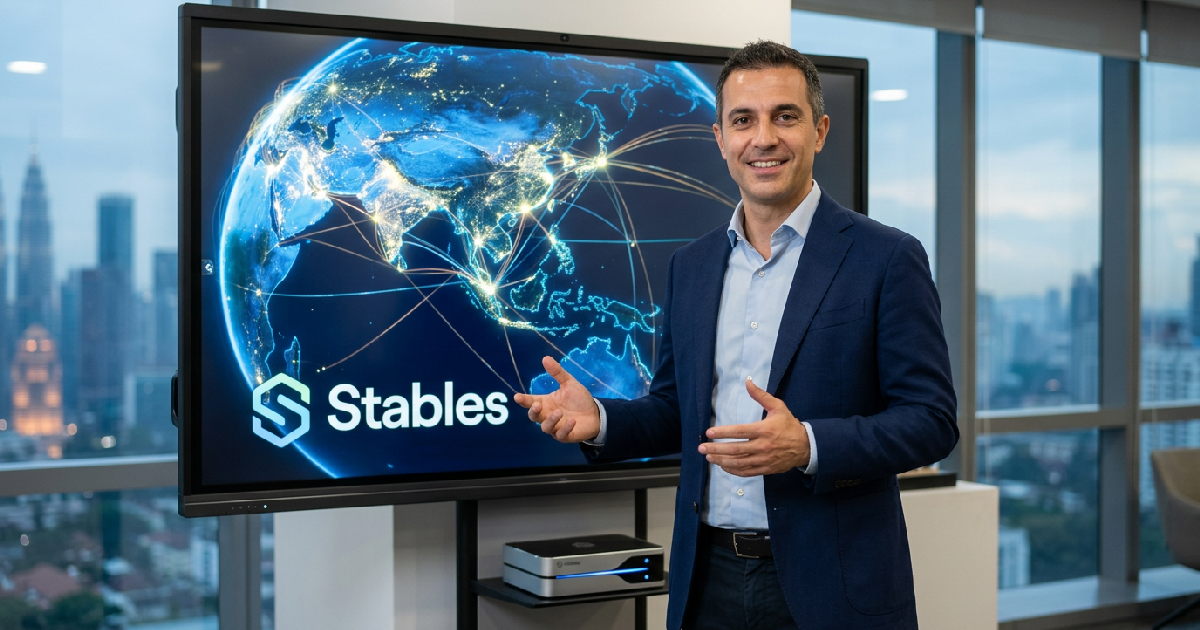

Singapore-based startup Stables is introducing a universal AI payment plug into Asia’s multi-trillion dollar trade ecosystem, aiming to bypass the fragmented legacy infrastructure that currently slows cross-border business. CEO Bernardo Bilotta is positioning the firm to capture a share of the Asia-Pacific business-to-business (B2B) e-commerce market, which is projected to exceed $28.
9 trillion by the end of 2026. Rather than focusing on retail traders, the project targets machine-to-machine payments where autonomous software agents move capital without human intervention.
The technical ambition involves embedding an Anthropic-standard Model Context Protocol (MCP) server directly into payment rails. Stables aims for this integration to allow software systems to programmatically navigate compliance, pull real-time FX quotes, and settle transactions natively across borders. Current financial regulations and identity checks were built for humans, often requiring manual intervention that prevents AI agents from executing payment loops independently.
This shift toward machine-centric infrastructure addresses a significant bottleneck in a region where roughly 60% of global stablecoin payments occur. As Bitcoin signals market structure analysis 2026 indicates, the industry is increasingly moving toward utility-driven settlement layers. By serving as a universal interpreter for autonomous agents, Stables hopes to solve the friction within a banking system that remains slow for international trade.
Infrastructure for a machine-led economy
The scale of the “machine economy” is expected to dwarf traditional retail crypto activity over the coming decade. Stables CEO Bernardo Bilotta argued in an interview with CoinDesk that the entirety of commerce could move through AI agents within the next five years. He noted that money will increasingly flow through software systems acting on behalf of businesses rather than directly between human individuals.
This outlook is shared by other industry leaders. Charles Hoskinson, Founder and CEO of Cardano’s Input Output, has stated that AI agents will become more relevant than humans by 2035. The growth of B2B e-commerce in Asia, which is currently expanding at a 15% annual clip, provides a massive testing ground for these automated rails.
While Tether treasury holdings highlight how stablecoins have integrated into U.S. debt markets, Stables is focusing on the execution layer for real-world trade.
While companies like Stripe and Mastercard have invested heavily in fiat-to-crypto APIs, the specific niche of machine-to-machine settlement remains largely underserved. Stables intends its backend middleware to act as a compliant bridge, allowing AI systems to pay for APIs, compute power, and other services without a human procurement officer clearing every step.
This bypasses the regional accounts where corporate funds often sit idle during slow legacy settlement processes.
The rise of autonomous economic agents
The movement toward machine-optimized execution goes beyond simple payments to include decentralized intelligence markets. Projects like Fetch.ai and Olas (formerly Autonolas) are already building the infrastructure required for autonomous economic agents to coordinate tasks and share data independently. This ecosystem is being supported by a sharp rebound in venture capital, with $7.9 billion deployed into U.S. crypto firms in 2025.
Even former digital asset miners are pivoting to support this AI-driven future. Core Scientific and IREN Limited, which operates data centers in Australia and Canada, have shifted focus toward high-performance computing (HPC) for AI clients. This transition highlights a broader trend: the crypto sector’s most valuable assets are no longer just tokens, but the power contracts and data centers that fuel machine intelligence.
Furthermore, the efficiency of on-chain capital is reaching new highs, with representations of cash and money market instruments crossing $36 billion in 2025. As Hyperliquid potential market assessments often suggest, the real growth vector lies in serving the trillions of dollars in real-world assets migrating to digital rails. For these assets to move efficiently, the infrastructure must assume the end-user is a piece of software.
Transitioning from retail to industrial utility
The focus on B2B trade represents a maturation of the digital asset industry. Stablecoin transactions on-chain now frequently rival the volumes of major credit card processors. However, the existing “plumbing” of global finance remains a barrier. Bilotta noted that an autonomous AI agent cannot currently pass a standard compliance check without human steps, a structural gap Stables aims to bridge.
If successful, the introduction of universal AI payment plugs could transform how $28.9 trillion in Asian trade is settled. The goal is to move from a world of human-triggered wire transfers to a programmatic environment where software handles FX and settlement natively.
Bilotta concludes that the next phase of stablecoin adoption will not be driven by price speculators but by businesses and AI systems moving real money in the real economy.
The broader market reflects this optimism, with the total cryptocurrency market cap anticipated to approach $10 to $12 trillion by 2030. Within that same timeframe, the demand for tokenized real-world assets is projected by some analysts to reach tens of trillions of dollars.
Building the infrastructure now is a prerequisite for that scale, ensuring that the software agents of the 2030s have a reliable way to pay for the resources they consume.