
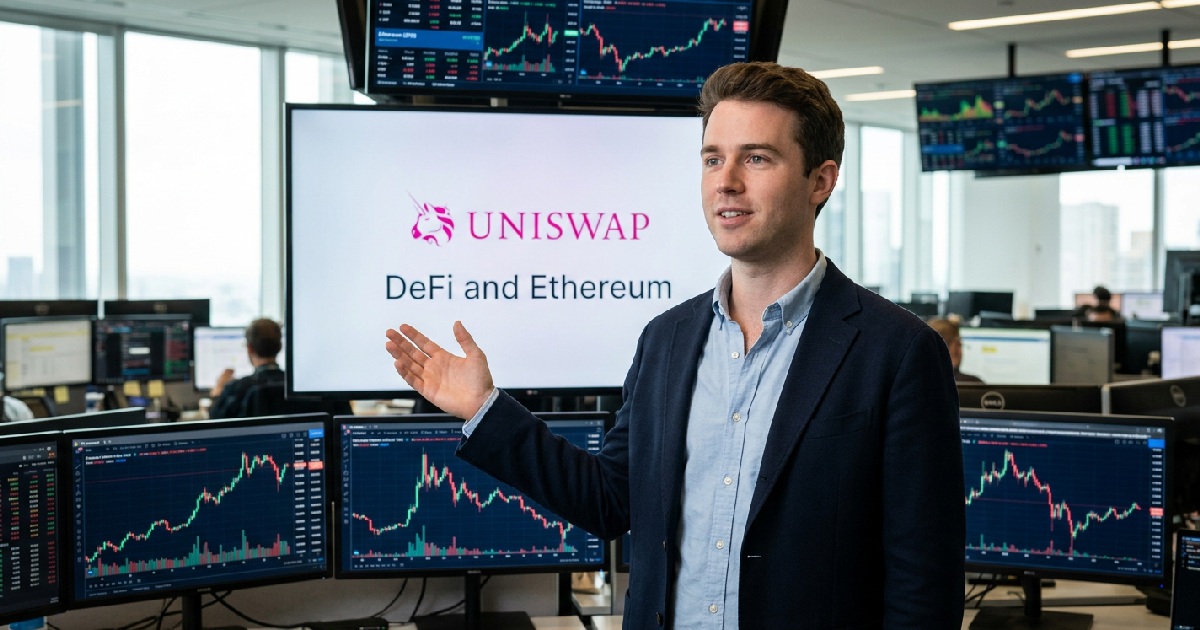

Uniswap founder Hayden Adams declared on June 5, 2026, that he remains “extremely bullish” on the future of Decentralized Finance (DeFi) and Ethereum despite a prolonged market downturn that has seen token prices languish far below historic highs.
Posting to the social media platform X, the CEO of Uniswap Labs drew direct parallels between the current industry sentiment and the 2018 bear market, a period of deep skepticism that eventually gave way to the expansion of the on-chain economy.
The founder noted that the “DeFi summer” of 2020 was only possible because developers relentlessly built infrastructure when Ethereum sentiment was at all-time lows. This historical perspective comes at a pivotal moment for the protocol, as it continues to process massive volumes while its native token, UNI, trades at approximately $2.47.
This valuation represents a decline of more than 92% from the May 2021 peak of $44.97, underlining the disconnect between protocol utility and market pricing.
Adams’ optimism is backed by recent on-chain metrics showing that activity on the decentralized exchange remains robust. On June 4, just one day prior to his comments, the UNIfication program recorded a single-day record burn of 134,000 UNI tokens.
By permanently removing these tokens from circulation through the “Firepit” contract, the protocol is executing a long-term deflationary strategy designed to align the interests of the platform with its token holders over time.
Hayden Adams highlights DeFi growth and historical market cycles
The core of the bullish thesis presented by Hayden Adams rests on the idea that bear markets act as a crucible for genuine innovation. He reminded his followers that Uniswap actually launched in the middle of the 2018 crash.
During that era, many critics questioned whether Ethereum had any viable use cases beyond simple token transfers. The subsequent rise of automated market makers (AMMs) proved that Ethereum could host entire financial ecosystems without traditional intermediaries.
Current data suggests that Uniswap is maintaining its dominance in the decentralized trading space. The protocol currently holds $2.86 billion in Total Value Locked (TVL) spread across multiple blockchain networks. Ethereum remains the primary anchor for this liquidity, accounting for $1.96 billion.
However, the growth of Layer 2 solutions such as Base, which holds $416 million in TVL, suggests the ecosystem is successfully scaling to meet lower-cost demand.
As the market watches for a late-2026 breakout potential, the steady accumulation of fees on Uniswap tells a story of consistent usage. Since its inception, the protocol has generated a cumulative $5.59 billion in fees. Recent reports indicate that annualized fee generation is currently running near $882 million, a figure that rivals many traditional fintech companies and reinforces Adams’ confidence in the model’s sustainability.
Record UNI token burn signals shift in protocol economics
The record-breaking burn of 134,000 UNI tokens in 24 hours marks a significant milestone for the UNIfication mechanism. This plan, first approved in late 2025, requires users claiming protocol fees to burn an equivalent value of UNI. This process effectively redirects a portion of the protocol’s success back into the scarcity of the token.
To date, this mechanism has directed approximately $14.15 million in value to the burn address.
While some traders have focused on the $1.54 billion market cap of UNI, proponents argue the real value lies in the protocol’s expanding footprint. In May 2026, governance passed Proposal 96, which broadened the fee collection and burn mechanism to include BNB Chain, Polygon, and Celo.
This brings the total number of chains participating in the burn program to 11, despite Uniswap operating across more than 40 different networks in total.
This expansion mirrors broader trends where Binance Chain token open interest and similar metrics show a shift toward diversified on-chain activity. By capturing fees across multiple ecosystems, Uniswap is positioning itself as the universal liquidity layer of the crypto economy. This multi-chain strategy appears to be paying off in terms of user acquisition and retention.
Onboarding a new generation of decentralized traders
Internal research from Uniswap Labs indicates that the protocol remains the primary entry point for newcomers. According to data from early 2026, approximately 49.9% of new traders on Ethereum, Arbitrum, and Base performed their first-ever cryptocurrency swap on Uniswap. This high capture rate of new users provides a defensive moat against competitors and validates the recent focus on user experience features.
To maintain this lead, the team recently rolled out four major cross-chain features, including in-app wallets and live portfolio tracking. These updates aim to abstract away the complexity of managing assets across different blockchains.
By offering zero interface fees on many of these swaps, Uniswap is directly challenging centralized exchanges for the casual retail market, even as professional liquidity providers remain anchored to the core protocol.
The long-term outlook for Ethereum itself remains a core component of this strategy. With analysts monitoring the 200-day moving average and other technical indicators for signs of a broader market reversal, Hayden Adams is betting that the underlying utility of DeFi will eventually decouple from speculative price action. For now, the “relentless building” phase continues, regardless of the daily ticker price.