
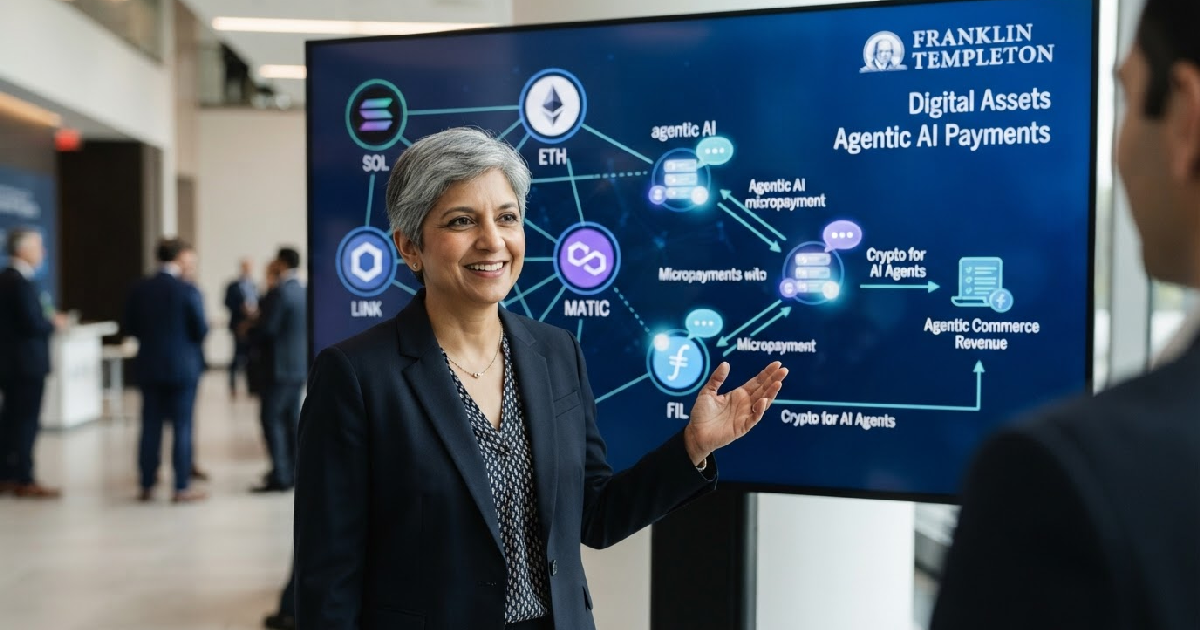

Franklin Templeton suggests investors consider altcoins as a key way to profit from the growing agentic AI sector, managing $1.8 trillion in assets. 8 trillion in assets, has strongly suggested that investors look to altcoins as a critical component for capitalizing on the burgeoning agentic artificial intelligence (AI) sector.
Sandy Kaul, the firm’s Head of Digital Assets, contends that autonomous AI agents will necessitate blockchain technology for efficient micropayments, effectively making altcoins a foundational layer for this next wave of AI innovation.
Blockchain’s efficiency for AI transactions
This perspective, reported on July 22, 2026, signals a significant endorsement from a major traditional finance player. It challenges the conventional wisdom that investors should only chase growth opportunities by buying shares in AI-aligned technology companies.
Kaul’s core thesis centers on how AI agents will operate and transact within their ecosystems. These autonomous software entities will constantly make small, sub-cent payments for compute resources, data access, and various services.
Traditional payment networks, with their typical 2% to 3% transaction fees plus flat charges per payment, simply aren’t viable for these tiny, high-frequency machine-to-machine payments. Blockchains, however, offer a solution by settling transactions in seconds at a fraction of a cent, with automatic record-keeping.
“Agentic AI will likely need to rely on crypto technologies and blockchains to enable their activities as these rails are ideally suited for these use cases,” Kaul explained. She sees blockchains and crypto technologies becoming the “foundational delivery layer” for these critical transactions.
Furthermore, AI agents face inherent limitations in accessing traditional financial services. They cannot easily open bank accounts or comply with strict Know Your Customer (KYC) requirements, making decentralized crypto rails a necessity.
Altcoins as the engine of agentic AI
The investment logic follows directly from this transaction demand. For an AI agent to record activity or pay for services on a blockchain network, it must use that network’s native token.
Kaul uses Solana (SOL) as a prime example, suggesting that increased agent activity on such chains could directly boost demand for their respective native tokens. She anticipates enterprise software will drive the initial wave of this adoption.
“To capture the potential of agentic AI, those same portfolios should consider extending their exposure to cryptocurrencies and the alt coins being generated by blockchain-based apps and projects,” Kaul advised.
This means investors looking to tap into AI’s growth shouldn’t solely focus on technology stocks. They should broaden their portfolios to include the digital assets that power the underlying infrastructure AI agents will depend on.
Growing institutional validation and adoption
Franklin Templeton isn’t just talking about crypto; they’re actively building in the space. The firm has been expanding its digital asset portfolio and now offers exchange-traded funds (ETFs) tracking major cryptocurrencies like Bitcoin, Ethereum, Solana, and XRP.
Their active involvement highlights a broader trend of institutional players recognizing crypto’s growing significance. The firm also acquired a crypto investment firm earlier in 2026 to further bolster its digital asset capabilities.
John Gillen, former BlackRock Vice President and host of Milk Road Daily, commented on Tuesday that a “Head of Digital Assets and Innovation for a $2 trillion asset manager ‘just said to buy $ETH’.” This underscores the weight of Kaul’s statements within the broader financial community.
Emerging standards also support the shift towards blockchain-based payments for AI. Coinbase, for instance, developed the x402 payment protocol. It has since moved to the Linux Foundation, gaining support from industry giants like Visa, Mastercard, Stripe, Google, and Circle.
Future of agentic commerce and investment
The opportunity in agentic commerce, powered by AI and blockchain, is substantial. McKinsey estimates this sector could orchestrate between $3 trillion and $5 trillion in revenue by 2030.
If a significant portion of these transactions occurs on blockchain networks, the demand for the cryptocurrencies that power those ecosystems could see a dramatic increase. This scenario presents a compelling investment case for altcoins beyond just traditional AI stocks.
Earlier reports from Franklin Templeton, dating back to January 2025, also highlighted the transformative potential of AI agents, particularly in areas like social media. These reports predicted a surge in AI-related tokens as agents learned to launch brands, create content, and generate economic value.
As the firm deepens its bet on both AI equities and crypto ETFs, it also plans to expand its use of Wand AI’s intelligent agents in 2026. This move aims to drive digital transformation and enhance investment research internally, showcasing a practical application of the very technology they’re advocating for.
The International Monetary Fund (IMF) also weighed in recently, stating in an April report that agentic AI is set to reshape payments. They noted that relevant standards are already under development. This adds another layer of institutional validation to Kaul’s outlook.
Ultimately, Kaul believes that to truly capture the value emerging from decentralized networks and businesses, investors will need to acquire the cryptocurrencies and altcoins issued by these entities. Such investments, she suggests, are poised to become “key holdings in portfolios” for those aiming to capitalize on the agentic AI opportunity.