
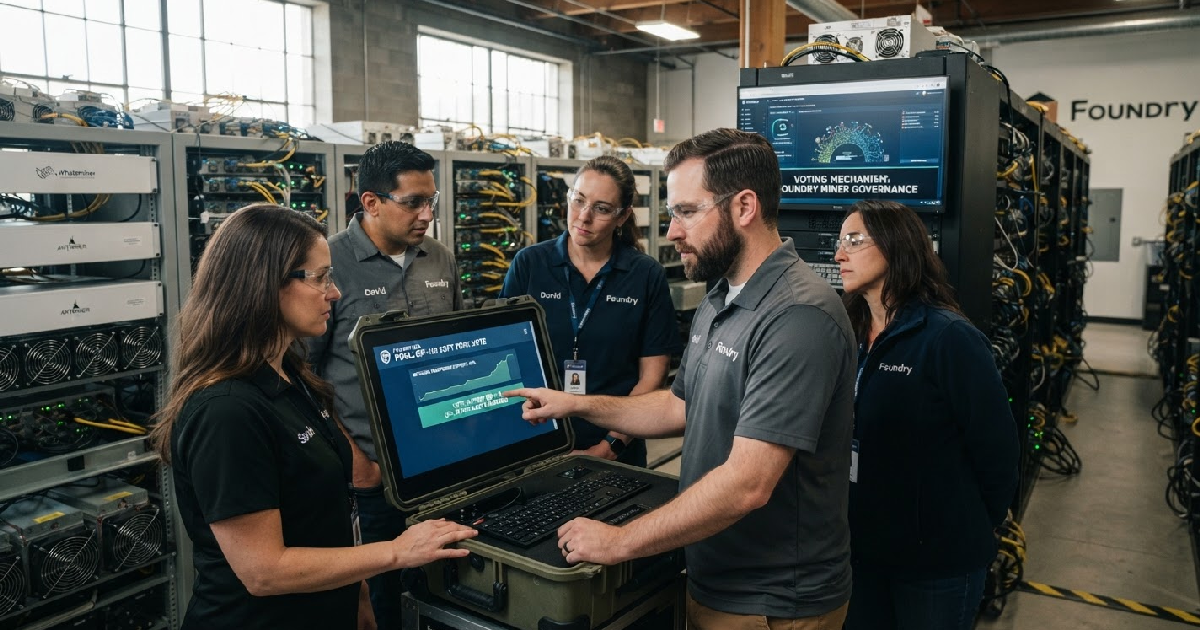

Foundry Digital will let its mining clients decide on the Foundry BIP-110 vote for Bitcoin Improvement Proposal 110, announced Friday, July 17, 2026. This Foundry BIP-110 vote places significant decision-making power directly in the hands of the miners who contribute computing power to the Rochester, New York-based firm.
BIP-110 is a proposed temporary soft fork designed to restrict arbitrary, non-monetary data embedded on the Bitcoin blockchain. The outcome of this internal Foundry BIP-110 vote could profoundly influence whether the proposal gains enough support to activate, given Foundry’s substantial share of the network’s hashrate.
Miner control over the Foundry BIP-110 vote
Foundry Digital’s decision marks a pivotal moment in the ongoing debate around Bitcoin’s blockchain usage. As the operator of roughly one-third of the entire Bitcoin network’s hashrate, Foundry’s signaling stance carries immense weight. The firm stated that it’s “important for you to have a voice and participate in the governance of the network,” acknowledging the active discussions surrounding BIP-110.
The proposal itself, also known as the “Reduced Data Temporary Softfork,” aims to cap the amount of arbitrary data that can be carried within transactions. This includes specific limits like restricting most new outputs to 34 bytes and restoring an 83-byte limit on OP_RETURN outputs, while rejecting data pushes exceeding 256 bytes.
Divergent Views on Bitcoin’s Purpose
BIP-110 has sharply divided the Bitcoin community, pitting those who see the network primarily as a medium for peer-to-peer money against those who champion its capacity for broader data embedding. Proponents, including the proposal’s author Dathon Ohm, argue that the soft fork would allow Bitcoin to function as pure peer-to-peer money.
They believe it would temporarily curb “spam” and refocus efforts on improving Bitcoin as a monetary system.
For them, restricting non-monetary data would alleviate the burden on node operators and prevent data storage from unfairly competing with payment transactions. This, they contend, makes Bitcoin transactions unnecessarily costly and could inadvertently push users towards third-party payment processors. The rules would specifically target data associated with Ordinals inscriptions, BRC-20 tokens, Runes, and oversized OP_RETURN payloads.
However, prominent figures like Strategy founder Michael Saylor and Blockstream co-founder Adam Back staunchly oppose BIP-110. They contend that it transforms a policy disagreement into a consensus-level change that could invalidate transactions that are currently considered valid and fee-paying. Michael Saylor specifically warned that this “precedent is the danger,” raising concerns about protocol-level censorship.
Foundry’s Unique Voting Mechanism
Foundry Digital has outlined a distinct, hashrate-weighted voting process for its clients. Miners will cast their votes using their actual computing power, and each vote’s influence will be proportional to the account’s average 10-day hashrate on the pool, calculated between July 6 and July 15. This method ensures that the collective decision reflects the mining power committed to the pool.
Crucially, Foundry’s default position is “No” for BIP-110. The pool will signal “No” with all of its blocks until “Yes” votes from its clients collectively cross a 51% threshold of the total voting hashrate. Once this threshold is met, Foundry will switch its signaling to “Yes” across all its blocks. Accounts that do not actively respond will automatically count as “No” votes.
Miners retain the flexibility to change their vote during the signaling period, which is expected to extend through early August, aligning with Bitcoin block 961,632. While individual votes will remain confidential, Foundry may share aggregate results. This transparent but confidential process aims to balance individual miner autonomy with the pool’s unified signaling requirements.
The Road to Activation and Beyond
The signaling period and the impending mandatory signaling window are critical for BIP-110’s future. A mandatory signaling window between blocks 961,632 and 963,647 will compel a decision before the activation timeline closes. During this period, any blocks not signaling bit 4 will be rejected as invalid. If sufficient support is garnered, activation is projected around block 965,664, likely near September 1, 2026.
Should BIP-110 activate, its rules are designed to be temporary, expiring automatically after approximately one year, or 52,416 blocks. This temporary nature is a key aspect for proponents, who view it as a corrective measure rather than a permanent alteration. However, opponents remain wary of the precedent set by any protocol-level change that could be perceived as censorship, even if time-bound.
The debate surrounding BIP-110 isn’t new; it echoes historical discussions like the “OP_RETURN wars” of 2014, where developers and projects argued over the appropriate size limits for data embedded in transactions. Back then, compromises were made to prevent blockchain bloat while allowing some data. Today’s discussion reopens those fundamental questions about Bitcoin’s design philosophy and its intended use cases.
Impact on Bitcoin’s Ecosystem and Future Development
Foundry Digital’s decision to decentralize the BIP-110 vote among its clients underscores the ongoing tension between technical efficiency, network governance, and philosophical purity within the Bitcoin ecosystem. If the “Yes” votes prevail within Foundry, it will send a powerful signal to the wider network and significantly boost BIP-110’s chances of activation.
The temporary restriction of data could impact various segments of the crypto market, particularly those leveraging Bitcoin for non-monetary applications like NFTs and alternative tokens.
While proponents see this as a necessary step to maintain Bitcoin’s core function and reduce network strain, critics fear it could stifle innovation and set a dangerous precedent for future protocol changes. The outcome of this Foundry BIP-110 vote will undoubtedly shape discussions around Bitcoin’s evolving role for months to come.