
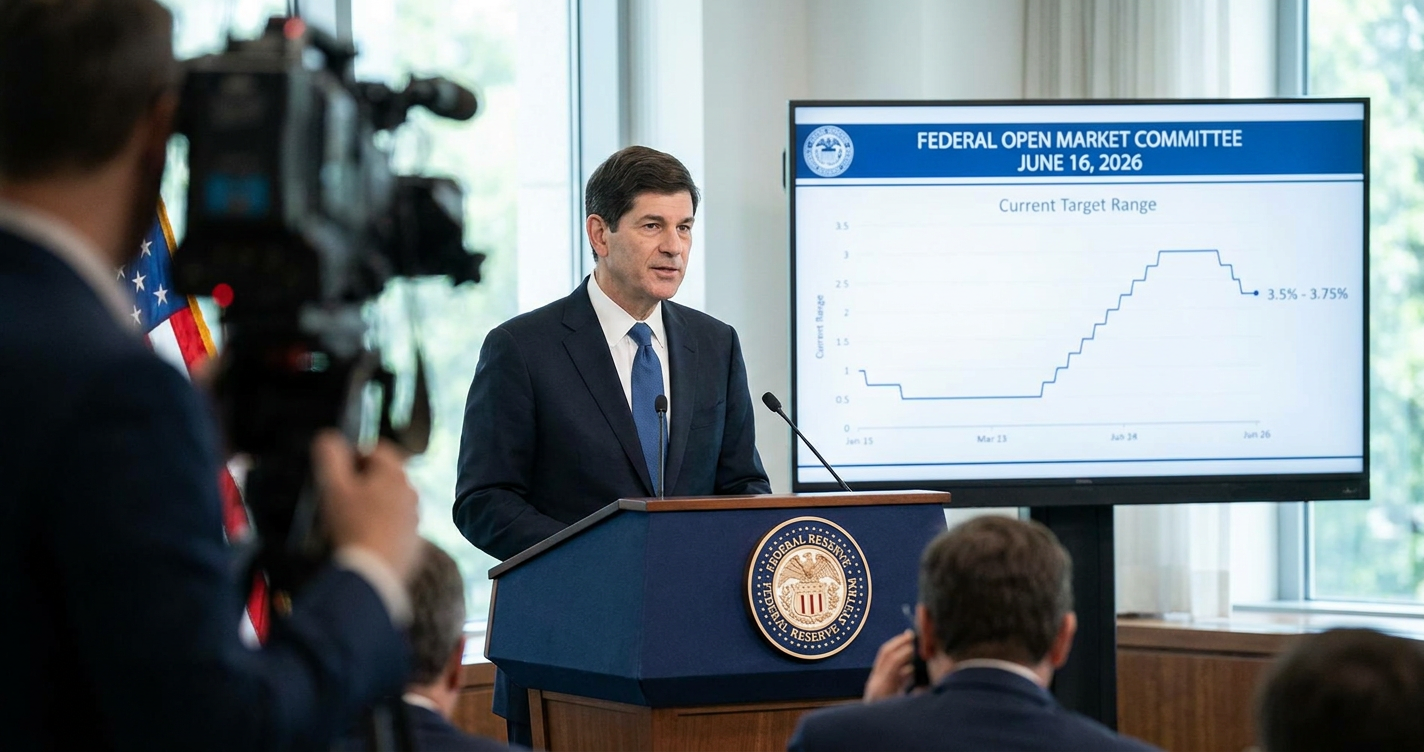

The Federal Reserve held interest rates unchanged on Wednesday, June 17, 2026, marking the fourth consecutive meeting where the central bank opted for stability over further adjustments. In a move that signaled rare unity among policymakers, the Federal Open Market Committee (FOMC) voted unanimously to maintain the federal funds rate target range at 3.
5% to 3.75%. New Fed Chair Kevin Warsh, overseeing his first policy meeting since being appointed by Donald Trump, presided over the decision at 2:00 PM Eastern Time.
The consensus represents a shift from previous months characterized by internal friction. During the April 2026 meeting under former Chair Jerome Powell, the committee saw multiple dissents regarding the “easing bias” in the Fed’s policy statement. This time, the FOMC removed that specific language entirely, effectively ending the formal signal that rate cuts were imminent.
The decision reflects a cautious approach as the central bank grapples with an inflation rate that has climbed to 4.2%, its highest level since 2023.
The Fed’s official statement highlighted that while economic activity is expanding at a “solid pace,” elevated uncertainty remains. Much of this instability stems from ongoing conflict in the Middle East, which has triggered supply shocks in the energy sector. Although productivity and capital investment remain strong, policymakers are clearly wary of a secondary inflation wave.
Core inflation, which strips out volatile food and energy costs, rose to 2.9% over the past year, moving further away from the Fed’s 2% target.
Kevin Warsh takes the helm amid stubborn inflation
For Chair Kevin Warsh, this meeting served as a return to the center of American monetary policy. It was his first FOMC vote since January 2011, when he resigned from the Fed’s board over concerns regarding large-scale bond-buying programs. Now leading the 19-member committee, Kevin Warsh appears to be prioritizing a unified front.
The lack of dissents suggests a collective agreement that the current 3.5% to 3.75% range is necessary to cool price pressures without choking off growth.
The central bank’s pivot away from an easing bias is a direct response to the “sticky” nature of current price increases. While some com/bitcoin-signals-market-structure-analysis-2026/”>analysts forecast late-2026 breakout potential for risk assets if liquidity returns, the Fed’s current stance suggests the cost of borrowing will remain high for longer than many market participants had hoped. The removal of the easing bias indicates the Fed is no longer looking for immediate excuses to lower rates.
Labor market conditions also factored into the decision. The FOMC noted that job gains have largely kept pace with the workforce, keeping the unemployment rate stable. However, hourly earnings dropped to a seasonally adjusted 0.7%, a figure that might offer some relief to those worried about a wage-price spiral.
Despite this cooling in wages, the headline inflation figure remains more than double the Fed’s long-term goal.
Energy volatility and the 2% inflation target
The shadow of geopolitical tension loomed large over the meeting. Supply shocks driven by the Middle East conflict have been a primary driver of recent energy price spikes.
While a recent ceasefire deal between the United States and Iran helped push oil prices to a three-month low, the Fed cautioned that these costs will take months to filter through the economy. The committee stated clearly that it “will deliver price stability” regardless of external shocks.
This commitment to the 2% target comes at a time when traditional market structures are under scrutiny. As the Federal Reserve maintains its restrictive stance, some investors are looking toward alternative stores of value, much like how Tether reveals treasury holdings as a way to hedge against traditional debt risks.
The disconnect between falling energy prices and rising core inflation remains the Fed’s primary challenge heading into the second half of the year.
The unanimity of the vote is particularly striking given the history of the current committee. In meetings earlier this year, members such as Christopher Waller and Stephen Miran frequently dissented, often pushing for quarter-point cuts to prevent an economic slowdown. By removing the easing bias and securing a 12-0 vote, Chair Kevin Warsh has successfully consolidated the committee’s message around a “wait and see” approach.
Future implications for the federal funds rate
The Federal Reserve’s decision to hold steady leaves the federal funds rate significantly lower than its June 2025 peak of 4.25% to 4.5%. However, the pause in the easing cycle suggests that the rapid cuts seen in late 2025 have come to an end.
Markets must now adjust to the reality that the baseline interest rate is likely to stay above 3% for the foreseeable future, provided inflation does not retreat toward the 2% goal rapidly.
Investors monitoring the 200-day moving average and other technical indicators will likely view this pause as a sign of consolidation in the broader economy. Without the promise of cheaper money, the burden of growth shifts back to productivity and corporate earnings.
Chair Kevin Warsh confirmed in his press conference at 6:30 PM GMT that the committee remains data-dependent, meaning every upcoming meeting is “live” for a potential move in either direction.
With four meetings left in 2026, the Federal Reserve faces a narrow path. It must balance the need to curb 4.2% inflation against the risk of an over-tightened economy. For now, the messaging is simple: the era of easy pivots is over, and the focus has returned squarely to the mandate of price stability.
The next FOMC gathering will be scrutinized for whether this newfound unanimity can survive another round of inflation data.