
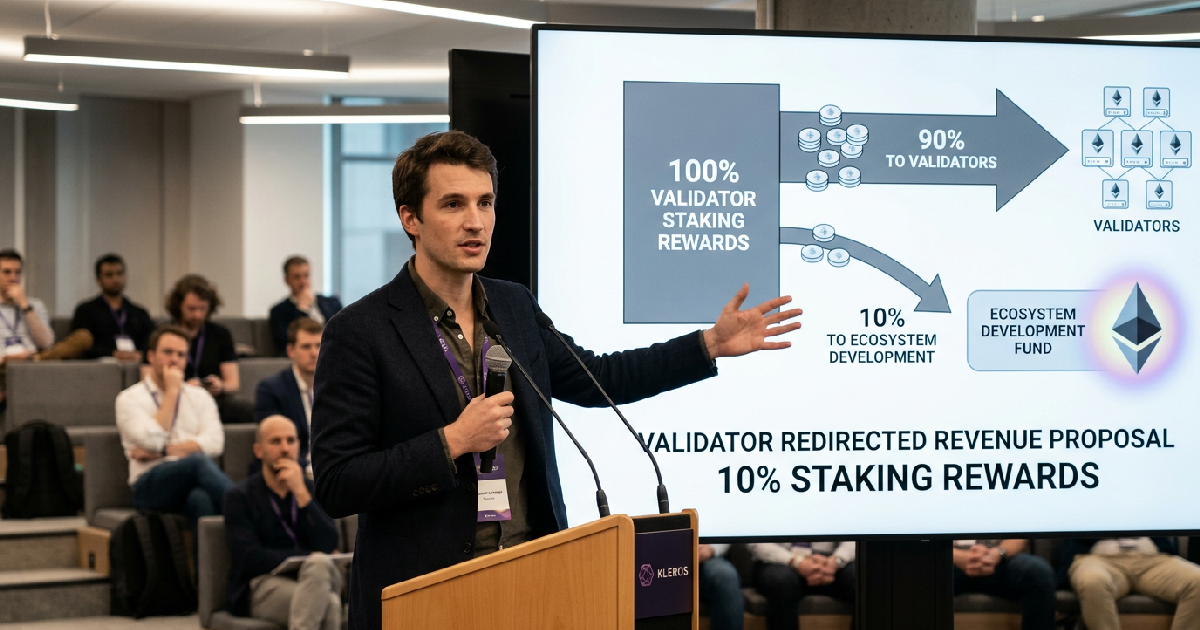

Clément Lesaege, founder of Kleros, has sparked a fierce debate across the cryptocurrency community by proposing a new “Validator Redirected Revenue” mechanism that would funnel a portion of Ethereum staking rewards into a fund for ecosystem development. The proposal, published on the Ethereum Research forum on Sunday, June 21, 2026, suggests that the redirect rate would be capped at 10% of staking rewards, a measure critics have quickly labeled a controversial Ethereum “tax.”
Clément Lesaege argues that the network is currently hamstrung by a “coordination failure” where various entities benefit from software upgrades and security research without contributing to the costs. By making a majority-approved redirect rate mandatory for all participants, Lesaege believes Ethereum can more effectively compete with traditional corporations and centralized economic systems that reinvest a share of their earnings into future growth.
Proposal targets funding gaps in Ethereum development
The core of the proposal involves a voting mechanism where validators set a preferred rate, with the redirect rate itself capped at 10% of rewards. If a majority of the network agrees on a rate above zero, that percentage becomes a protocol-level requirement for every validator. This comes at a time when the Ethereum network navigates key support levels and faces fresh questions regarding its long-term economic model and investor appeal.
Financial estimates suggest the impact of such a move would be substantial for the ecosystem’s development pipeline. With current annual staking rewards estimated at approximately 700,000 ETH, a redirection of 5% to 10% of these rewards could channel roughly 50,000 to 70,000 ETH annually to ecosystem funding. At the current market price of $1,705.24 per ETH as of June 22, 2026, this could provide approximately $120 million in annual funding for public goods like developer tools and security research.
Addressing the free-rider problem and core stability
Clément Lesaege maintains that this measure is fundamental to tackling the “free-rider problem,” where individuals and institutions piggyback on the investments of others. The proposal follows a warning issued on June 19, 2026, by former Ethereum Foundation contributor Trent Van Epps, who noted that core development could face a funding gap within three to nine months. Van Epps estimated that Ethereum may need about $30 million a year to keep core development stable.
The Ethereum Foundation has been pursuing a “subtraction strategy,” aiming to reduce its annual spending from 15% to around 5% by 2030. This shift places a higher burden on independent institutions to find sustainable ways to finance the network’s evolution. While many agree that funding is necessary, the method of extracting it directly from validator yields has proven highly divisive among the protocol’s most vocal contributors.
Prominent developers and attorneys reject the Ethereum tax
Opposition to the plan was swift and blunt, led by pseudonymous developer banteg, who argued that the proposal would “bring politics into consensus layer” and fundamentally weaken the network’s stability. The concern is that by introducing a voting mechanism for financial redirection at the base layer, the community would be forced into political maneuvering. This could damage the Ethereum network outlook just as activity on decentralized exchanges is showing increased activity.
Crypto attorney Gabriel Shapiro joined the backlash, noting that any Layer 1 “devmine” or tax requires a level of robust on-chain governance that Ethereum currently lacks. According to Shapiro, these systems rarely work because the individuals designing the redirection mechanisms are often the same people who receive the funds. He warned that introducing such a debate now is ill-timed, given that “ETH investability is already majorly questioned.”
Risks of validator cartelization and yield misalignment
One of the most pressing technical concerns involves the formation of cartels. Clément Lesaege acknowledged in his research post that a majority of validators could theoretically coordinate to redirect funds back to themselves. While Lesaege argues the proposed voting model would not settle into a stable distribution for greedy actors, critics remain unconvinced that the system could be protected from manipulation.
Banteg specifically warned that an autonomous cartel contract could be deployed to effectively take the 10% from those who opt out and boost the rewards of those who join. Furthermore, a misalignment could occur between the staking operators who cast the votes and the ETH holders who delegate their assets. These delegators would effectively see their yields reduced by decisions made by their service providers, potentially affecting the overall staking market.
As the “Validator Redirected Revenue” proposal remains in the discussion phase, the community must also contend with external pressures like the U.S. Tax Court’s recent ruling in Paschall v. Commissioner. That decision, handed down on June 17, 2026, clarified that staking rewards are taxable income the moment a user gains “dominion and control” over them. Lesaege has stated he is seeking further feedback before attempting to formalize the proposal as an Ethereum Improvement Proposal (EIP).