
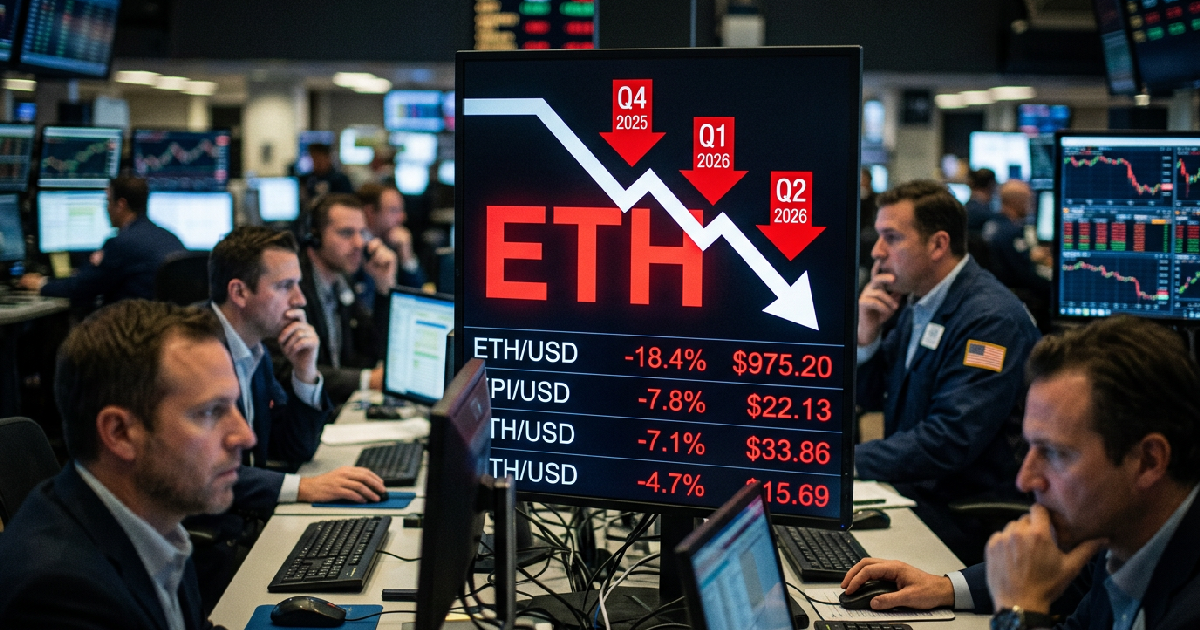

Ethereum (ETH) is on track to record its first-ever sequence of three consecutive quarterly losses, a milestone that underscores the sustained pressure facing the second-largest cryptocurrency. According to data from Coinglass, Ethereum has never before posted three straight quarters of negative returns, having historically recorded a positive quarter immediately after every previous instance of back-to-back losses.
The current downward trend began in Q4 2025, when Ethereum fell 28.28%, representing the fourth-worst final quarter in the asset’s history. This was followed by a 29.26% drop in Q1 2026, and as of mid-June 2026, the asset remains in the red for the second quarter.
The potential for a historic three-quarter losing streak has sparked intense discussion across financial markets regarding shifts in global crypto sentiment.
Analysis of quarterly performance and market volatility
Despite the bearish price action, underlying network activity has reached significant milestones. In Q1 2026, monthly active users averaged 13.2 million, an 85.9% increase year-over-year that set a new all-time high. This suggests that while Ethereum network outlook remains tied to high adoption and increased DEX activity, market prices are currently decoupled from these utility metrics.
The first half of 2026 has been characterized by extreme price swings and tightening liquidity. In Q1 2026, Ethereum opened at $2,967 and rallied to a high of $3,356 on January 15 before plummeting to a quarterly low of $1,820 on February 6. This movement represented a 46% drawdown within just six weeks, eventually closing the quarter at $2,024.
As of June 18, 2026, Ethereum was trading at $1,748.28. Market data shows varying degrees of loss for Q2 2026 depending on the reporting date; it was down 18.39% as of June 15 and 17.2% as of June 18. This prolonged slump puts Ethereum on track for its second-worst first half of the year, surpassed only by the downturn in 2022.
Investor participation has notably cooled during this period. In June 2026, large on-chain transfers—typically associated with “whale” activity—dropped by 86%. Furthermore, open interest for ETH derivatives during the first half of 2026 slid from over $17 billion to approximately $10 million by mid-June, reflecting a significant reduction in speculative activity and risk appetite.
Institutional engagement and tokenization growth
While the broader market struggles with market resistance and sustained selling pressure, institutional metrics on the Ethereum blockchain show steady growth. The average size of tokenized funds on the network reached $194 billion in Q1 2026, a 73.1% increase year-over-year. Tokenized commodities saw even more aggressive growth, rising 325.9% compared to the previous year to reach $4.7 billion.
Ethereum also remains the dominant force in fee generation, accounting for 58.4% of total fees across the top five blockchain networks. In Q1 2026, the network generated $2.0 billion in ecosystem fees. Additionally, the scale of stablecoins on the network averaged $178.9 billion, with Tether (USDT) accounting for $94.1 billion and Circle (USDC) reaching $54.5 billion by the end of March.
However, these fundamental strengths have not protected the asset from external pressures. The downturn is attributed to a combination of macroeconomic factors, such as inflation concerns, and regulatory uncertainty. These factors have contributed to reduced retail and institutional participation across the digital asset sector.
Technical outlook and upcoming Glamsterdam upgrade
Developers are currently preparing for the Glamsterdam upgrade, which is scheduled for the third quarter of 2026. Unlike previous updates that introduced new user-facing features, Glamsterdam focuses exclusively on improving transaction processing efficiency. If successful, this could help alleviate some of the wedge breakdown patterns observed in recent technical analyses.
The upgrade includes EIP-7732, which increases the block building and sharing window from approximately two seconds to nine seconds. It also incorporates EIP-7928, a proposal that allows the network to identify transaction requirements before processing, enabling more efficient parallel handling. The goal of these changes is to reduce congestion and lower long-term costs for users.
Entering the third quarter, Ethereum faces a statistically challenging period. Historically, Q3 has been the network’s weakest quarter, yielding an average return of just 7.44%. As the current quarter approaches its conclusion, traders are monitoring whether the combination of technical upgrades and record-high network usage can overcome the historic selling pressure that has defined the last nine months.