
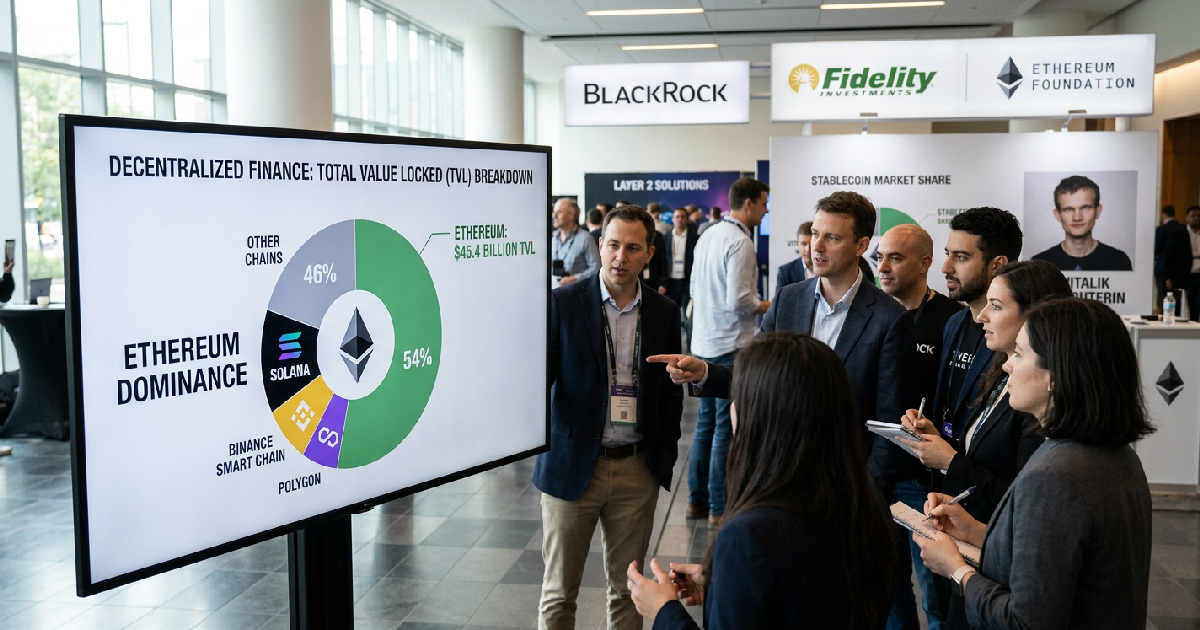

Ethereum remains a central pillar of the decentralized finance (DeFi) ecosystem, holding $45.4 billion in locked assets as of May 9, 2026. While the network faces increasing competition, it continues to lead the sector with a 54% share of Total Value Locked (TVL) as of early May. This dominance persists despite a shrinking market share, which previously stood at over 63% in early 2025.
The network, founded in 2015 by Vitalik Buterin, Gavin Wood, and Joseph Lubin, has evolved into what many analysts consider the institutional-grade settlement layer for onchain finance. Its foundational role in smart contracts and decentralized applications (dApps) has created powerful network effects. Today, Ethereum holds 24 times more value locked in its protocols than its closest competitor, the BNB Chain.
While retail users gravitate toward cheaper alternatives, institutional adoption has accelerated through spot exchange-traded products (ETPs) offered by BlackRock and Fidelity. In July 2025, the network recorded $5.4 billion in net inflows to these products. These capital flows reinforce the Ethereum network outlook as the primary choice for large-scale financial management.
Shifting metrics in the decentralized finance landscape
Ethereum’s grip on the market is currently in a state of transition as the industry enters a “multi-chain era.” In mid-2025, the network accounted for approximately 65% of all TVL when including Layer 2 solutions. However, data from May 7, 2026, shows that Ethereum’s share of DeFi TVL is approximately 54%, reflecting the rise of faster and cheaper competitors like Solana and Base.
Despite this contraction in market percentage, the network’s specialized utility remains largely unchallenged in several key areas. For example, nearly 80% of all tokenized US Treasury products are currently hosted on Ethereum. This preference among asset issuers suggests that the security and decentralization prioritized by the Ethereum Foundation are more valuable for high-stakes finance than transaction speed alone.
Creative markets also show a significant disparity between platforms. Ethereum currently handles 55 times more NFT volume than its closest rival. While traders may be navigating Ethereum support levels during broader market volatility, the underlying activity within the developer community remains a robust driver of value that few other blockchains can replicate.
Institutional settlement and the stablecoin market
Zach Pandl, lead of Grayscale Research, has identified Ethereum as a critical settlement layer due to its dominance in stablecoins and real-world assets. As of mid-2025, Ethereum and its Layer 2 networks held over 50% of all stablecoin balances globally. Furthermore, the network processes roughly 45% of all stablecoin transactions by dollar value, cementing its role as the backbone of digital liquidity.
The Ethereum Foundation, currently led by Co-Executive Directors Hsiao-Wei Wang and Tomasz Stańczak alongside President Aya Miyaguchi, has focused on long-term sustainability and security. A major milestone in this trajectory was “The Merge” in 2022. This upgrade moved the network to Proof-of-Stake (PoS), successfully reducing its energy consumption by 99.9% and making it more attractive to ESG-conscious institutions.
This institutional confidence was further bolstered by the Pectra upgrade in May 2025 and the subsequent approval of spot ETFs. While some investors watch for BNB ETF filing updates to gauge the competition, Ethereum’s established infrastructure and compliance-friendly upgrades have given it a considerable lead in securing massive net inflows from traditional finance firms.
Overcoming the blockchain trilemma and high fees
One of the primary challenges facing Ethereum is the “blockchain trilemma,” where the network prioritizes security and decentralization over scalability. This trade-off frequently leads to network congestion and high costs. In 2023, the median price for gas fees was $2.99, but during periods of high activity, costs have exceeded $30 per transaction.
To address these hurdles, the ecosystem has increasingly relied on Layer 2 scaling solutions. These protocols live on top of the main network, providing faster execution and lower fees while still utilizing Ethereum’s security. This layered approach is designed to stop liquidity fragmentation as users move between different blockchains in search of efficiency.
The future of DeFi appears increasingly decentralized across multiple networks, yet Ethereum’s deep liquidity and thousands of nodes continue to act as a gravitational center. As developers continue to build on its programmable foundation, the network remains the herald for smart contracts, even as it navigates a more competitive and diverse digital asset market.