
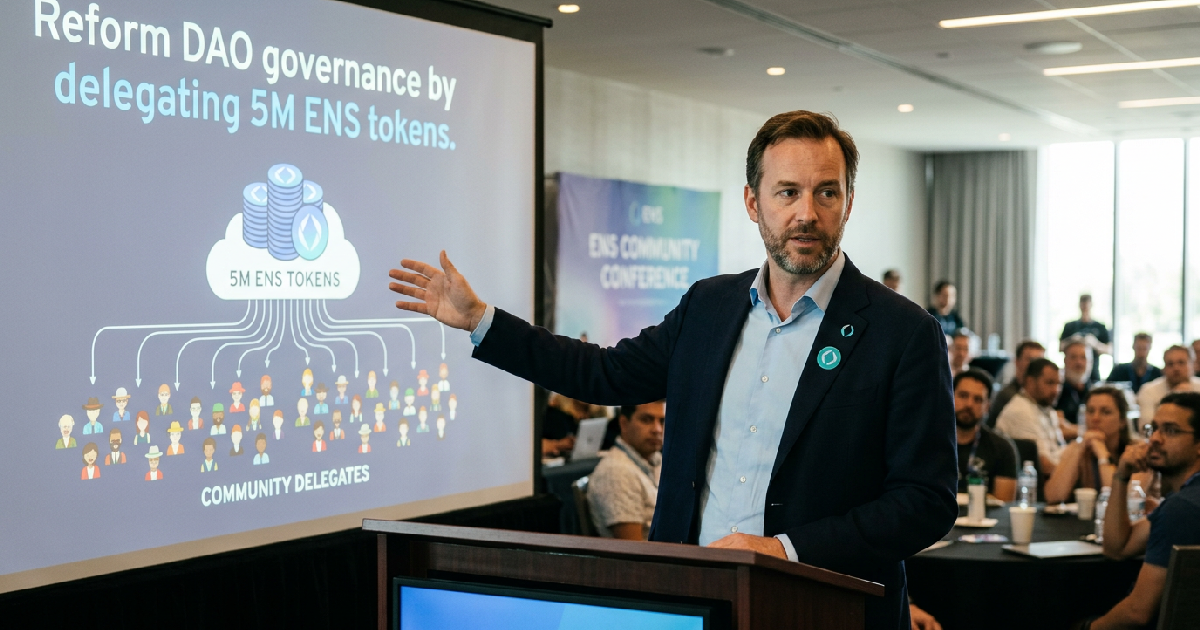

Alex Van de Sande, a co-founder of the Ethereum Name Service (ENS), filed a formal draft proposal on Monday to delegate 5 million ENS tokens from the protocol’s dormant community treasury to individual participants. The initiative aims to decentralize governance power within the ENS DAO, which Van de Sande argues is currently over-reliant on a structure dominated by fellow co-founder Nick Johnson.
The proposal, titled “Reform DAO governance by delegating 5M ENS tokens,” was submitted to the Meta-Governance section of the ENS DAO discourse forum. According to Van de Sande, co-founder Nick Johnson currently holds enough quorum to execute any proposal and outvote the next 50 delegates combined. This delegation plan would mark the first major attempt to broaden voting control since the DAO launched in 2021.
Addressing governance concentration in the ENS DAO
The core of the proposal centers on breaking what Van de Sande described as “just a 1-of-1 multisig” influence over the protocol. This refers to the significant voting power concentrated in a single entity. By tapping into the community treasury, the plan utilizes unclaimed supply from the original ENS airdrop five years ago.
While 50% of tokens were originally earmarked for the community to be distributed over five years, that window has expired with much of the allocation remaining undistributed. This undelegated supply now forms the basis for Van de Sande’s plan to redistribute influence.
Under this new plan, participants would not gain ownership of the tokens, nor would they be allowed to sell them. The assets would remain the property of the ENS DAO, with recipients only holding the associated voting rights. This distinction ensures the tokens serve a purely political purpose within the DAO’s decision-making framework rather than acting as a traditional liquidity injection.
Governance shifts like these often occur as major blockchain ecosystems reach maturity. While the Ethereum network outlook remains strong due to increasing activity, internal management of its core infrastructure services like ENS often requires structural updates to maintain decentralization. Van de Sande’s proposal represents a significant step in that direction.
Mechanics and safeguards for token delegation
To ensure the system remains active and accountable, Alex Van de Sande included specific operational triggers and timelines in the draft. He floated the possibility of adding another 5 million tokens to the delegation pool next year, effectively doubling the initial commitment if the first phase proves successful.
The plan also includes a strict “undelegation trigger” that would revoke voting rights from any participant after six months of inactivity. Furthermore, the entire arrangement would carry a full sunset clause after two years. These measures are designed to prevent the emergence of “ghost delegates” who hold influence without participating in the governance process.
This push for accountability comes at a time when users are increasingly sensitive to the transparency of major crypto platforms. Similar trends are visible in other sectors of the industry, where top crypto casinos are moving toward higher standards of transparency to satisfy growing market demand for provable fairness and open operations.
Internal conflict and the path forward
The proposal surfaces during a period of sustained tension within the ENS ecosystem. Recent reports indicated a community member proposed dissolving the DAO entirely after a founder blocked a security council renewal vote. Additionally, some delegates previously labeled a Foundation proposal to assume certain treasury and day-to-day authorities as a “governance attack.”
ENS DAO also opened a temporary check on that foundation handover in June, indicating the ongoing debate around governance and control. These various internal disputes highlight the challenges of managing decentralized autonomous organizations as they scale and mature.
At present, Van de Sande’s plan remains a draft with no formal vote scheduled. If it moves forward, the community will need to decide if this redistribution of voting weight is the correct remedy for the current concentration of power.
Implications for Web3 governance models
This proposal by Van de Sande isn’t just about ENS; it carries broader implications for Web3 governance. Decentralized autonomous organizations are still evolving, and the issue of concentrated power, even when held by founders, is a recurring challenge. The ENS move could set a precedent for other DAOs looking to refine their power distribution.
For many, true decentralization is a cornerstone of Web3