
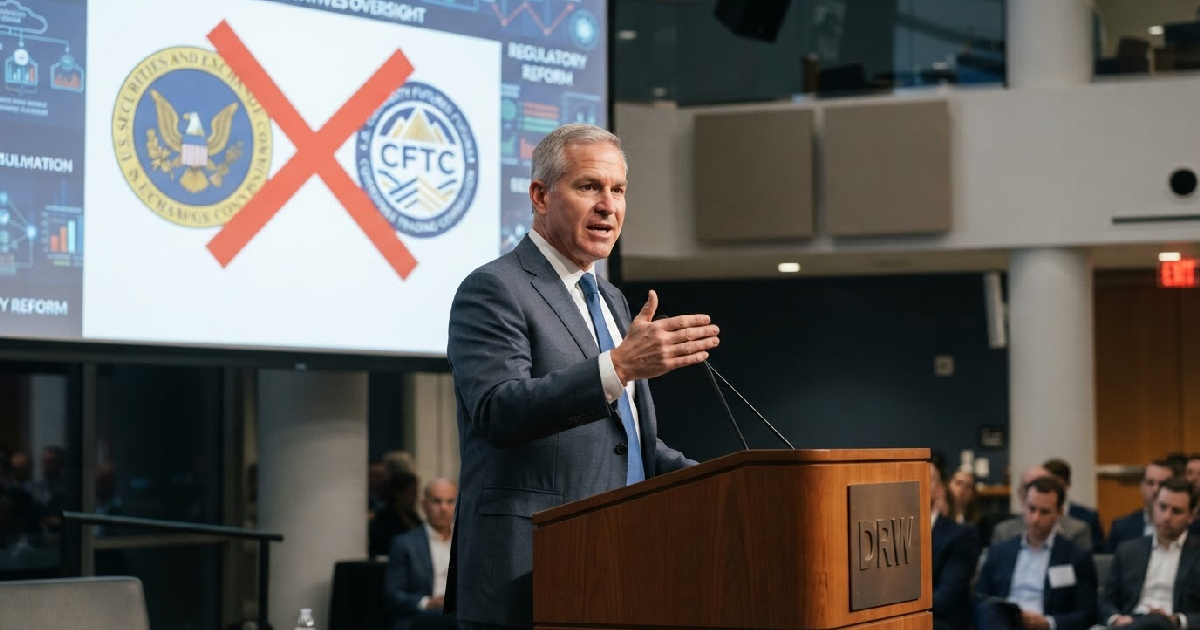

Don Wilson, the veteran Wall Street trader and CEO of proprietary trading firm DRW, has once again sharply criticized U.S. financial regulators. Speaking on July 28, 2026, Wilson asserted that authorities are fundamentally misunderstanding perpetual futures, commonly known as “perps,” viewing them as inherently risky gambling tools rather than sophisticated financial instruments.
His latest comments reignite a long-standing debate about how digital assets should be regulated. Wilson also reiterated his controversial call for a radical overhaul of the U.S. financial regulatory system, proposing the abolishment of both the Securities and Exchange Commission (SEC) and the Commodity Futures Trading Commission (CFTC) in favor of a single, unified body.
Don Wilson challenges regulators’ ‘perps’ perception
Wilson contends that much of the prevailing regulatory narrative around perpetual futures is misinformed. He argues that “perps” are simply futures contracts designed without an expiration date. This key feature is their primary innovation, eliminating the need for investors to repeatedly roll over expiring contracts.
This avoids transaction costs, market impact, and roll slippage. Instead, perpetuals allow positions to track the front of the futures curve more closely, which is a significant advantage for sophisticated traders.
The myth of inherent high risk features
The DRW CEO stresses that characteristics often associated with crypto perpetuals, such as extremely high leverage and auto-deleveraging (ADL), aren’t inherent to the contract itself. He insists these are merely implementation choices made by specific crypto exchanges.
“Most of what people think they know about ‘perps’ … has nothing to do with the contract itself,” Wilson wrote, pushing back against the notion that the product is intrinsically dangerous. He also made it clear he’s “not a fan of ADL,” noting there’s “no reason it needs to be used for perps.”
Digital infrastructure for enhanced risk management
Wilson’s perspective highlights the potential of digital payment rails to significantly improve risk management practices. Traditional clearinghouses often calculate margin requirements only once a day, allowing for market shifts before additional collateral is posted. This necessitates larger initial margin buffers to account for potential volatility.
However, digital systems enable real-time settlement and continuous margin recalculation. Traders can be required to post collateral immediately, thereby maintaining the same level of protection with potentially lower upfront margin requirements. This technological efficiency, he says, is a business decision when it comes to leverage, not a defining characteristic of perpetual futures.
Wider adoption beyond crypto
Wilson advocates for perpetual futures to be embraced across a broader spectrum of financial markets, not just crypto. He envisions them as a valuable tool for price discovery and risk management in sectors like commodities and securities.
His argument centers on economic substance over legal labels. “There’s no reason to treat perpetuals as swaps simply because they don’t expire,” Wilson stated. “Economically, they’re futures,” a categorization that would simplify their regulatory treatment.
This push for broader acceptance is gaining traction. Kalshi, an exchange known for its event contracts, has already seen an explosion in perps trading. They recently submitted a proposal to regulators to expand their offerings to include precious metals, signaling a wider industry interest in these instruments.
A history of battling regulators
Wilson’s critical stance on regulatory bodies isn’t new; it’s deeply informed by his firm’s past encounters with U.S. financial oversight. He’s been a vocal proponent of regulatory reform for years, arguing the current dual-agency model is inefficient and counterproductive.
Back on November 27, 2024, Wilson famously called for the outright abolishment of the SEC and CFTC. He described the ongoing friction between them as “an ongoing counterproductive force,” proposing an entirely new, unified regulatory body to replace them.
The CFTC lawsuit and a landmark victory
His most notable regulatory battle began in November 2013 when the CFTC sued DRW for allegedly manipulating interest rate swap futures. The agency accused DRW of “banging the close” to gain over $20 million, seeking a lifetime trading ban and significant penalties.
Wilson steadfastly denied the charges, maintaining that his firm had simply identified a mispricing due to a “convexity bias” in the IDEX USD Three-Month Interest Rate Swap Futures Contract. He believed DRW was buying an asset ahead of the market recognizing its true value.
In December 2018, U.S. District Judge Richard Sullivan dismissed all claims against DRW. The judge’s scathing rebuke, stating “it is not illegal to be smarter than your counterparties in a swap transaction,” validated Wilson’s position and underscored his view of systemic issues within the regulatory framework.
SEC charges against Cumberland DRW
More recently, in October 2024, the SEC charged DRW’s cryptocurrency arm, Cumberland DRW, with operating as an unregistered dealer. The charges involved over $2 billion in digital assets, prompting Wilson to publicly fight the allegations.
He characterized the SEC’s approach as “profoundly unfair” and reminiscent of “Atlas Shrugged,” claiming his firm made “good-faith efforts” to comply with unclear rules. The SEC abruptly dropped the case in March 2025, just 43 days after President Trump’s inauguration, raising eyebrows about political influence and the consistency of regulatory enforcement.
The path forward for crypto regulation
Wilson’s forceful arguments highlight the urgent need for a regulatory framework that genuinely understands the underlying technology and economic function of digital assets. His repeated calls for a unified regulator suggest a growing frustration with the existing patchwork approach, which often leads to conflicting interpretations and stifles innovation.
For the crypto industry, his advocacy could represent a pathway toward more streamlined and sensible oversight. If regulators were to adopt his economic substance over legal labels approach, it could pave the way for broader institutional adoption of products like perpetual futures, not just in crypto but across traditional finance as well.
The question remains whether U.S. regulators will heed the warnings from a veteran like Wilson, or continue on a path that he argues is fundamentally misguided.