
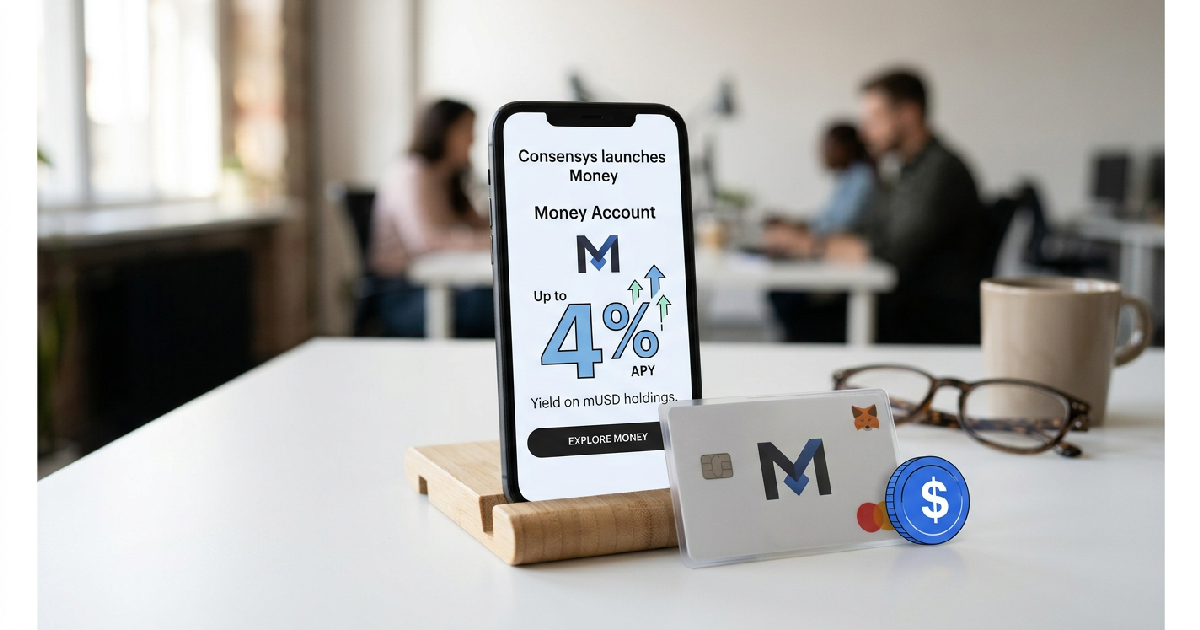

Consensys, the parent company of the MetaMask wallet, officially launched its “Money Account” feature on Tuesday, June 30, 2026. This new self-custodial offering allows users to earn a variable yield of up to 4% APY on their holdings of mUSD, the platform’s native stablecoin.
By integrating yield generation directly into the wallet interface, the product aims to transform static stablecoin balances into an active financial tool that can be used for earning, spending, and trading.
Earning and spending through self-custodial vaults
The Money Account is built on Monad, which has been designated as the “home chain” for the service. Monad is a high-performance, Layer 1 blockchain compatible with the Ethereum Virtual Machine (EVM), capable of reaching 10,000 transactions per second.
This underlying infrastructure allows for near-instant transaction finality, supporting the account’s integration with the Mastercard-powered MetaMask Card for real-world merchant spending. While Ethereum navigates key support levels in the broader market, Consensys is focusing on reducing the fragmentation of the user experience by centralizing these financial services.
Users who deposit funds into the Money Account generate yield through decentralized finance (DeFi) lending strategies. Initially, this yield is sourced via Morpho vaults, specifically the Steakhouse mUSD Reserved vault, with local infrastructure built by Veda. Steakhouse Financial serves as the risk curator for these strategies. Consensys has indicated that future updates will include integrations with Aave to provide additional avenues for yield generation.
The account is strictly self-custodial, meaning MetaMask cannot access, freeze, or move user funds. This maintains the core ethos of decentralized finance while adding the utility of a traditional account. Funds remain highly liquid with no lockups or withdrawal penalties.
Additionally, because the account is connected to the MetaMask Card, users can pay for purchases at millions of merchants worldwide directly from their yield-bearing balance without extra conversion steps.
Stablecoin integration and the expansion of mUSD
The central asset of the new account is mUSD, a stablecoin that launched in September 2025. It is issued by Bridge, a Stripe company, and is powered by the M0 protocol. Current data shows mUSD has a market capitalization of approximately $32 million, having reached a peak of $100 million shortly after its debut.
The asset is supported across several networks, including Ethereum Mainnet, Linea, and Monad. As altcoin demand shifts toward stable and productive assets, MetaMask is simplifying the onboarding process for these digital dollars.
Funding the Money Account is handled through multiple methods. Users can convert existing stablecoins like USDC, USDT, and DAI—or their yield-bearing versions from Aave—into mUSD at 1:1 parity with no conversion fees. Alternatively, mUSD can be purchased directly via credit card, bank transfer, or Apple Pay.
While the Money Account itself does not require Know Your Customer (KYC) verification for basic use, accessing regulated features like the MetaMask Card or fiat on-ramps requires verification through third-party providers.
Phased global rollout and ecosystem utility
The Money Account is rolling out globally in phases. It is currently excluded from the United Kingdom, European Union member states, and sanctioned countries. Beyond earning and spending, funds in the account remain available for other onchain services within the wallet, such as perps, prediction markets, and swaps.
This versatility is intended to solve the problem where users often had to choose between keeping funds ready for trading or moving them to a separate protocol to earn interest.
Consensys CEO Joe Lubin noted that the product was designed because users have historically had to fragment their crypto experience between different platforms to trade, earn, and spend. This launch represents a move toward a unified financial environment.
As the outlook for decentralized apps continues to evolve, the integration of high-performance chains like Monad suggests a future where blockchain complexity is handled “under the hood” for the average consumer.